10.1016/0022-328X(83)80109-0
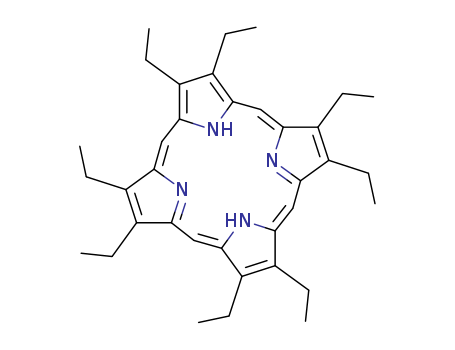
The research focuses on the synthesis and characterization of a series of alkyl(aryl)iron(III) porphyrins with a metal-carbon bond. The purpose of this study is to explore the synthesis of these metalloporphyrin complexes, which are of significant interest due to their potential role in the metabolism of certain polyhalogenated compounds by cytochrome P450 in the liver. The researchers synthesized these complexes using two main methods: the reaction of organomagnesium compounds with iron(III) chloride porphyrins and oxidative addition of alkyl halides to iron(I) porphyrins. Key chemicals used in the research include various porphyrin derivatives such as octaethylporphyrin (OEP), tetraphenylporphyrin (TPP), and their substituted forms, along with organomagnesium compounds like RMgX, and alkyl halides. The synthesized complexes were characterized using 1H NMR spectroscopy, which provided detailed information about the structure and environment of the protons in the porphyrin ring and the axial ligands. The study concludes that the synthesized alkyl(aryl)iron(III) porphyrins exhibit distinct spectroscopic characteristics, with the alkyl derivatives showing a more shielded environment for the protons compared to the aryl derivatives. The results also suggest a significant delocalization of spin from the metal to the axial ligand, indicating a strong interaction between the metal and the ligand. The findings contribute to a better understanding of the structure and properties of these metalloporphyrin complexes, which could have implications for their biological and chemical applications.