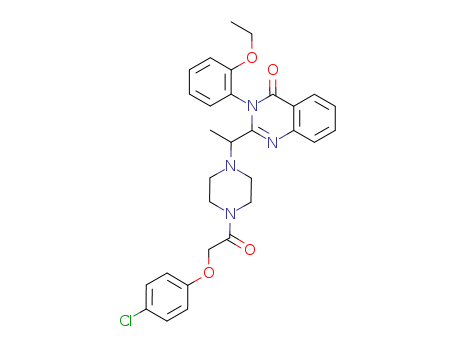
Chemical Property of Erastin
Chemical Property:
- Boiling Point:721.9±70.0 °C(Predicted)
- PKA:5.54±0.10(Predicted)
- PSA:76.90000
- Density:1.28±0.1 g/cm3(Predicted)
- LogP:4.59780
- Storage Temp.:−20°C
- Solubility.:DMSO: soluble5mg/mL, clear (warmed)
- XLogP3:4.8
- Hydrogen Bond Donor Count:0
- Hydrogen Bond Acceptor Count:6
- Rotatable Bond Count:8
- Exact Mass:546.2033832
- Heavy Atom Count:39
- Complexity:871
- Purity/Quality:
-
99% *data from raw suppliers
Erastin *data from reagent suppliers
Safty Information:
- Pictogram(s):

- Hazard Codes:T
- Statements:
25
- Safety Statements:
45
- MSDS Files:
-
SDS file from LookChem
Total 1 MSDS from other Authors
Useful:
- Canonical SMILES:CCOC1=CC=CC=C1N2C(=O)C3=CC=CC=C3N=C2C(C)N4CCN(CC4)C(=O)COC5=CC=C(C=C5)Cl
-
Description
Erastin, named for eradicator of RAS and small T (ST) antigen-expressing cells, is a ferroptosis inducer. It induces ferroptotic cell death in vitro, an effect that can be blocked by the ferroptosis inhibitors ciclopirox olamine, Trolox , ferrostatin-1 , U-0126 , cycloheximide , and β-mercaptoethanol. Erastin (5 μM) inhibits cystine uptake by the system xc- cystine-glutamate transporter in HT-1080 fibrosarcoma and Calu-1 lung carcinoma cells and inhibits glutamate release in an enzyme-coupled fluorescence assay (EC50 = 1.2 μM). It also selectively induces cell death in cells expressing the SV40 small T oncoprotein and oncogenic Ras (IC50s = 1.25-5 μg/ml).
-
Uses
Erastin has been used:as a positive control for inducing ferroptosis in hepatic stellate cell (HSC)to induce ferroptosis and in transferrin internalization assay of human fibrosarcoma HT1080 cellsto induce ferroptosis of muscle-derived cell lines Erastin, named for eradicator of RAS and ST-expressing cells, is an irreversible antitumor agent that selectively kills cells expressing the small T oncoprotein and oncogenic Ras (IC50s = 1.25-5 μg/ml). It produces non-apoptotic tumor cell death by altering mitochondrial voltage-dependent anion channel gating, allowing cations to enter mitochondria and leading to release of oxidative species causing oxidative cell death.[Cayman Chemical]