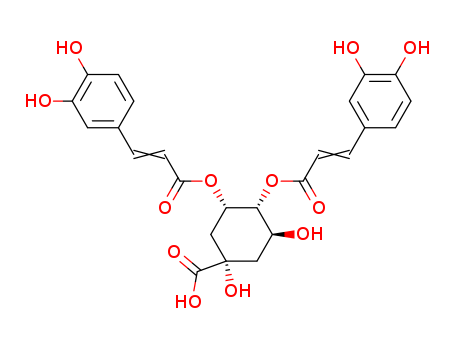
Chemical Property of (1R,3R,4S,5R)-3,4-bis[3-(3,4-dihydroxyphenyl)prop-2-enoyloxy]-1,5-dihydroxycyclohexane-1-carboxylic acid
Chemical Property:
- Vapor Pressure:8.9E-28mmHg at 25°C
- Melting Point:140 °C
- Refractive Index:1.719
- Boiling Point:810.8 °C at 760 mmHg
- PKA:3.70±0.50(Predicted)
- Flash Point:274.9 °C
- PSA:211.28000
- Density:1.64 g/cm3
- LogP:1.02960
- Storage Temp.:?20°C
- XLogP3:1.5
- Hydrogen Bond Donor Count:7
- Hydrogen Bond Acceptor Count:12
- Rotatable Bond Count:9
- Exact Mass:516.12677620
- Heavy Atom Count:37
- Complexity:887
- Purity/Quality:
-
99% *data from raw suppliers
4,5-DicaffeoylquinicAcid *data from reagent suppliers
Safty Information:
- Pictogram(s):
- Hazard Codes:
- MSDS Files:
-
SDS file from LookChem
Useful:
- Canonical SMILES:C1C(C(C(CC1(C(=O)O)O)OC(=O)C=CC2=CC(=C(C=C2)O)O)OC(=O)C=CC3=CC(=C(C=C3)O)O)O
- Isomeric SMILES:C1[C@H]([C@@H]([C@@H](C[C@]1(C(=O)O)O)OC(=O)C=CC2=CC(=C(C=C2)O)O)OC(=O)C=CC3=CC(=C(C=C3)O)O)O
-
Description
4,5-Dicaffeoylquinic acid (4,5-DCQA) is a polyphenol originally isolated from G. fagetorum and G. pseudomollugo that has diverse biological activities, including anti-HIV replication, antioxidative, anti-inflammatory, and anti-melanogenic properties. It inhibits HIV-1 integrase 3'' end processing, 3’ end joining, and disintegration with IC50 values of 0.13, 0.24, and 0.3 μg/ml, respectively. It also inhibits HIV-1 replication in MT-2 T lymphoblastoid cells with an EC50 value of 2 μg/ml. 4,5-DCQA scavenges 2,2-diphenyl-1-picrylhydrazyl (DPPH; Item No. 14805) radicals in a cell-free assay (IC50 = 19.8 μM) and inhibits superoxide production in human neutrophils activated by N-formyl-Met-Leu-Phe (fMLF; ) and cytochalasin B (; IC50 = 1.49 μM). It decreases prostaglandin E2 (PGE2; ) production in LPS-stimulated U937 cells when used at concentrations of 5 and 10 μg/ml but increases it when used at 200 μg/ml and increases production of TNF-α at concentrations ranging from 5 to 200 μg/ml. It inhibits the synthesis of MCP3 in U937 cells. 4,5-DCQA (25 μM) inhibits melanogenesis by 84% and decreases the levels of proteins involved in melanin biosynthesis, including tyrosinase, TRP-1, DCT, and MITF in B16F1 murine melanocytes.