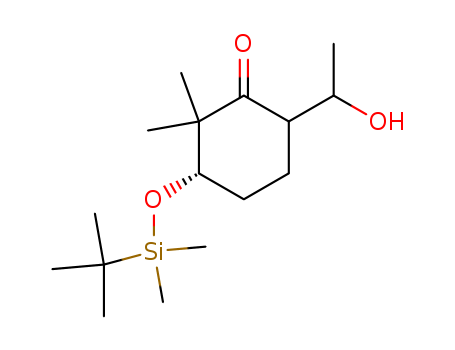
Multi-step reaction with 29 steps
1: Et3N / tetrahydrofuran / 1a) 0 to 5 degC, 2 h, 1b) r.t., 1 h
2: 56.0 g / DBU / tetrahydrofuran / 1 h / 50 °C
3: 88 percent / NaBH4 / tetrahydrofuran; ethanol / 2 h / 0 - 5 °C
4: 98.1 percent / toluene-p-sulphonic acid monohydrate / Ambient temperature
5: 96 percent / Bu4NF / tetrahydrofuran / 4 h / Heating
6: 70 percent / N-iodosuccinimide / acetonitrile / 12 h / Ambient temperature
7: 95 percent / 1,8-diazabicyclo<5.4.0>undec-7-ene / toluene / 24 h / Heating
8: 1) 9-borabicyclo<3.3.1>nonane, 2) aq. NaOH, 35percent aq. H2O2 / 1) THF, r.t., 2 h, 2) 30 - 60 degC, 1 h
9: 1) oxalyl dichloride, DMSO, 2) NEt3 / 1) CH2Cl2, -60 to -50 degC, 1 h, 2) to -10 degC, 1 h 10 min
10: 13.9 g / tetrahydrofuran / 1 h / -78 °C
11: 90 percent / imidazole, DMAP / dimethylformamide / Ambient temperature
12: 75 percent / OsO4, NaIO4 / diethyl ether; H2O / 13 h / Heating
14: 84 percent / 60percent NaH / tetrahydrofuran / 15 h / Ambient temperature
15: 8.37 g / Ca(BH4)2 / ethanol / 2.5 h / Ambient temperature
16: 8.50 g / Et3N / CH2Cl2 / 3.5 h / Ambient temperature
17: 94 percent / Bu4NBr, diisopropylethylamine / CH2Cl2 / 120 h / Heating
18: 93 percent / MeLi / diethyl ether; diethyl ether / 0.5 h / -20 °C
19: 1) oxalyl dichloride, DMSO, 2) Et3N / 1a) CH2Cl2, -78 degC, 15 min, 1b) 30 min, 2a) -78 degC, 30 min, 2b) -10 to -5 deg C, 30 min
20: 3.92 g / NaH2PO4, NaClO2, 2-methylbut-2-ene / 2-methyl-propan-2-ol; H2O / 1 h / Ambient temperature
21: 3.24 g / triphenylphosphine, diethyl azodicarboxylate / tetrahydrofuran / 3 h / Ambient temperature
22: 83 percent / pyridinium toluene-p-sulphonate, H2O / methanol / 48 h / Ambient temperature
23: 1) oxalyl chloride, DMSO, 2) Et3N / 1a) CH2Cl2, -78 degC, 15 min, 1b) 2 h, 2) -5 to 0 degC, 30 min
24: 99 percent / m-chloroperbenzoic acid, NaHCO3 / CH2Cl2 / 14 h / Ambient temperature
25: 1) Me2CuLi / 1) THF/Et2O, -78 degC, 8 h, 2) Et2O, 0 degC, 2 h
26: 82 percent / pyridine, SOCl2 / 1.5 h / -20 °C
27: 92 percent / tetrabutylammonium hydroxide, aq. LiOH / tetrahydrofuran / 30 h / Ambient temperature
28: 1) LiBF4, 2) tris(dimethylamino)sulphonium difluorotrimethylsiliconate / 1) MeCN, 50 degC, 24 h, 2) MeCN, r.t., 4 h
29: 95 percent / diisopropylethylamine / acetonitrile / 1 h
With
pyridine; 1H-imidazole; dmap; lithium hydroxide; sodium hydroxide; sodium chlorite; sodium tetrahydroborate; sodium periodate; sodium dihydrogenphosphate; N-iodo-succinimide; osmium(VIII) oxide; lithium tetrafluoroborate; 9-borabicyclo[3.3.1]nonane dimer; thionyl chloride; calcium borohydride; 2-methyl-but-2-ene; oxalyl dichloride; lithium dimethylcuprate; tetrabutyl ammonium fluoride; tetrabutylammomium bromide; tetra(n-butyl)ammonium hydroxide; tris(dimethylamino)sulfonium trimethylsilyldifluoride; water; methyllithium; dihydrogen peroxide; pyridinium p-toluenesulfonate; sodium hydride; sodium hydrogencarbonate; toluene-4-sulfonic acid; dimethyl sulfoxide; 1,8-diazabicyclo[5.4.0]undec-7-ene; triethylamine; N-ethyl-N,N-diisopropylamine; 3-chloro-benzenecarboperoxoic acid; triphenylphosphine; diethylazodicarboxylate;
In
tetrahydrofuran; methanol; diethyl ether; ethanol; dichloromethane; water; N,N-dimethyl-formamide; toluene; acetonitrile; tert-butyl alcohol;