Welcome to LookChem.com Sign In|Join Free
  • or

Encyclopedia

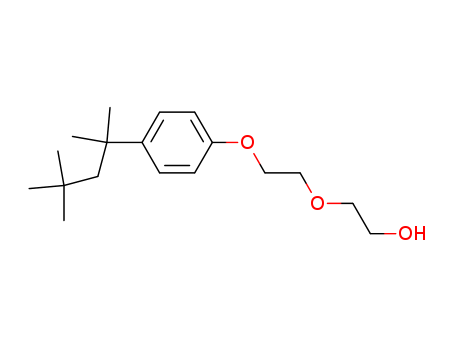
2-{2-[4-(1,1,3,3-Tetramethylbutyl)phenoxy]ethoxy}ethanol

Base Information
  • Chemical Name:2-{2-[4-(1,1,3,3-Tetramethylbutyl)phenoxy]ethoxy}ethanol
  • CAS No.:2315-61-9
  • Molecular Formula:C18H30O3
  • Molecular Weight:294.434
  • Hs Code.:2909499000
  • European Community (EC) Number:621-341-7
  • UNII:P801HF8Z9A
  • DSSTox Substance ID:DTXSID3075044
  • Nikkaji Number:J143.885I
  • Wikipedia:NP-40
  • Wikidata:Q27286342
  • ChEMBL ID:CHEMBL1236356
  • Mol file:2315-61-9.mol
2-{2-[4-(1,1,3,3-Tetramethylbutyl)phenoxy]ethoxy}ethanol

Synonyms:Igepal CA-630;Non-Idet P-40;Nonidet P-40;Nonidet P-40, potassium salt;NP-40;ORF 3617;Triton X-114;TX-144 surfactant

Suppliers and Price of 2-{2-[4-(1,1,3,3-Tetramethylbutyl)phenoxy]ethoxy}ethanol
Supply Marketing:
Business phase:
The product has achieved commercial mass production*data from LookChem market partment
Manufacturers and distributors:
  • Manufacture/Brand
  • Chemicals and raw materials
  • Packaging
  • price
  • TRC
  • 4-tert-OctylphenolDiethoxylate
  • 50mg
  • $ 1005.00
  • Sigma-Aldrich
  • 4-tert-Octylphenol diethoxylate solution 10μg/mL in acetone, analytical standard
  • 1ml
  • $ 166.00
  • Sigma-Aldrich
  • 4-tert-Octylphenol diethoxylate solution 1μg/mL in acetone, analytical standard
  • 10ml
  • $ 235.00
  • Cayman Chemical
  • 4-tert-Octylphenol diethoxylate ≥98%
  • 10mg
  • $ 313.00
  • Cayman Chemical
  • 4-tert-Octylphenol diethoxylate ≥98%
  • 5mg
  • $ 232.00
  • Cayman Chemical
  • 4-tert-Octylphenol diethoxylate ≥98%
  • 1mg
  • $ 52.00
  • Cayman Chemical
  • 4-tert-Octylphenol diethoxylate ≥98%
  • 500μg
  • $ 29.00
Total 10 raw suppliers
Chemical Property of 2-{2-[4-(1,1,3,3-Tetramethylbutyl)phenoxy]ethoxy}ethanol
Chemical Property:
  • Boiling Point:402.6±35.0 °C(Predicted) 
  • PKA:14.36±0.10(Predicted) 
  • Flash Point:-17℃ 
  • PSA:38.69000 
  • Density:0.982±0.06 g/cm3(Predicted) 
  • LogP:3.78810 
  • Storage Temp.:?20°C 
  • XLogP3:4.5
  • Hydrogen Bond Donor Count:1
  • Hydrogen Bond Acceptor Count:3
  • Rotatable Bond Count:9
  • Exact Mass:294.21949481
  • Heavy Atom Count:21
  • Complexity:273
Purity/Quality:

99.9% *data from raw suppliers

4-tert-OctylphenolDiethoxylate *data from reagent suppliers

Safty Information:
  • Pictogram(s):  
  • Hazard Codes:F,Xi 
  • Statements: 11-36-52/53-66-67 
  • Safety Statements: 16-26-61-9 
MSDS Files:

SDS file from LookChem

Useful:
  • Canonical SMILES:CC(C)(C)CC(C)(C)C1=CC=C(C=C1)OCCOCCO
  • Uses 2-[2-[4-(1,1,3,3-tetraMethylbutyl)phenoxy]ethoxy]-Ethanol is a common enironmental pollutant showing weak estrogenic effects. Has been shown to cause harm to the male reproductive system of vertebrates in particular among aquatic species where gonadal intersex , altered sex ratios, and reduced gonad size has been observed.
Technology Process of 2-{2-[4-(1,1,3,3-Tetramethylbutyl)phenoxy]ethoxy}ethanol

There total 5 articles about 2-{2-[4-(1,1,3,3-Tetramethylbutyl)phenoxy]ethoxy}ethanol which guide to synthetic route it. The literature collected by LookChem mainly comes from the sharing of users and the free literature resources found by Internet computing technology. We keep the original model of the professional version of literature to make it easier and faster for users to retrieve and use. At the same time, we analyze and calculate the most feasible synthesis route with the highest yield for your reference as below:

synthetic route:
Guidance literature:
With lithium aluminium tetrahydride; In tetrahydrofuran; at 5 - 20 ℃;
DOI:10.1271/bbb.66.1792
Guidance literature:
Multi-step reaction with 2 steps
1.1: NaH / tetrahydrofuran / 1 h / 20 °C
1.2: 84.4 percent / tetrahydrofuran / 3 h / Heating
2.1: 78.3 percent / LiAlH4 / tetrahydrofuran / 5 - 20 °C
With lithium aluminium tetrahydride; sodium hydride; In tetrahydrofuran;
DOI:10.1271/bbb.66.1792
Guidance literature:
Multi-step reaction with 3 steps
1.1: 87.2 percent / LiAlH4 / tetrahydrofuran / 5 - 20 °C
2.1: NaH / tetrahydrofuran / 1 h / 20 °C
2.2: 84.4 percent / tetrahydrofuran / 3 h / Heating
3.1: 78.3 percent / LiAlH4 / tetrahydrofuran / 5 - 20 °C
With lithium aluminium tetrahydride; sodium hydride; In tetrahydrofuran;
DOI:10.1271/bbb.66.1792
Refernces

Supramolecular aggregates of azobenzene phospholipids and related compounds in bilayer assemblies and other microheterogeneous media: Structure, properties, and photoreactivity

10.1021/ja971291n

The study focuses on the synthesis and investigation of azobenzene phospholipids (APLs) in aqueous dispersions, both in pure form and when mixed with saturated and unsaturated phospholipids. The research explores the structures of the assemblies formed by these APLs, which include various forms such as large plates, and their ability to form "H" aggregates with typical aggregation numbers being multiples of three. The study utilizes techniques like microcalorimetry, dynamic light scattering, cryo-transmission electron microscopy, and reagent entrapment to analyze the assemblies. It also examines the photoreactivity of the azobenzenes, which can photoisomerize to produce cis-rich photostationary states. Interestingly, the cis-azobenzenes do not aggregate and can be reverted back to the trans form through irradiation or thermal means. The research further explores the controlled release of entrapped reagents from vesicles formed by mixed aqueous dispersions of trans-APLs with other phospholipids, demonstrating that photoisomerization can induce reagent release. The study provides insights into how aggregation influences the microstructure and macroscopic properties of the assemblies, with potential applications in drug delivery and other areas requiring photoresponsive materials.


Post a RFQ

Enter 15 to 2000 letters.Word count: 0 letters

Attach files(File Format: Jpeg, Jpg, Gif, Png, PDF, PPT, Zip, Rar,Word or Excel Maximum File Size: 3MB)

1 Customer Service

What can I do for you?
Get Best Price

Get Best Price for 2315-61-9