



Relevant articles and documents
Radiolytic silylation of alkenes and alkynes by gaseous R3Si+ ions. Stereochemical evidence for the β-silyl effect
Chiavarino, Barbara Crestoni, Maria Elisa Fornarini, Simonetta
Carbocation intermediate stabilized by a β silyl group have been characterized using the silylation of alkenes by R3Si+ ions as a route of formation. Neutral silylated products have been obtained from the reaction of R3Si+ ions, generated in a gaseous medium at atmospheric pressure by a radiolytic technique, with selected alkenes, alkynes, and allene, thereby indicating the occurrence of electrophilic silylation. Notable fectures of the charged silylated intermediates emerge from the isomeric product distribution. The silylation of cis- and trans-2-butene shows a high degree of retention of configuration, as expected if a bridged species (I) were the reaction intermediate. Alternatively, the intermediacy of an open structure (II), whereby C-C bond rotation is inhibited by the hyperconjugative interaction between the β silyl group and the vacant up orbital, should be inferred. The charged intermediates from the silylation of alkenes and alkynes are found to be unreactive toward conceivable isomerizations to more stable species, such as the ones bearing the positive charge of silicon. Stereoelectronic factors affect the deprotonation of the silylated intermediates, which may involves loss of the proton either the α or the γ position with respect to the silylated carbon. A comparison of the reactivity of alkenes and alkynes in the cationic silylation reaction is presented.


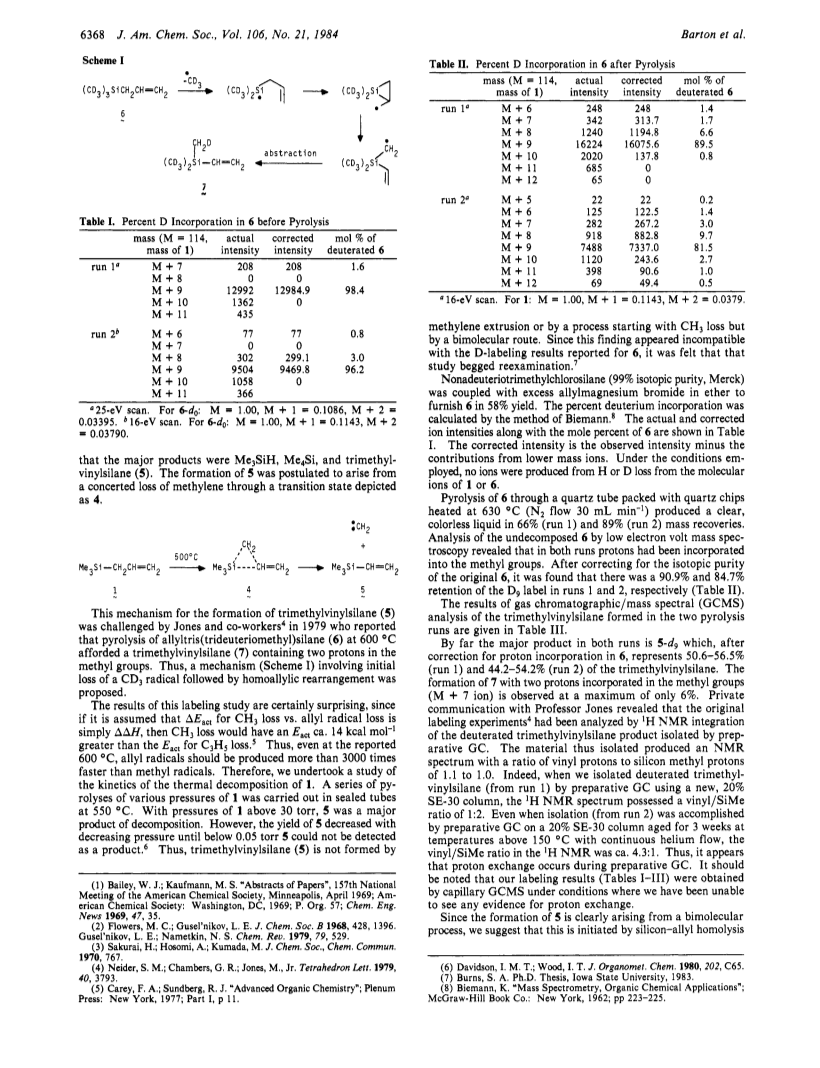
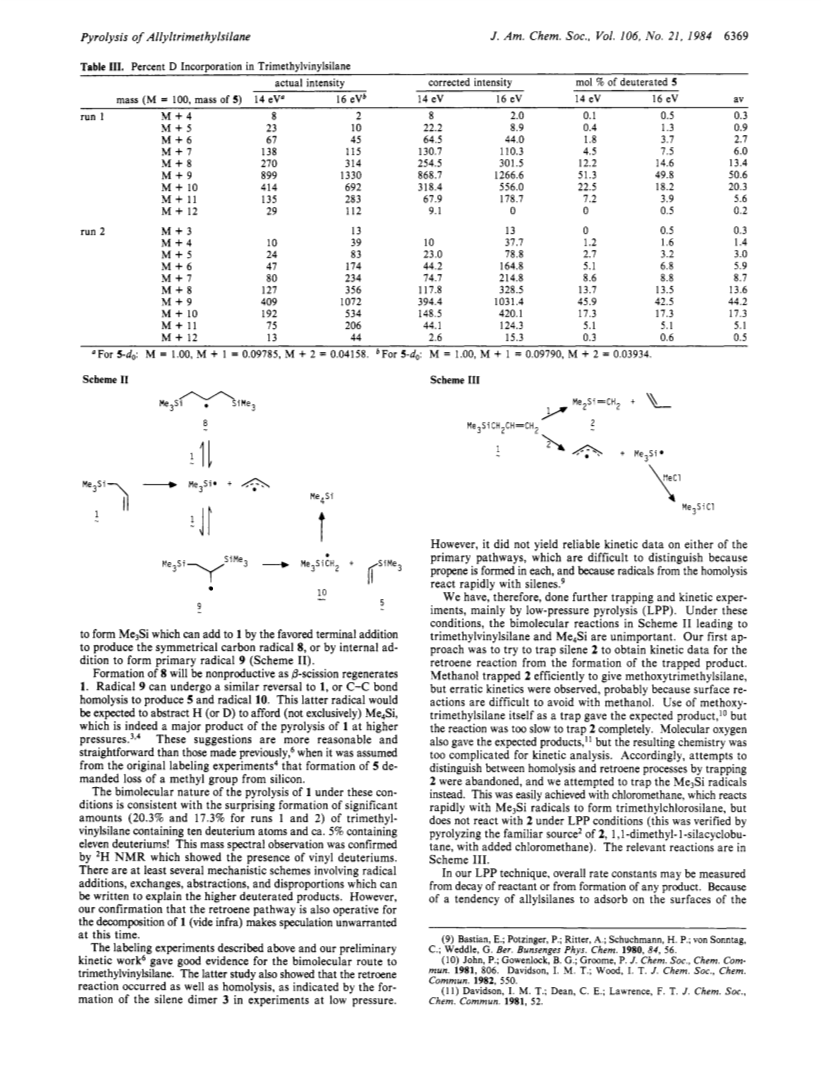
KINETICS AND MECHANISM OF THE PYROLYSIS OF ALLYLTRIMETHYLSILANE.
Barton Burns Davidson Ijadi-Maghsoodi Wood
The gas-phase thermal decomposition of allyltrimethylsilane has been reinvestigated by using deuterium labeling and kinetic studies of variable pressure. Trimethylvinylsilane, the major product at high pressures, is found not to be a primary product of unimolecular decomposition. Silyl radical trapping allowed kinetic separation of the two competitive primary processes of decomposition: a concerted retroene elimination of propene to directly produce a silene and Si-C bond homolysis.

 Germany | Contact:Romesh
  United States | Contact:John
 United Kingdom | Contact:Elsa Young
 China (Mainland) | Contact:Lynn