Antioxidant Synergism Between Butylated Hydroxyanisole and Butylated Hydroxytoluene
Omura, Kanji
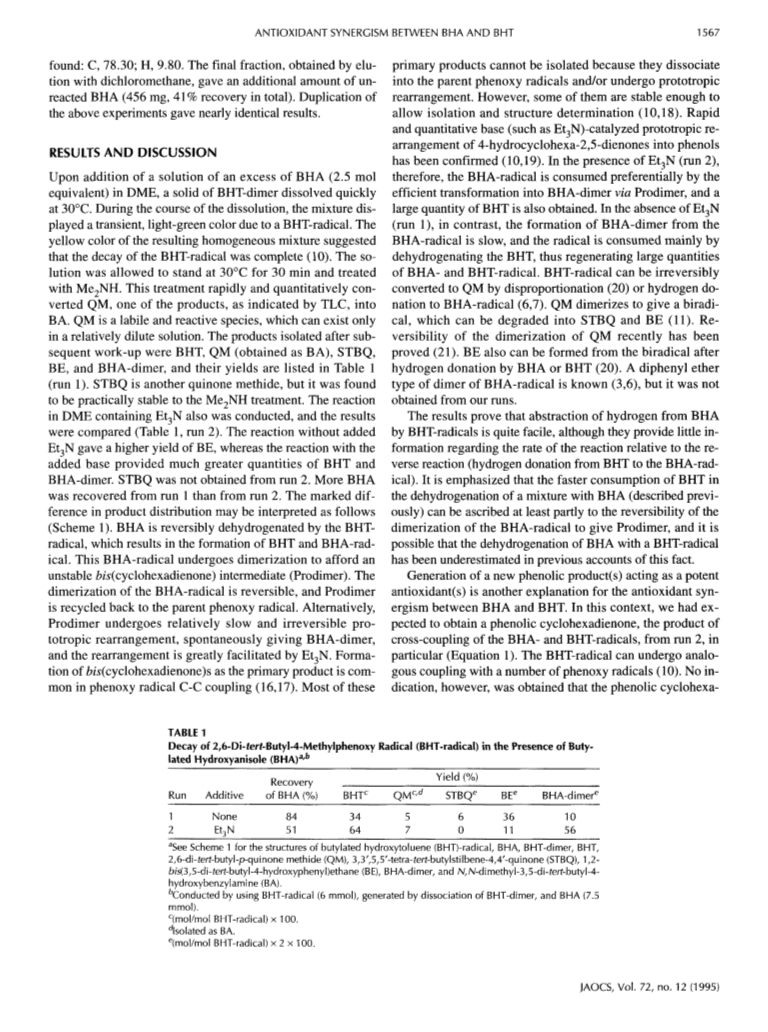
Decay of the 2,6-di-tert-butyl-4-methylphenoxy radical in the presence of butylated hydroxyanisole (BHA) was investigated in 1,2-dimethoxyethane with or without triethylamine.BHT-radical was conveniently generated by dissociation of its unstable dimer in solution.The products were BHT, 3,3'-di-tert-butyl-5,5'-dimethoxy-2,2'-dihydroxybiphenyl (BHA-dimer), 2,6-di-tert-butyl-p-quinone methide (QM), 1,2-bis(3,5-di-tert-butyl-4-hydroxyphenyl)ethane, and 3,3',5,5'-tetra-tert-butyl-4,4'-stilbenequinone.The reaction without added triethylamine gave larger quantities of the last two products and BHA (recovery), whereas the reaction with it provided larger quantities of the first two products.The marked difference in the product distribution can be accounted for by a series of reactions including reversible dehydrogenation of BHA with BHT-radical, which generates 2-tert-butyl-4-methoxyphenoxy radical (BHA-radical) and BHT, reversible dimerization of BHA-radical, which affords an intermediary bis(cyclohexadienone), and spontaneous and base-catalysed prototropic rearrangement of the intermediate into BHA-dimer.Products of coupling between BHT-radical and BHA-radical were not obtained.BHA was found to undergo facile acid-catalyzed addition to QM, providing two isomeric bis(hydroxyphenyl)methanes.The results help to elucidate the mechanism of antioxidant synergism between BHA and BHT and may suggest that the synergism can be affected by base or acid. - Key words: Antioxidant synergism; butylated hydroxyanisole; butylated hydroxytoluene; effect of acid; effect of base; fate of phenoxy radicals involved.
Alkylation of p-cresol with tert-butyl alcohol using benign Bronsted acidic ionic liquid catalyst
Kondamudi, Kishore Elavarasan, Pandian Dyson, Paul J. Upadhyayula, Sreedevi
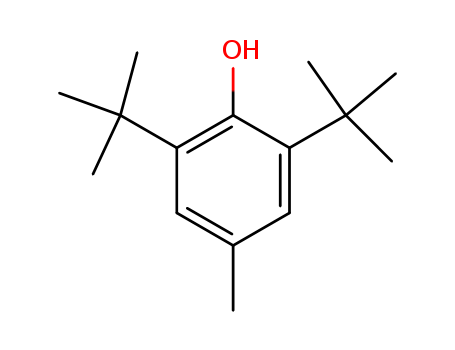
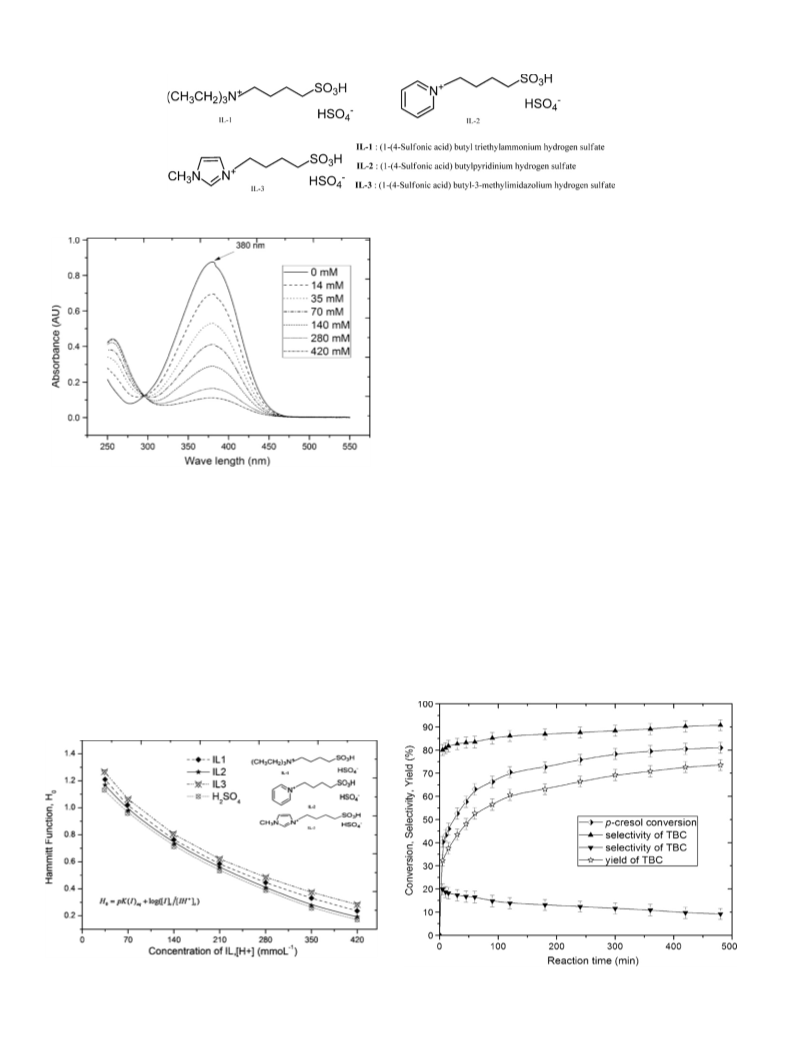
Novel and environmentally benign Bronsted acidic ionic liquids with SO3-H functionality were prepared using N-methyl imidazole, pyridine, triethylamine and 1,4-butanesultone as the source chemicals. The prepared ionic liquid catalysts were characterized by NMR and their catalytic activity in tert-butylation of p-cresol with tert-butyl alcohol (TBA) was investigated. The effects of reaction time, reaction temperature, reactant mole ratio and the recyclability of the catalysts on the conversion of p-cresol and selectivity to 2-tert-butyl-p-cresol (TBC) and 2,6-di-tert-butyl-p-cresol (DTBC) called butylated hydroxytoluene (BHT) were investigated. Lower alcohol to p-cresol mole ratios, lower ionic liquid to p-cresol ratio and temperature as low as 70 °C gave 80% conversion of p-cresol. The catalyst activity was found to be almost completely retained even after 5 recycles. Extended Arrhenius equation was used to calculate the rate constants for this reaction.

![N-[4-Cyano-3-(trifluoromethyl)phenyl]-2-methacrylamide](http://file1.lookchem.com/cas/reactions/2021/05/29/7095859.png)


![N-[4-Cyano-3-(trifluoromethyl)phenyl]methacrylamide epoxide](http://file1.lookchem.com/cas/reactions/2021/05/29/7097248.png)




 Turkey | Contact:M.TOLGA TUNCEL
 Thailand | Contact:Piyapong Ruangrong
 Switzerland | Contact:sir
 South Africa | Contact:sir
 Saudi Arabia | Contact:sir
 Russian Federation | Contact:sir
 Pakistan | Contact:muhammad imran