



Relevant articles and documents
Thermokinetics of reactions with liquid-liquid phase separation
Baumann, Christian Becker, Friedrich
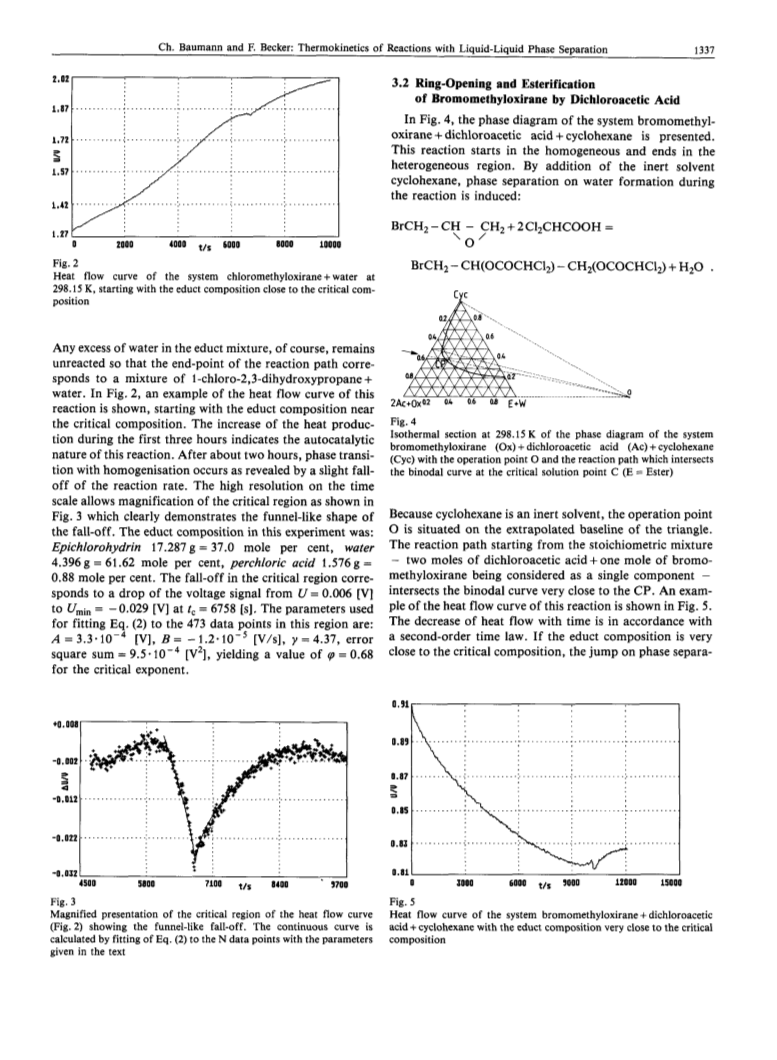
Isothermal heat flow calorimetry with controlled thermoelectric cooling resp. heating is applied to study the critical slowing down of the kinetics of reactions with liquid-liquid phase separation. Results (i) on the acid-catalysed hydrolysis of chloromethyloxirane by water, and (ii) on the ring-opening and esterification of bromomethyloxirane by dichloroacetic acid in the presence of cyclohexane as an inert solvent, both at 298.15 K, are presented. The heat production w(t) which is proportional to the reaction rate ?ζ/?t (where ζ, is the reaction coordinate) exhibits a funnel-like fall-off when the reaction path intersects the binodal curve at the critical solution point CP. From the shape of this part of the w(t) curves an average value of the critical exponent Φ = 0.72±0,003, which refers to the change of ζ with t at constant T and p, is calculated. This result is to be compared with the theoretical value of Φ = 0.708 obtained from a modification of the Griffiths and Wheeler theory of critical points in multicomponent systems to chemically reacting systems far from equilibrium by introducing f as an additional extensive variable. This allows the critical slowing down of the reaction rates to be interpreted as resulting from the divergence of the correlation length ζ, resp. from the convergence of the transport phenomena to zero at the CP. ? VCH Verlagsgesellschaft mbH, 1996.
Curing Behavior and Properties of Sustainable Furan-Based Epoxy/Anhydride Resins
Marotta, Angela Faggio, Noemi Ambrogi, Veronica Cerruti, Pierfrancesco Gentile, Gennaro Mija, Alice
The last two decades have witnessed a significant growth in using bioderived materials, driven by the necessity of replacing fossil-derived precursors, reducing the fossil fuel consumption, and lowering the global environmental impact. This is possible thanks to the availability of abundant resources from biomasses and the development of optimized technologies based on the principles of sustainability and circular economy. Herein, we report on the synthesis and characterization of new carbohydrate-derived epoxy resins. In particular, 2,5-bis[(oxiran-2-ylmethoxy)methyl]furan has been synthesized and cured with methyl nadic anhydride. The effect of different initiators was studied, in order to identify the most efficient curable formulations. A series of resins was then prepared varying the epoxide-anhydride ratios. The results gathered from physicochemical, mechanical, morphological analyses have demonstrated that the produced furan-based thermosets have the potential to be proposed as sustainable alternatives to the traditional, bisphenol A-containing epoxy resins.


 Other Country | Contact:Dave Lim
 Zimbabwe | Contact:Yevai Goto
 Zambia | Contact:Sumandeep
 Vietnam | Contact:Sir
 Venezuela | Contact:Sir