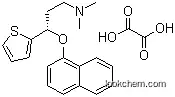
Detail of > 136434-34-9
- CAS Number:
- 136434-34-9
- Name:
Duloxetine hydrochloride
- Formula:
- C18H19NOS.HCl
- Molecular Structure:

- Synonyms:
- (S)-Duloxetine hydrochloride;Cymbalta;LY 248686 HCl;Duloxetine Hcl;2-Thiophenepropanamine,N-methyl-g-(1-naphthalenyloxy)-, hydrochloride,(S)-;2-Thiophenepropanamine, N-methyl-g-(1-naphthalenyloxy)-, hydrochloride, (gS)- (9CI);(S)-(+)-Duloxetine hydrochloride;(S)-(+)-N-Methyl-3-(1-naphthalenyloxy)-3-(2-thienyl)propanamine hydrochloride;
- Molecular Weight:
- 333.88
- Melting Point:
- 118-122 °C
- Boiling Point:
- 466.2 °C at 760 mmHg
- Flash Point:
- 235.7 °C
- Appearance:
- White or white crystalline powder
- Hazard Symbols:
Xi- Risk Codes:
- 36/37/38
- Safety:
- 26-36/37Details
Related products
- 136434-34-9Duloxetine hydrochloride
- 650638-17-83-Hydrazinopyridine hydrochloride
- 89203-22-53-Aminopyridazine hydrochloride
- 89381-07-73-Methylcyclobutanamine hydrochloride
- 937046-97-41-amino-1H-Pyrrole-2-carbonitrile hydrochloride
- 194602-08-9Tramadol hydrochloride
- 19503-22-11H-Benzotriazole-1-carboxamidine Hydrochloride
- 207296-89-74-Benzyloxycarbonylaminopiperidine Hydrochloride
Other Products
- Titanium Dioxide Carbon black Glutathione Adenosine Cable pulling lubricant
- 136434-34-9Duloxetine hydrochloride
- 18619-97-14-Pyridinecarboxylicacid, 3-cyano-1,2-dihydro-6-methyl-2-oxo-, ethyl ester
- 61968-07-8C.I. Acid Yellow 184
- 41827-15-01,2,4-triethoxybenzene
- 17557-23-2Oxirane,2,2'-[(2,2-dimethyl-1,3-propanediyl)bis(oxymethylene)]bis-
- 118-30-91-Naphthalenamine,2-ethoxy-
- 156876-26-5Carbonochloridic acid,1-(6-nitro-1,3-benzodioxol-5-yl)ethyl ester
- 141-70-8Heptane,2,2,6,6-tetramethyl-4-methylene-
- 25932-11-0Benzenesulfinic acid,sodium salt, hydrate (1:1:2)
- 402-41-5Benzenemethanol,4-fluoro-a,a-dimethyl-
- 503-40-2Methanedisulfonic acid
- 118409-58-8Propanedinitrile,2-[(3,4,5-trihydroxyphenyl)methylene]-
- 995-25-5Silane,chlorotripropyl-
- 72479-26-61H-Imidazole,1-[2-(2,4-dichlorophenyl)-2-[[4-(phenylthio)phenyl]methoxy]ethyl]-
- 13444-93-4Osmium trichloride
Refine Suppliers Do you want your product ranking ahead? Know what is 'Top Seller'!
- Supplier Location:
China (Mainland)(44)
India(14)
Italy(1)
United States(1)
Hong Kong(1)
Canada(1)
- Business Type:
- Importer/Exporter(39)Lab/Research institutions(8)Manufacturers(1)Other(1)
- Certificates:
- ISO(3)Production License(1)
Please post your buying leads,so that our qualified suppliers
will soon contact you!
*Required Fields
Reference
- Effect of age on the pharmacokinetics of duloxetine in women
- Effect of age on the pharmacokinetics of duloxetine in women. Skinner, Michael H.; Kuan, Han-Yi; Skerjanec, Andrej; Seger, Mary E.In this study,136434-34-9 is also used.; Heathman, Michael; O'Brien, Lisa; Reddy, Shobha; Knadler, Mary P. ( Lilly Laboratory for Clinical Research, Indiana University Hospital and Outpatient Center, Indianapolis, IN 46202, USA). British Journal of Clinical Pharmacology, 57(1), 54-61 (English) 2004 Blackwell Publishing Ltd. CODEN: BCPHBM. ISSN: 0306-5251. DOCUMENT TYPE: Journal CA Section: 1 (Pharmacology) Aims: The effect of age on duloxetine pharmacokinetics was evaluated in healthy volunteers and in patients with urinary incontinence. Methods: Twenty-four healthy subjects (12 women 65 - 77 yr, and 12 women 32 - 50 yr) were given a single 40-mg oral dose of duloxetine in Study 1. Plasma concn.-time data were analyzed by noncompartmental pharmacokinetic methods. Sparse plasma samples were obtained from patients with urinary incontinence treated in two phase II studies: 70 women (24 - 77 yr) who received duloxetine 20 mg day-1, 30 mg day-1, or 40 mg day-1 in Study 2A and 128 women (28 - 64 yr) who received duloxetine 20 mg day-1, 40 mg day-1, or 80 mg day-1 in Study 2B. Based upon the combined data, a model was developed to characterize population pharmacokinetics of duloxetine using the nonlinear mixed-effects modeling program (NONMEM). Results: In Study 1, the elderly (3 65 yr) exhibited a statistically significant slower elimination rate const. lz compared with younger subjects {elderly - younger difference = -0.022 h-1 [95% confidence interval (Cl) -0.036, -0.008]}. However, no statistically significant differences in either CL/F [elderly-younger difference = -17.4 I h-1 (95% Cl -41.1, 6.23)] or V/F [elderly - younger difference = 115.9 I (95% Cl -168.6, 400.4)] were obsd. The population pharmacokinetic anal. of Studies 2A and 2B revealed that the CL/F of duloxetine decreased with increasing age. Despite statistical significance, the age effect only accounted for 3% of the interindividual variability in CL/F and unexplained sources of the variation in clearance were still substantial (> 50%). Adverse events were generally mild to moderate, and the incidence of adverse events was generally similar in elderly and non-elderly participants in these studies. Conclusions: Whereas the results suggest that age has an effect on duloxetine pharmacokinetics, primarily reflected as a slower lz in the elderly, the magnitude of mean changes in CL/F, or V/F was small relative to the large interindividual variation in pharmacokinetics. Elderly participants had a safety profile of duloxetine comparable to their younger counterparts. Specific dose recommendations for duloxetine in the elderly are not warranted. .
- Is HCl Duloxetine Effective in the Management of Urinary Stress Incontinence after Radical Prostatectomy?
- All Rights Reserved. Is HCl Duloxetine Effective in the Management of Urinary Stress Incontinence after Radical Prostatectomy?. Zahariou, Athanasios; Papaioannou, Polyanthi; Kalogirou, Georgia ( Urology Department, ELPIS Hospital, Volos, Greece). Urologia Internationalis, 77(1), 9-12 (English) 2006 S. Karger AG. CODEN: URINAC. ISSN: 0042-1138. DOCUMENT TYPE: Journal CA Section: 1 (Pharmacology) Introduction: Up to 70% of patients who undergo radical prostatectomy complain about urine leakage, but persistent stress incontinence 1 yr after surgery affects <5% of them. HCl duloxetine is a dual serotonin and norepinephrine reuptake inhibitor that relieves the symptoms of stress urinary incontinence. The purpose of this study was to evaluate the efficacy of HCl duloxetine in the management of urinary incontinence after radical prostatectomy and its impact in urodynamic parameters such as maximal urethral closure pressure (MUCP), abdominal leak point pressure (ALPP) and retrograde leak point pressure (RLPP). Material and Methods: The study included 18 men with stress urinary incontinence 12 mo after radical prostatectomy. All underwent a pad test to quantify the degree of urine loss and a urodynamic evaluation before and after a three month treatment with HCl duloxetine. The intrinsic sphincter was evaluated by ALPP and RLPP and the striated sphincter by MUCP. Results: At the pretreatment evaluation the mean ALPP was 52.1 cm H2O, the mean MUCP was 52.5 cm H2O and the mean RLPP was 43.1 cm H2O. 136434-34-9 is the cas registry number of certain chemical which is used as reagents here. After 3 mo of HCl duloxetine treatment the mean ALPP was 59.1 cm H2O, the mean MUCP was 67.3 cm H2O and the mean RLPP was 45.1 cm H2O. There was a statistically significant correlation among RLPP, MUCP and ALPP before treatment. After HCl duloxetine treatment there was significant correlation between RLPP and ALPP. Conclusion: The use of HCl duloxetine results in mild increase of MUCP and in significant redn. of urine loss. Its action on the extrinsic sphincter does not provide a complete treatment option for postprostatectomy incontinence. .
- About us
- |
- Payment
- |
- Contact us
- |
- Links
- |
- Help Center
- |
- Disclaimer
- |
- Add to favorite
- | SiteMap
- |
- Product SiteMap
- |
- Manufacturers
- |
- Suppliers
©2008 LookChem.com,License:ICP NO.:Zhejiang10014259
[Hangzhou]86-571-85317600,85317603,85317620