Products Categories
| CAS No.: | 90076-65-6 |
|---|---|
| Name: | Lithium bis(trifluoromethanesulphonyl)imide |
| Article Data: | 15 |
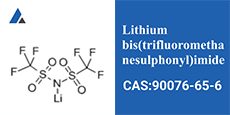
| Molecular Structure: | |
|
|
|
| Formula: | C2F6LiNO4S2 |
| Molecular Weight: | 287.09 |
| Synonyms: | Methanesulfonamide,1,1,1-trifluoro-N-[(trifluoromethyl)sulfonyl]-, lithium salt (9CI);1,1,1-Trifluoro-N-[(trifluoromethyl)sulfonyl]methanesulfonamide lithium salt;Bis[(trifluoromethyl)sulfonyl]imide lithium salt;Fluorad HQ 115;Fluorinert HQ115;Fluorinert HQ 115J;HQ 115;LiTFSI;Lithiotrifluoromethanesulfonimide;Lithium bis(perfluoromethylsulfonyl)imide;Lithium triflimide;MEK 50R;N,N-Bis[(trifluoromethyl)sulfonyl]amine lithium salt;Sankonol EAc 20R; |
| EINECS: | 415-300-0 |
| Density: | 1.334 g/cm3 |
| Melting Point: | 234-238 °C(lit.) |
| Boiling Point: | 190.5oC at 760 mmHg |
| Flash Point: | 69oC |
| Solubility: | H2O: 10 mg/mL, clear, colorless |
| Appearance: | white hygroscopic powder |
| Hazard Symbols: |
 T, T, C C
|
| Risk Codes: | 24/25-34-52/53; |
| Safety: | 22-26-36/37/39-45-61 |
| Transport Information: | UN 2923 8/PG 2 |
| PSA: | 88.28000 |
| LogP: | 2.61350 |
- 958254-66-51H-Imidazo[4,5-b]pyridine-2-carboxaldehyde, 1-methyl-, hydrochloride
- 99170-93-1N-Methyl-2-oxazolamine
- 914458-26-7[5-(2-fluorophenyl)-1-pentyl-1H-pyrrol-3-yl]-1-naphthalenyl-Methanone
- 90221-55-92-bromo-5-methylbenzaldehyde
- 97730-31-9(S)-4'-(2-Methylbutyl)Biphenyl-4-Carbonitrile
- 926293-55-26-Bromo-2-methylpyridine-3-carboxaldehyde
- 911112-05-55-Iodo-3-(trifluoromethyl)-2-pyridinamine
- 95789-13-21,3,7-trimethylpurine-2,6-dione
- 956104-42-02-Bromo-5-nitro-3-(trifluoromethyl)pyridine
- 910247-97-11,2,3-Trimethylimidazolium dimethyl phosphate

- 84-65-1Anthraquinone
- 7758-87-4Calcium phosphate
- 420-04-2Cyanamide
- 57-48-7D(-)-Fructose
- 112926-00-8Silica gel, pptd., cryst.-free
- 112-00-51-Dodecanaminium,N,N,N-trimethyl-, chloride (1:1)
- 1885-14-9Phenyl chloroformate
- 121-88-02-Amino-5-nitrophenol
- 104987-11-3Tacrolimus
- 141-53-7Sodium formate
- 8001-54-5Quaternary ammonium compounds, alkylbenzyldimethyl, chlorides
- 9003-39-8Povidone
- 10161-34-9Trenbolone acetate
- 402957-28-2Telaprevir
- 68-19-9Cyanocobalamin

What can I do for you?
Get Best Price


Specification
The Lithium bis(trifluoromethanesulphonyl)imide, with the CAS registry number 90076-65-6, is also known as Bis(trifluoromethylsulfonyl)amine lithium salt. It belongs to the product categories of Synthetic Organic Chemistry;Typical Metal Compounds.This chemical's molecular formula is C2F6LiNO4S2 and molecular weight is 287.08. What's more,Its systematic name is Methanesulfonamide, 1,1,1-trifluoro-N-((trifluoromethyl)sulfonyl)-,lithium salt.It is a White hygroscopic powder and moisture sensitive.
Physical properties about Lithium bis(trifluoromethanesulphonyl)imide are:
(1)ACD/LogP: 1.488; (2)# of Rule of 5 Violations: 0; (3)ACD/LogD (pH 5.5): -0.51; (4)ACD/LogD (pH 7.4): -0.51; (5)ACD/BCF (pH 5.5): 1.00; (6)ACD/BCF (pH 7.4): 1.00; (7)ACD/KOC (pH 5.5): 1.54; (8)ACD/KOC (pH 7.4): 1.54; (9)#H bond acceptors: 5; (10)#H bond donors: 1; (11)#Freely Rotating Bonds: 0; (12)Flash Point: 69 °C; (13)Enthalpy of Vaporization: 42.67 kJ/mol; (14)Boiling Point: 190.5 °C at 760 mmHg; (15)Vapour Pressure: 0.54 mmHg at 25°C.
Safety Information of Lithium bis(trifluoromethanesulphonyl)imide:
The Lithium bis(trifluoromethanesulphonyl)imide is toxic in contact with skin and if swallowed,and can causes burns.It is harmful to aquatic organisms, may cause long-term adverse effects in the aquatic environment.Avoid release to the environment. Refer to special instructions safety data sheet.When you use it ,wear suitable protective clothing, gloves and eye/face protection.Do not breathe dust.In case of contact with eyes, rinse immediately with plenty of water and seek medical advice.
You can still convert the following datas into molecular structure:
(1)SMILES:[Li+].FC(F)(F)S(=O)(=O)[N-]S(=O)(=O)C(F)(F)F;
(2)Std. InChI:InChI=1S/C2F6NO4S2.Li/c3-1(4,5)14(10,11)9-15(12,13)2(6,7)8;/q-1;+1;
(3)Std. InChIKey:QSZMZKBZAYQGRS-UHFFFAOYSA-N.
-
Premium Related Products