3
The residue was reprecipitated by the addition of hexane to a
dichloromethane solution of the mixture to afford [PdCl{P(2-
SC6H4)(2-t-BuSC6H4)2}] (7) (150 mg, 0.245 mmol, 94%). 7: red
3JHH = 8, 8 Hz, 2H), 7.53 (dd, JHH = 8, 8 Hz, 2H), 7.58 (d,
3JHH = 8 Hz, 2H), 7.63 (dd, 3JHH = 8, 8 Hz, 2H). 31P{1H} NMR
(202 MHz, CDCl3): ¤ 63.2 (s). UV-vis (chloroform) -max 294
(¾ 35000), 323 (¾ 21000), 366 (¾ 16000), 541 (¾ 640) nm.
Anal. Calcd. for C44H42P2Pd2S6¢CHCl3: C, 46.70; H, 3.74%.
Found: C, 46.37; H, 3.91%.
1
crystals, mp 151 °C (decomp); H NMR (500 MHz, CDCl3): ¤
1.51 (s, 18H), 7.02 (ddd, 3JHH = 8, 8 Hz, JHP = 3 Hz, 1H), 7.23-
7.31 (m, 4H), 7.39-7.44 (m, 3H), 7.54 (dd, 3JHH = 8, 8 Hz, 2H),
3
7.70 (dd, JHH = 8 Hz, JHP = 4 Hz, 2H). 13C{1H} NMR (126
Thermolysis of [PdCl{P(2-i-PrSC6H4)3}]Cl (3a). In a 5 º
NMR tube was placed a CDCl3 solution (0.5 mL) of 3a (30 mg,
0.045 mmol). After three freeze-pump-thaw cycles, the tube
was frozen, evacuated, and sealed. The solution was heated at
60 °C for 7 h, during which time the reaction was followed by
1H NMR spectroscopy. The sealed tube was opened, and the
reaction mixture was concentrated. The residue was reprecipi-
tated by the addition of hexane to a chloroform solution of
the mixture to afford [Pd{P(2-SC6H4)(2-i-PrSC6H4)2}] (11) in
a quantitative yield. 11: red crystals, mp 227 °C (decomp);
1H NMR (400 MHz, CDCl3): ¤ 1.33 (d, 3JHH = 7 Hz, 6H), 1.48
MHz, CDCl3): ¤ 31.4 (CH3), 55.0 (C), 122.4 (d, JCP = 9 Hz,
CH), 128.4 (d, 1JCP = 65 Hz), 129.3 (d, JCP = 20 Hz, CH),
129.4 (d, JCP = 3 Hz, CH), 130.2 (CH), 132.1 (CH), 132.9
(CH), 133.1 (d, JCP = 5 Hz, CH), 136.3 (d, JCP = 11 Hz, CH),
138.5 (d, 1JCP = 63 Hz), 139.0 (d, 2JCP = 17 Hz), 159.1 (d,
2JCP = 25 Hz). 31P{1H} NMR (202 MHz, CDCl3): ¤ 72.8 (s).
UV-vis (chloroform) -max 336.5 (¾ 1800), 384 (¾ 570), 451 (¾
110) nm. Anal. Calcd. for C26H30ClPPdS3¢CHCl3: C, 44.37; H,
4.27%. Found: C, 44.27; H, 4.14%.
Reaction of 1b with [PtCl2(cod)].
A mixture of 1b
3
3
(140 mg, 0.266 mmol), [PtCl2(cod)] (100 mg, 0.267 mmol), and
dichloromethane (2.0 mL) was stirred at 25 °C for 48 h. After
filtration of the reaction mixture, the filtrate was concentrated.
The residue was reprecipitated by the addition of hexane to a
chloroform solution of the mixture to afford [PtCl{P(2-SC6H4)-
(2-t-BuSC6H4)2}] (8) (180 mg, 0.257 mmol, 97%). 8: orange
(d, JHH = 7 Hz, 6H), 3.77 (sep, JHH = 7 Hz, 2H), 7.01 (ddd,
3JHH = 7, 7 Hz, JHP = 3 Hz, 1H), 7.24-7.42 (m, 7H), 7.55 (ddd,
3JHH = 8 Hz, JHH = 2 Hz, JHP = 2 Hz, 2H), 7.65 (dd, JHH
=
4
3
8 Hz, JHP = 4 Hz, 2H). 13C{1H} NMR (126 MHz, CDCl3): ¤
22.3 (CH3), 23.5 (CH3), 45.7 (CH), 122.4 (d, JCP = 9 Hz, CH),
1
128.5 (d, JCP = 66 Hz), 129.1 (d, JCP = 8 Hz, CH), 129.5 (d,
CP = 20 Hz, CH), 130.3 (CH), 132.7 (d, JCP = 2 Hz, CH),
132.9 (d, JCP = 5 Hz, CH), 133.0 (CH), 134.7 (d, JCP = 10 Hz,
1
crystals, mp 166 °C (decomp); H NMR (500 MHz, CDCl3): ¤
J
1.31 (s, 18H), 6.90 (ddd, 3JHH = 7, 7 Hz, JHP = 3 Hz, 1H), 7.20
3
3
1
2
(dd, JHH = 7, 7 Hz, 1H), 7.25-7.54 (m, 7H), 7.55 (dd, JHH
=
CH), 136.5 (d, JCP = 61 Hz), 139.8 (d, JCP = 18 Hz), 159.0
(d, 2JCP = 25 Hz). 31P{1H} NMR (202 MHz, CDCl3): ¤ 72.0
(s). Anal. Calcd. for C24H26ClPPdS3: C, 49.40; H, 4.49%.
Found: C, 49.24; H, 4.30%.
Thermolysis of [PtCl2{P(2-i-PrSC6H4)3}] (5). In a 5 º
NMR tube was placed a solution of 5 (13 mg, 0.017 mmol) in
CDCl3 (0.5 mL). The solution was heated at 60 °C for 6 h, dur-
ing which time the reaction was followed by 1H NMR spectros-
7 Hz, JHP = 3 Hz, 1H), 7.67 (dd, 3JHH = 8 Hz, JHP = 4 Hz, 2H).
13C{1H} NMR (126 MHz, CDCl3): ¤ 31.1 (CH3), 54.2 (C),
122.2 (d, JCP = 9 Hz, CH), 127.3 (d, JCP = 76 Hz), 129.0 (d,
CP = 4 Hz, CH), 129.3 (d, JCP = 17 Hz, CH), 130.3 (d, 1JCP
1
J
=
67 Hz), 131.9 (CH), 132.17 (d, JCP = 4 Hz, CH), 132.22 (d,
CP = 4 Hz, CH), 133.5 (d, JCP = 5 Hz, CH), 136.4 (d, JCP
J
=
9 Hz, CH), 141.4 (d, JCP = 16 Hz), 160.6 (d, JCP = 26 Hz).
1
1
31P{1H} NMR (202 MHz, CDCl3): ¤ 47.9 (s, JPPt = 3679 Hz).
copy. The H NMR spectrum of the reaction mixture showed
1
195Pt{1H} NMR (129 MHz, CDCl3): ¤ ¹4418 (s, JPPt = 3659
quantitative formation of [Pt{P(2-SC6H4)(2-i-PrSC6H4)2}] (12).
For isolation of 12, see: A solution of 5 (100 mg, 0.133
mmol) in chloroform (4 mL) was heated at 60 °C for 48 h. After
filtration of the reaction mixture, the filtrate was concentrated.
The residue was reprecipitated by the addition of hexane to a
chloroform solution of the mixture to give [Pt{P(2-SC6H4)(2-i-
PrSC6H4)2}] (12) (73 mg, 0.109 mmol, 82%). 12: orange crys-
tals, mp 213 °C (decomp); 1H NMR (600 MHz, CDCl3, 60 °C):
¤ 1.22 (br d, 3JHH = 6.6 Hz, 6H), 1.26 (br d, 3JHH = 6.6 Hz, 6H),
3.53 (br s, 2H), 6.90-6.95 (m, 1H), 7.14-7.19 (m, 1H), 7.31-
7.51 (m, 8H), 7.56-7.60 (m, 2H). 13C{1H} NMR (150 MHz,
CDCl3, 60 °C): ¤ 22.1 (s, CH3), 22.9 (s, CH3), 44.8 (br s, CH),
Hz). UV-vis (chloroform) -max 291.5 (¾ 13500), 343.5 (¾
3300), 394.5 (¾ 910) nm. Anal. Calcd. for C26H30ClPPtS3: C,
44.60; H, 4.32%. Found: C, 44.50; H, 4.79%.
Thermolysis of 7. In a 5 º NMR tube was placed a CDCl3
solution (0.6 mL) of 7 (30 mg, 0.049 mmol). After three freeze-
pump-thaw cycles, the tube was frozen, evacuated, and sealed.
The solution was heated at 100 °C for 4 h, during which time
the reaction was followed by 1H NMR spectroscopy. The sealed
tube was opened, and the reaction mixture was concentrated.
The residue was reprecipitated by the addition of hexane to a
chloroform solution of the mixture to afford [Pd{P(2-SC6H4)2-
(2-t-BuSC6H4)}]2 (9) in a quantitative yield.
1
122.4 (d, JCP = 8.6 Hz, CH), 127.5 (d, JCP = 74.6 Hz), 129.1
In order to obtain the yield of t-BuCl: In a pressure-resistant
NMR tube was placed a CDCl3 solution (0.6 mL) of 7 (29.3
mg, 0.048 mmol) and mesitylene (10 ¯L, 0.072 mmol as a
standard). The solution was gradually warmed to 100 °C and
heated at 100 °C for 4 h. The 1H NMR spectrum of the reaction
mixture indicated the formation of 9, t-BuCl (integral ratio of
mesitylene:t-BuCl = 1.0:0.62, 0.045 mmol, 93%) and a trace
amount of isobutene. 9: red crystals, mp 238 °C (decomp);
1H NMR (500 MHz, CDCl3): ¤ 1.47 (s, 18H), 6.85-6.97 (m,
(br s, CH), 129.7 (d, JCP = 11.0 Hz, CH), 131.3 (s, CH), 132.6
(s, CH), 132.7 (s, CH), 133.0 (br s, CH), 134.7 (br d, JCP = 6.0
1
2
Hz, CH), 135.5 (d, JCP = 67.5 Hz), 141.9 (br d, JCP = 15.9
2
Hz), 160.6 (br d, JCP = 21.5 Hz). 31P{1H} NMR (243 MHz,
CDCl3, 60 °C): ¤ 50.0 (s, 1JPPt = 3566 Hz). 31P{1H} NMR (243
MHz, CDCl3, 20 °C): ¤ 49.9 (s, 1JPPt = 3583 Hz). Anal. Calcd.
for C24H26ClPPtS3: C, 42.88; H, 3.90%. Found: C, 42.58; H,
4.18%.
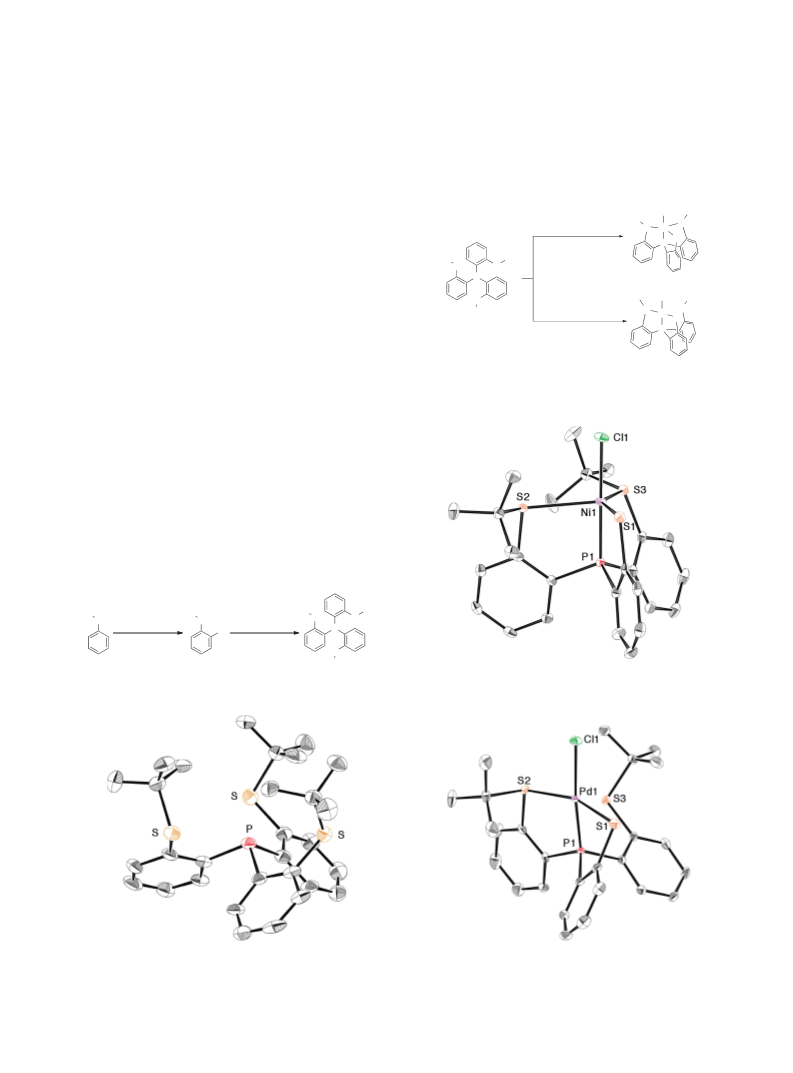
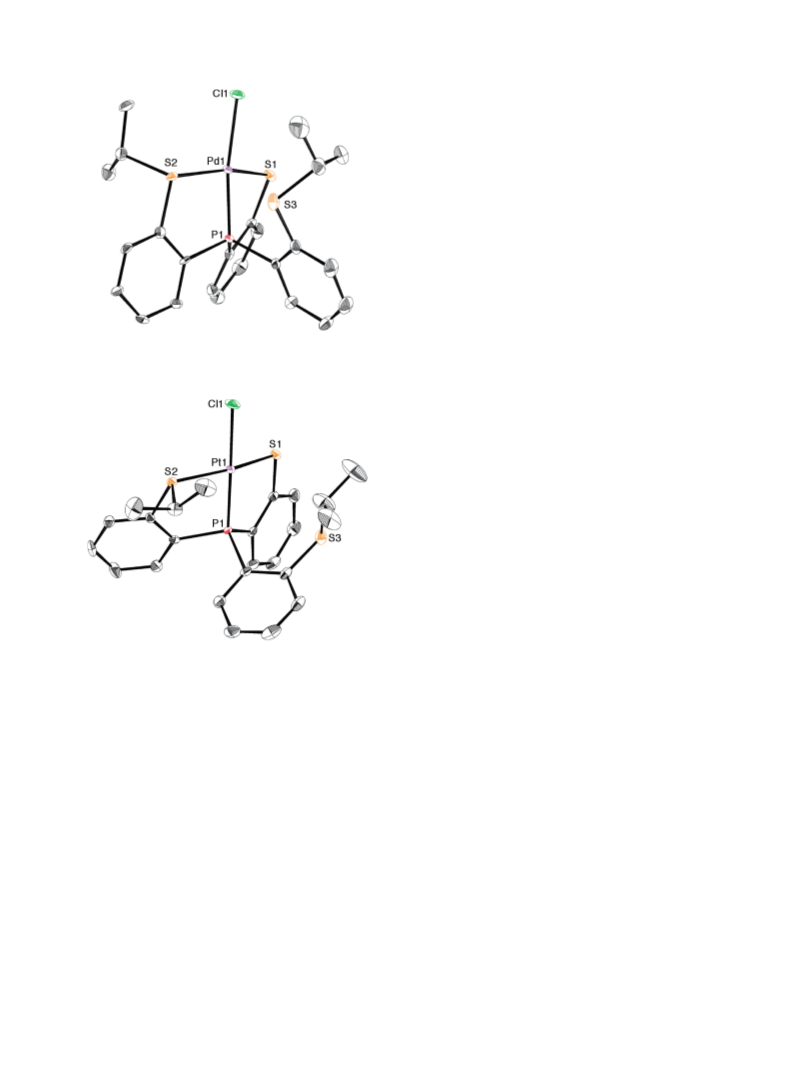
X-Ray Crystallography of 1b¢H2O, 6, 7¢CH2Cl2,
3
3
4H), 6.99 (dd, JHH = 8, 8 Hz, 2H), 7.13 (dd, JHH = 8, 8 Hz,
8¢0.5CHCl3, 9¢CHCl3, 11, and 12.
Single crystals of
3
2H), 7.17 (dd, JHH = 8, 8 Hz, 2H), 7.26-7.23 (m, 2H), 7.36
1b¢H2O, 6, 7¢CH2Cl2, 8¢0.5CHCl3, 9¢CHCl3, 11, and 12 suita-
ble for X-ray structural analysis were obtained by slow recrys-
3
3
(d, JHH = 8 Hz, 2H), 7.41 (dd, JHH = 8, 8 Hz, 2H), 7.47 (dd,
© 2016 The Chemical Society of Japan

 Takeda, Nobuhiro