Welcome to LookChem.com Sign In|Join Free
  • or

Encyclopedia

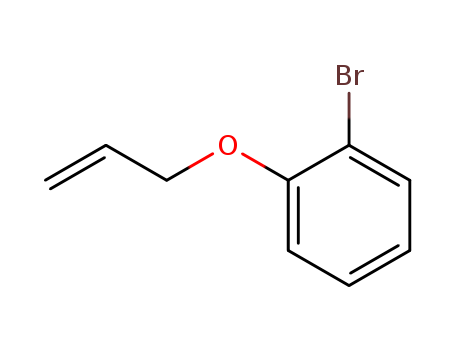
1-BroMo-2-(2-propen-1-yloxy)-benzene

Base Information
  • Chemical Name:1-BroMo-2-(2-propen-1-yloxy)-benzene
  • CAS No.:60333-75-7
  • Molecular Formula:C9H9BrO
  • Molecular Weight:213.074
  • Hs Code.:
  • Mol file:60333-75-7.mol
1-BroMo-2-(2-propen-1-yloxy)-benzene

Synonyms:benzene,1-bromo-2-(2-propenyloxy);1-allyloxy-2-bromo-benzene;ortho-allyloxy-bromobenzene;o-allyloxy-bromo-benzene;EINECS 246-754-6;2-bromophenyl 2-propenyl ether;1-bromo-2-(prop-2-enyloxy)benzene;allyl o-bromophenyl ether;allyl (2-bromophenyl) ether;

Suppliers and Price of 1-BroMo-2-(2-propen-1-yloxy)-benzene
Supply Marketing:
Business phase:
The product has achieved commercial mass production*data from LookChem market partment
Manufacturers and distributors:
  • Manufacture/Brand
  • Chemicals and raw materials
  • Packaging
  • price
  • TRC
  • 1-Bromo-2-(2-propen-1-yloxy)-benzene
  • 25g
  • $ 1190.00
  • Rieke Metals
  • 1-Allyloxy-2-bromobenzene
  • 1g
  • $ 661.00
  • Crysdot
  • 1-(Allyloxy)-2-bromobenzene 97%
  • 5g
  • $ 1131.00
  • Crysdot
  • 1-(Allyloxy)-2-bromobenzene 97%
  • 1g
  • $ 444.00
Total 3 raw suppliers
Chemical Property of 1-BroMo-2-(2-propen-1-yloxy)-benzene
Chemical Property:
  • PSA:9.23000 
  • LogP:3.01390 
  • Storage Temp.:-20°C Freezer 
  • Solubility.:Chloroform (Slightly), Methanol (Slightly) 
Purity/Quality:

99% *data from raw suppliers

1-Bromo-2-(2-propen-1-yloxy)-benzene *data from reagent suppliers

Safty Information:
  • Pictogram(s):  
  • Hazard Codes: 
MSDS Files:

SDS file from LookChem

Useful:
  • General Description 1-Bromo-2-(2-propen-1-yloxy)-benzene (also known as o-allyloxy-bromobenzene or allyl (2-bromophenyl) ether) is a key intermediate in copper(I)-mediated radical cyclization reactions, particularly in the synthesis of chroman derivatives. It reacts with copper(I) diethyl malonate to form diethyl o-(allyloxy)phenylmalonates, which subsequently undergo cyclization to yield functionalized chromans, such as 4,4-bis(ethoxycarbonyl)-3-methylchromans and related structures. The presence of electron-withdrawing groups on the aromatic ring enhances reactivity and improves yields in these transformations.
Technology Process of 1-BroMo-2-(2-propen-1-yloxy)-benzene

There total 8 articles about 1-BroMo-2-(2-propen-1-yloxy)-benzene which guide to synthetic route it. The literature collected by LookChem mainly comes from the sharing of users and the free literature resources found by Internet computing technology. We keep the original model of the professional version of literature to make it easier and faster for users to retrieve and use. At the same time, we analyze and calculate the most feasible synthesis route with the highest yield for your reference as below:

synthetic route:
Guidance literature:
With potassium carbonate; In acetone; for 6h; Heating / reflux;
Guidance literature:
With potassium carbonate; In acetone; for 12h; Inert atmosphere; Reflux;
DOI:10.3390/molecules25030602
Guidance literature:
With potassium carbonate; sodium iodide; In acetone; for 5h; Heating;
DOI:10.1021/ol0258029
Refernces

COPPER(I)-INDUCED RADICAL CYCLIZATION OF DIETHYL o-(ALLYLOXY)PHENYLMALONATES TO CHROMAN DERIVATIVES

10.1246/cl.1984.1931

The study investigates the copper (I)-induced radical cyclization of diethyl o-(allyloxy)phenylmalonates to chroman derivatives. The key chemicals involved are o-(allyloxy)bromobenzenes and copper (I) diethyl malonate. The o-(allyloxy)bromobenzenes react with copper (I) diethyl malonate to form diethyl o-(allyloxy)phenylmalonates, which then undergo cyclization under the reaction conditions to produce various chroman derivatives such as 4,4-bis(ethoxycarbonyl)3-methylchromans, 4,4-bis(ethoxycarbonyl)-3-methylenechromans, and 3-(3-butenyl)-4,4-bis(ethoxycarbonyl)chromans. The copper (I) diethyl malonate plays a crucial role in this process, as the homolysis of the Cu(I)-C bond generates the radical species necessary for the cyclization to occur. The study also examines how different substituents on the aromatic ring and at the o-allyloxyl group influence the product distribution, finding that electron-withdrawing substituents accelerate the initial aromatic substitution reaction and lead to better isolation yields of chromans.


Post a RFQ

Enter 15 to 2000 letters.Word count: 0 letters

Attach files(File Format: Jpeg, Jpg, Gif, Png, PDF, PPT, Zip, Rar,Word or Excel Maximum File Size: 3MB)

1 Customer Service

What can I do for you?
Get Best Price

Get Best Price for 60333-75-7