Welcome to LookChem.com Sign In|Join Free
  • or

Encyclopedia

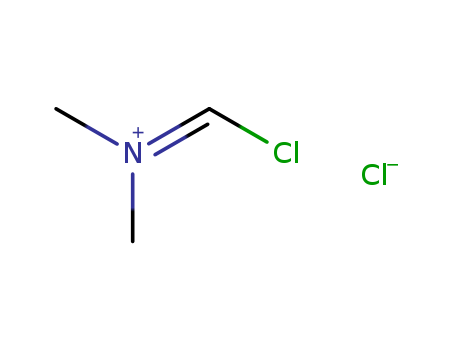
N-(Chloromethylidene)-N-methylmethanaminium chloride

Base Information
  • Chemical Name:N-(Chloromethylidene)-N-methylmethanaminium chloride
  • CAS No.:3724-43-4
  • Deprecated CAS:1487-66-7,92458-33-8,1512534-40-5,92458-33-8
  • Molecular Formula:C3H7ClN*Cl
  • Molecular Weight:128.001
  • Hs Code.:29252000
  • European Community (EC) Number:425-970-6,609-368-2
  • UNII:Q39V7G8776
  • DSSTox Substance ID:DTXSID7044423
  • Wikipedia:Vilsmeier_reagent
  • Wikidata:Q27894258
  • ChEMBL ID:CHEMBL3183181
  • Mol file:3724-43-4.mol
N-(Chloromethylidene)-N-methylmethanaminium chloride

Synonyms:3724-43-4;(Chloromethylene)dimethyliminium chloride;arnold's reagent;Vilsmeier reagent;N-(Chloromethylidene)-N-methylmethanaminium chloride;(CHLOROMETHYLENE)DIMETHYLAMMONIUM CHLORIDE;Methanaminium, N-(chloromethylene)-N-methyl-, chloride;MFCD00011868;N-(chloromethylene)-N-methylmethanaminium chloride;chloromethylene dimethylammonium chloride;chloromethylidene(dimethyl)azanium;chloride;DTXSID7044423;Dimethylchloromethyliminium chloride;N-Chloromethylene-N,N-dimethyl ammonium chloride;chloro-n,n-dimethylformiminium chloride;Chloromethylenedimethylammonium chloride;Q39V7G8776;N,N-Dimethylchloromethyliminium chloride;Chloromethylene(dimethyl)ammonium chloride;EC 425-970-6;EC 609-368-2;[chloromethylene]dimethylammonium chloride;(Chloromethylene)dimethylammonium chloride (6CI,7CI);Ammonium, (chloromethylene)dimethyl-, chloride (8CI);Viismeier reagent;Dimethylchloroformiminium chloride;(Chlormethylene)dimethylammonium chloride;C3H7ClN.Cl;SCHEMBL280;C3-H7-Cl-N.Cl;CHEMBL3183181;DTXCID5024423;UNII-Q39V7G8776;Tox21_302163;GEO-04109;AKOS017345161;chlormethylene dimethylammonium chloride;FS-4034;(chloromethylene)dimethylammoniumchloride;chloromethylene-dimethylammonium chloride;chloromethylene dimethyl-ammonium chloride;N,N,-Dimethylchloromethyliminium chloride;NCGC00255861-01;(Chloromethlene)dimethyl ammonium chloride;(chloromethylidene)dimethylazanium chloride;(chloro-methylene)dimethylammonium chloride;(chloromethylene)-dimethylammonium chloride;(Chloromethylene)-dimethylammonium-chloride;(Chloromethylene)dimethyl ammonium chloride;CAS-3724-43-4;(chloro-methylen)-dimethyl-ammonium-chloride;FT-0604890;D89427;Q27894258;Methanaminium, N-(chloromethylene)-N-methyl-, chloride (1:1)

Suppliers and Price of N-(Chloromethylidene)-N-methylmethanaminium chloride
Supply Marketing:
Business phase:
The product has achieved commercial mass production*data from LookChem market partment
Manufacturers and distributors:
  • Manufacture/Brand
  • Chemicals and raw materials
  • Packaging
  • price
  • TRC
  • (Chloromethylene)dimethylammoniumChloride
  • 50g
  • $ 690.00
  • TCI Chemical
  • (Chloromethylene)dimethyliminium Chloride >95.0%(T)
  • 250g
  • $ 717.00
  • TCI Chemical
  • (Chloromethylene)dimethyliminium Chloride >95.0%(T)
  • 25g
  • $ 122.00
  • Sigma-Aldrich
  • (Chloromethylene)dimethyliminium chloride 95%
  • 25g
  • $ 149.00
  • Sigma-Aldrich
  • (Chloromethylene)dimethyliminium chloride 95%
  • 5g
  • $ 46.30
  • JR MediChem
  • (Chloromethylene)dimethyliminium Chloride 96%
  • 1kg
  • $ 2480.00
  • JR MediChem
  • (Chloromethylene)dimethyliminium Chloride 96%
  • 25g
  • $ 88.00
  • Chem-Impex
  • (Chloromethylene)dimethyliminiumchloride,95%(Assaybytitration) 95%(Assaybytitration)
  • 25G
  • $ 117.60
  • Chem-Impex
  • (Chloromethylene)dimethyliminiumchloride,≥95%(Assaybytitration)Hazmat ≥95%(Assaybytitration)
  • 100G
  • $ 430.98
  • Chem-Impex
  • (Chloromethylene)dimethyliminiumchloride,≥95%(Assaybytitration)Hazmat ≥95%(Assaybytitration)
  • 5G
  • $ 40.77
Total 60 raw suppliers
Chemical Property of N-(Chloromethylidene)-N-methylmethanaminium chloride
Chemical Property:
  • Appearance/Colour:White to off-white powder 
  • Melting Point:132 ºC (dec.) 
  • Refractive Index:1.4525 (estimate) 
  • Boiling Point:°Cat760mmHg 
  • Flash Point:°C 
  • PSA:3.01000 
  • Density:g/cm3 
  • LogP:-2.47040 
  • Storage Temp.:2-8°C 
  • Sensitive.:Moisture Sensitive 
  • Water Solubility.:reacts 
  • Hydrogen Bond Donor Count:0
  • Hydrogen Bond Acceptor Count:1
  • Rotatable Bond Count:0
  • Exact Mass:126.9955546
  • Heavy Atom Count:6
  • Complexity:44.9
Purity/Quality:

99.9% *data from raw suppliers

(Chloromethylene)dimethylammoniumChloride *data from reagent suppliers

Safty Information:
  • Pictogram(s):  
  • Hazard Codes:
  • Statements: 61-20/21/22-34-22-14-35 
  • Safety Statements: 53-26-36/37/39-45 
MSDS Files:

SDS file from LookChem

Total 1 MSDS from other Authors

Useful:
  • Canonical SMILES:C[N+](=CCl)C.[Cl-]
  • General Description (Chloromethylene)dimethyliminium chloride, also known as Arnold's reagent, is a highly reactive electrophilic reagent commonly used in organic synthesis for formylation and chloromethylation reactions. It functions as a versatile intermediate in the preparation of various heterocyclic compounds, pharmaceuticals, and other functionalized molecules. (Chloromethylene)dimethyliminium chloride's reactivity stems from its ability to act as a chloromethyl cation equivalent, facilitating the introduction of chloromethyl or formyl groups into target substrates. Its applications are particularly notable in the synthesis of complex organic frameworks, where it serves as a key building block for constructing carbon-nitrogen and carbon-carbon bonds. Due to its strong electrophilicity, it is often handled under controlled conditions to avoid undesired side reactions.
Technology Process of N-(Chloromethylidene)-N-methylmethanaminium chloride

There total 13 articles about N-(Chloromethylidene)-N-methylmethanaminium chloride which guide to synthetic route it. The literature collected by LookChem mainly comes from the sharing of users and the free literature resources found by Internet computing technology. We keep the original model of the professional version of literature to make it easier and faster for users to retrieve and use. At the same time, we analyze and calculate the most feasible synthesis route with the highest yield for your reference as below:

synthetic route:
Guidance literature:
chloroform; N,N-dimethyl-formamide; With oxygen; at 30 ℃; for 3h; Irradiation;
at 50 ℃; for 2h;
DOI:10.1021/acs.joc.1c00334
Refernces

Synthesis of structurally diverse 2-azetidinones via staudinger reaction on a solid support

10.1246/bcsj.20100212

The research focuses on the synthesis of structurally diverse 2-azetidinones, which are key structural elements in the family of β-lactam antibiotics and possess significant biological activities. The study aims to develop a new method for the synthesis of β-lactams via ketene-imine cycloaddition using polymer-supported ketene on a solid support, specifically Merrifield resin. The researchers successfully synthesized a variety of β-lactam derivatives with different substituents at positions 1 and 4, which could serve as potential intermediates for the synthesis of active compounds. The process involved the use of trimellitic anhydride, phthaloylglycine, imines, Vilsmeier reagent, triethylamine, trifluoroacetic acid, methylhydrazine, and other reagents. The conclusions of the research highlight the selective cleavage of supported β-lactams by trifluoroacetic acid and methylhydrazine to obtain 4-carboxyphthalimido- and 3-amino-β-lactams, respectively. The method offers simplified purification through filtration, avoiding time-consuming separation techniques, and the ability to regenerate the starting polymer-supported phthaloylglycine, making it a valuable contribution to solid-phase polymer-supported synthesis.

PYRROLE CHEMISTRY. XXIV. THE VILSMEIER FORMYLATION AND CYANATION OF PYRROLE ACETALS. A SYNTHESIS OF PYRROLE-2,3,5-TRICARBOXALDEHYDE

10.1139/v82-060

The research focuses on the synthesis of pyrrole acetals and their subsequent formylation and cyanation reactions. The purpose of the study was to explore the reactivity of pyrrole acetals towards electrophilic substitution, specifically using the Vilsmeier formylation and chlorosulfonyl isocyanate (CSI) cyanation reactions. The researchers aimed to substitute carboxyaldehyde or carbonitrile groups onto the pyrrole ring, provided the reactivity of the unsubstituted ring positions was not too low. The study concluded that while the Vilsmeier reaction could be effectively used for formylation when the pyrrole ring was reactive, the cyanation using CSI was limited due to the lability of the acetal function towards decomposition under the required reaction conditions. Key chemicals used in the process included pyrrole mono- and dicarboxaldehydes, Vilsmeier reagent (a mixture of phosphorus oxychloride and N,N-dimethylformamide), chlorosulfonyl isocyanate, and various solvents and reagents for purification and analysis. The successful synthesis of gyrrole-2,3,5-tricarboxaldehyde and other substituted pyrroles demonstrated the potential for these reactions in the preparation of complex pyrrole derivatives.

AN ITERRUPTED PUMMERER REACTION INDUCED BY VILSMEIER REAGENT (POCl3/DMF)

10.1016/S0040-4039(00)95528-X

The study investigates an interrupted Pummerer reaction induced by Vilsmeier reagent (POCl3/DMF). The researchers treated N-(2-ethylsulfinylphenyl)pyrrole (3a) with Vilsmeier reagent in a one-pot sequence, resulting in the formation of 1- and 3-pyrrolo[2,1-b]benzothiazole carbaldehydes (5 and 6) with yields of 73% and 9% respectively. This reaction deviates from the typical Pummerer reaction pathway, where the tricoordinate sulfur intermediate reacts with a nucleophile at sulfur instead of carbon, leading to unexpected products. The study also explores the influence of different solvents and leaving groups on the reaction outcome, noting that simple alkyl side-chains in the sulfoxide enhance the likelihood of interrupted Pummerer products.

Post a RFQ

Enter 15 to 2000 letters.Word count: 0 letters

Attach files(File Format: Jpeg, Jpg, Gif, Png, PDF, PPT, Zip, Rar,Word or Excel Maximum File Size: 3MB)

1 Customer Service

What can I do for you?
Get Best Price

Get Best Price for 3724-43-4