Welcome to LookChem.com Sign In|Join Free
  • or

Encyclopedia

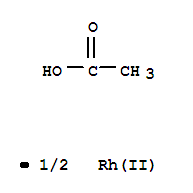
Rhodium(II) acetate

Base Information
  • Chemical Name:Rhodium(II) acetate
  • CAS No.:5503-41-3
  • Molecular Formula:C2H4 O2 . 1/2 Rh
  • Molecular Weight:223.03
  • Hs Code.:
  • European Community (EC) Number:255-707-9,226-843-6,240-084-8
  • DSSTox Substance ID:DTXSID30203567
  • Nikkaji Number:J74.789K
  • Wikipedia:Rhodium(II)_acetate
  • Mol file:5503-41-3.mol
Rhodium(II) acetate

Synonyms:Rhodium(II) acetate;5503-41-3;aceticacid,rhodium(2+)salt;Rhodium (II) acetate;rhodium(2+);diacetate;Rhodium diacetate;Acetic acid, rhodium(2+) salt;Rh-110;EINECS 226-843-6;15956-28-2;C2H4O2.xRh;C2-H4-O2.x-Rh;diacetoxyrhodium;rhodium(II)acetate;Rhodium (II) acetate dimer dihydrate;rhodium(II)diacetate;2-(2-Methylbenzoyl)hydrazinecarbothioamide;-rhodium(2+) diacetate;42204-14-8;C4H6O4Rh;SCHEMBL196205;Acetic acid, rhodium(2) salt;Diacetic acid rhodium(II) salt;C2H4O2.1/2Rh;DTXSID30203567;ITDJKCJYYAQMRO-UHFFFAOYSA-L;C2-H4-O2.1/2Rh;TETRAKIS(ACETO)DIRHODIUM(II);AKOS015892709;FT-0658751

Suppliers and Price of Rhodium(II) acetate
Supply Marketing:
Business phase:
The product has achieved commercial mass production*data from LookChem market partment
Manufacturers and distributors:
  • Manufacture/Brand
  • Chemicals and raw materials
  • Packaging
  • price
  • Labseeker
  • Rhodium (II) acetate dimer dihydrate
  • 10g
  • $ 525.00
  • American Custom Chemicals Corporation
  • RHODIUM(II)ACETATE 95.00%
  • 2G
  • $ 1230.08
  • American Custom Chemicals Corporation
  • RHODIUM(II)ACETATE 95.00%
  • 500MG
  • $ 703.40
  • American Custom Chemicals Corporation
  • RHODIUM(II)ACETATE 95.00%
  • 100MG
  • $ 157.46
Total 20 raw suppliers
Chemical Property of Rhodium(II) acetate
Chemical Property:
  • Boiling Point:117.1°Cat760mmHg 
  • Flash Point:40°C 
  • PSA:80.26000 
  • Density:g/cm3 
  • LogP:-2.48760 
  • Hydrogen Bond Donor Count:0
  • Hydrogen Bond Acceptor Count:4
  • Rotatable Bond Count:0
  • Exact Mass:220.93210
  • Heavy Atom Count:9
  • Complexity:25.5
Purity/Quality:

95% *data from raw suppliers

Rhodium (II) acetate dimer dihydrate *data from reagent suppliers

Safty Information:
  • Pictogram(s): Xi 
  • Hazard Codes:Xi 
  • Statements: 36/38 
  • Safety Statements: 37/39-28A-26-15 
MSDS Files:

SDS file from LookChem

Useful:
  • Chemical Classes:Metals -> Organic Acids, Metal Salts
  • Canonical SMILES:CC(=O)[O-].CC(=O)[O-].[Rh+2]
Refernces

Rhodium carbenoid induced cycloadditions of diazo ketoimides across indolyl π-bonds

10.1055/s-2007-967982

The research focuses on the rhodium carbenoid induced cycloadditions of diazo ketoimides across indolyl p-bonds. The experiments involve the preparation of a series of diazo ketoimides from (1H-indol-3yl)acetyl chloride and alkyl 2-diazo-3-(3-substituted-2-oxopiperidin-3-yl)-3-oxopropanoates, which are then treated with rhodium(II) acetate. The key reaction is the attack of the imido carbonyl oxygen at the rhodium carbenoid center, leading to the formation of a transient push–pull carbonyl ylide dipole. This dipole undergoes an intramolecular dipolar cycloaddition across the indole p-bond, resulting in the formation of cycloadducts. The study explores the influence of substituents on the dipole's approach to the indole ring, with a focus on endo- and exo-cycloaddition products. The experiments utilize techniques such as X-ray crystal structure analysis for stereochemical assignments and involve the use of reagents like Lawesson's reagent and Raney-Ni for reduction steps. The analyses include infrared spectroscopy (IR) and nuclear magnetic resonance (NMR) to characterize the synthesized compounds.

Reactions of macrocyclic rhodium carbenoids: regioselective synthesis of indol-3-yl macrocyclic lactones and cryptands

10.1016/j.tetlet.2007.11.102

The research focuses on the synthesis and reactions of macrocyclic rhodium carbenoids, specifically targeting the regioselective synthesis of indol-3-yl macrocyclic lactones and cryptands. The experiments involved the preparation of a variety of macrocyclic diazocarbonyl compounds with different spacers, which were then reacted with rhodium(II) carbenoids generated from α-diazocarbonyl compounds and rhodium(II) carboxylates. This approach led to the formation of C–C bonds and the production of indol-3-yl macrocyclic di- or tetralactones through regioselective intermolecular alkylation/insertion. The study also explored double carbenoid insertion to synthesize indolyl cryptand molecules. The reactants included macrocyclic diazocarbonyl compounds, various substituted indoles, and rhodium(II) acetate as a catalyst. Analytical techniques such as nuclear magnetic resonance (NMR) spectroscopy and high-resolution mass spectrometry (HRMS) were employed to characterize the synthesized compounds, confirming the structure and purity of the products.

Post a RFQ

Enter 15 to 2000 letters.Word count: 0 letters

Attach files(File Format: Jpeg, Jpg, Gif, Png, PDF, PPT, Zip, Rar,Word or Excel Maximum File Size: 3MB)

1 Customer Service

What can I do for you?
Get Best Price

Get Best Price for 5503-41-3