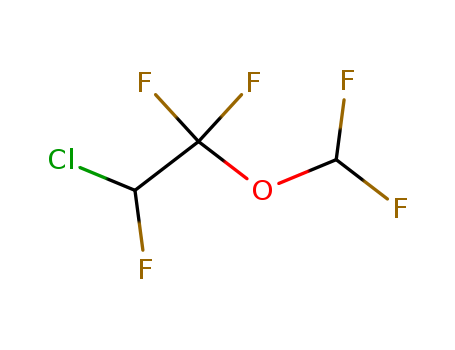
Chemical Property of Enflurane
Chemical Property:
- Vapor Pressure:272mmHg at 25°C
- Refractive Index:1.303
- Boiling Point:59.9°Cat760mmHg
- Flash Point:°C
- PSA:9.23000
- Density:1.489g/cm3
- LogP:2.35280
- Storage Temp.:2-8°C
- XLogP3:2.1
- Hydrogen Bond Donor Count:0
- Hydrogen Bond Acceptor Count:6
- Rotatable Bond Count:3
- Exact Mass:183.9714332
- Heavy Atom Count:10
- Complexity:107
- Purity/Quality:
-
97% *data from raw suppliers
Enflurane
*data from reagent suppliers
Safty Information:
- Pictogram(s):
Volatile with anesthetic properties, but nonflammable. TLV: 75 ppm; not classifiable as a human carcinogen.
- Hazard Codes:F,T,Xi
- Statements:
36
- Safety Statements:
23-26-36-39
- MSDS Files:
-
SDS file from LookChem
Total 1 MSDS from other Authors
Useful:
- Chemical Classes:Other Uses -> Waste Anesthetic Gases
- Drug Classes:Anesthetics, Halogenated
- Canonical SMILES:C(C(OC(F)F)(F)F)(F)Cl
- Recent ClinicalTrials:Vasodilation Effect of Inhalational Anesthetics
- Inhalation Risk:A harmful contamination of the air can be reached rather quickly on evaporation of this substance at 20 °C.
- Effects of Short Term Exposure:The substance is irritating to the eyes, skin and respiratory tract. The substance may cause effects on the central nervous system and cardiovascular system. Exposure at high levels could cause unconsciousness.
-
Uses
Anesthetic in clinical anesthesia Clinical anesthetic. Ethrane is widely used clinically as an anes thesia (by inhalation). Workers in operatingrooms are susceptible to inhaling 2-CHLORO-1,1,2-TRIFLUOROETHYL DIFLUOROMETHYL ETHER at low concentrations.
-
Therapeutic Function
Anesthetic
-
Biological Functions
Enflurane (Ethrane) depresses myocardial contractility
and lowers systemic vascular resistance. In contrast to
halothane, it does not block sympathetic reflexes, and
therefore, its administration results in tachycardia.
However, the increased heart rate is not sufficient to oppose
enflurane’s other cardiovascular actions, so cardiac
output and blood pressure fall. In addition, enflurane
sensitizes the myocardium to catecholamine-induced
arrhythmias, although to a lesser extent than with
halothane. Enflurane depresses respiration through
mechanisms similar to halothane’s and requires that the
patient’s ventilation be assisted.
Neuromuscular transmission is depressed by enflurane,
resulting in some skeletal muscle paralysis.Although
muscle relaxation is inadequate for many surgical procedures,
the anesthetic enhances the action of neuromuscular
blocking agents, thereby lowering the dose of the paralytic
agent needed and minimizing side effects.
Deep anesthesia with enflurane is associated with
the appearance of seizurelike electroencephalographic
(EEG) changes. Occasionally frank tonic–clonic seizures
are observed. Consequently, other inhalational
agents are usually given to patients with preexisting
seizure disorders.
Another concern associated with the use of enflurane
is its biotransformation, which leads to increased
plasma fluoride. Following lengthy procedures in
healthy patients, fluoride may reach levels that result in
a mild reduction in renal concentrating ability.Thus, enflurane
should be used cautiously in patients with clinically
significant renal disease.
-
Clinical Use
Enflurane was introduced into medical practice in the United States in 1973 and is a
clear, colorless, nonflammable general liquid with a mild, sweet odor. Although relatively stable
chemically, enflurane does not attack aluminum, copper, iron, or brass and is soluble in rubber
(partition coefficient = 74), which can prolong induction/recovery times, as seen with halothane.Enflurane has an intermediate solubility in blood and significant potency. Most of its
pharmacological properties are similar to those of halothane, although there may be slightly less
nausea, vomiting, arrhythmias, and postoperative shivering than observed with halothane. High
concentrations of enflurane, however, are more likely to produce convulsions and circulatory
depression. Enflurane also relaxes the uterus and, thus, should not be used as an anesthetic
during labor. Metabolism via CYP2E1 accounts for 2% of an inhaled dose and includes
transformation to the fluoride ion and fluoromethoxydifluoroacetic acid. During
recovery, enflurane leaves the fatty tissues rapidly and, therefore, is not available for a prolonged
period of time for significant metabolism to proceed.