Welcome to LookChem.com Sign In|Join Free
  • or

Encyclopedia

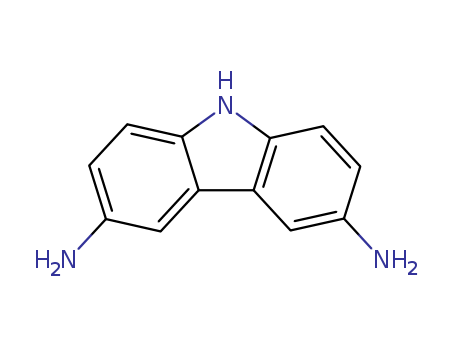
9H-Carbazole-3,6-diamine

Base Information
  • Chemical Name:9H-Carbazole-3,6-diamine
  • CAS No.:86-71-5
  • Molecular Formula:C12H11N3
  • Molecular Weight:197.239
  • Hs Code.:29332900
  • European Community (EC) Number:201-692-9
  • NSC Number:49770
  • UNII:UR9L7T736V
  • DSSTox Substance ID:DTXSID60235336
  • Nikkaji Number:J79.435J
  • Wikidata:Q72462735
  • ChEMBL ID:CHEMBL273309
  • Mol file:86-71-5.mol
9H-Carbazole-3,6-diamine

Synonyms:9H-Carbazole-3,6-diamine;3,6-Diaminocarbazole;86-71-5;UR9L7T736V;EINECS 201-692-9;NSC-49770;NSC49770;Carbazole,6-diamino-;Carbazole-3,6-diamine;9H-carbazol-3,6-diamin;Carbazole, 3,6-diamino-;UNII-UR9L7T736V;SCHEMBL64307;YSWG073;CHEMBL273309;DTXSID60235336;3,6-DIAMINO-9H-CARBAZOLE;MFCD00143081;NSC 49770;AKOS015840862;CS-W010564;CS-17337;D2116;S10922;A863062

Suppliers and Price of 9H-Carbazole-3,6-diamine
Supply Marketing:
Business phase:
The product has achieved commercial mass production*data from LookChem market partment
Manufacturers and distributors:
  • Manufacture/Brand
  • Chemicals and raw materials
  • Packaging
  • price
  • TRC
  • 3,6-Diaminocarbazole
  • 100mg
  • $ 110.00
  • TCI Chemical
  • 3,6-Diaminocarbazole >98.0%(T)
  • 5g
  • $ 1126.00
  • TCI Chemical
  • 3,6-Diaminocarbazole >98.0%(T)
  • 1g
  • $ 332.00
  • Frontier Specialty Chemicals
  • 3,6-Diaminocarbazole 98%
  • 1g
  • $ 306.00
  • Crysdot
  • 9H-Carbazole-3,6-diamine 95+%
  • 5g
  • $ 644.00
  • Crysdot
  • 9H-Carbazole-3,6-diamine 95+%
  • 1g
  • $ 188.00
  • Crysdot
  • 9H-Carbazole-3,6-diamine 95+%
  • 250mg
  • $ 75.00
  • Chem-Impex
  • 3,6-Diaminocarbazole,≥98%(Assaybytitration)Hazmat ≥98%(Assaybytitration)
  • 5G
  • $ 1288.45
  • Biosynth Carbosynth
  • 3,6-Diaminocarbazole
  • 500 mg
  • $ 250.00
  • Biosynth Carbosynth
  • 3,6-Diaminocarbazole
  • 100 mg
  • $ 100.00
Total 62 raw suppliers
Chemical Property of 9H-Carbazole-3,6-diamine
Chemical Property:
  • Vapor Pressure:3.42E-11mmHg at 25°C 
  • Melting Point:276-279 °C 
  • Refractive Index:1.889 
  • Boiling Point:526.9 °C at 760 mmHg 
  • PKA:18.84±0.30(Predicted) 
  • Flash Point:305.7 °C 
  • PSA:67.83000 
  • Density:1.403 g/cm3 
  • LogP:3.64790 
  • Storage Temp.:Keep in dark place,Inert atmosphere,Room temperature 
  • Solubility.:almost transparency in 1mol/L HCl 
  • XLogP3:2
  • Hydrogen Bond Donor Count:3
  • Hydrogen Bond Acceptor Count:2
  • Rotatable Bond Count:0
  • Exact Mass:197.095297364
  • Heavy Atom Count:15
  • Complexity:219
Purity/Quality:

98% *data from raw suppliers

3,6-Diaminocarbazole *data from reagent suppliers

Safty Information:
  • Pictogram(s):  
  • Hazard Codes: 
MSDS Files:

SDS file from LookChem

Useful:
  • Canonical SMILES:C1=CC2=C(C=C1N)C3=C(N2)C=CC(=C3)N
Technology Process of 9H-Carbazole-3,6-diamine

There total 9 articles about 9H-Carbazole-3,6-diamine which guide to synthetic route it. The literature collected by LookChem mainly comes from the sharing of users and the free literature resources found by Internet computing technology. We keep the original model of the professional version of literature to make it easier and faster for users to retrieve and use. At the same time, we analyze and calculate the most feasible synthesis route with the highest yield for your reference as below:

synthetic route:
Guidance literature:
With hydrogen; palladium on activated charcoal; In tetrahydrofuran; for 96h;
Guidance literature:
Multi-step reaction with 2 steps
1: nitric acid / 1,2-dichloro-ethane / 4 h / 45 °C
2: acetic acid; hydrogenchloride; tin(ll) chloride / water / Reflux
With hydrogenchloride; nitric acid; acetic acid; tin(ll) chloride; In water; 1,2-dichloro-ethane;
DOI:10.1039/c6ra15861g
Guidance literature:
With paraffin oil; at 320 ℃;
Refernces

Total synthesis of (+)-epilupinine via an intramolecular nitrile oxide-alkene cycloaddition

10.1021/jo101910r

The study presents a nine-step total synthesis of the quinolizidine alkaloid (+)-Epilupinine with an overall yield of 48%. The key step in this synthesis is the intramolecular nitrile oxide-alkene cycloaddition (INOC), which is used to construct the quinolizidine skeleton. The researchers developed a novel method to efficiently prepare the challenging intermediate (R)-(2-vinylpiperid-1-yl)propanal oxime (13a) from (R)-(2-vinylpiperid-1-yl)propanol (11a) using a two-step process involving Mitsunobu reaction and N-detosylation, avoiding the use of the highly unstable aldehyde intermediate. This method was further generalized to convert various 3-(N,N-dialkylamino)propanols into their corresponding oximes. The final steps of the synthesis involve a Raney nickel-promoted desulfurization to yield the target compound (+)-Epilupinine. The study not only provides a practical and scalable route to this biologically important alkaloid but also offers a new approach for the application of INOC in the total synthesis of other alkaloids.

Post a RFQ

Enter 15 to 2000 letters.Word count: 0 letters

Attach files(File Format: Jpeg, Jpg, Gif, Png, PDF, PPT, Zip, Rar,Word or Excel Maximum File Size: 3MB)

1 Customer Service

What can I do for you?
Get Best Price

Get Best Price for 86-71-5