Welcome to LookChem.com Sign In|Join Free
  • or

Encyclopedia

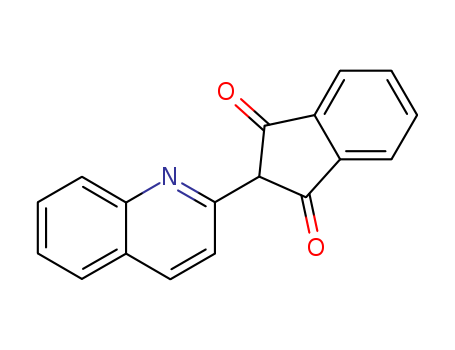
Quinoline Yellow

Base Information
  • Chemical Name:Quinoline Yellow
  • CAS No.:83-08-9
  • Molecular Formula:C18H11NO2
  • Molecular Weight:273.291
  • Hs Code.:2933499090
  • European Community (EC) Number:305-897-5,201-453-9
  • NSC Number:18950,7503,3047
  • UNII:44F3HYL954
  • DSSTox Substance ID:DTXSID00873130
  • Nikkaji Number:J29.108K
  • Wikipedia:Quinoline_Yellow_SS
  • Wikidata:Q7272330
  • NCI Thesaurus Code:C71670
  • RXCUI:1305581
  • Metabolomics Workbench ID:58717
  • ChEMBL ID:CHEMBL1486465
  • Mol file:83-08-9.mol
Quinoline Yellow

Synonyms:Quinoline Yellow;Quinophthalone;8003-22-3;Solvent yellow 33;11641 Yellow;Erio Chinoline Yellow 4G;2-quinolin-2-ylindene-1,3-dione;83-08-9;2-(2-Quinolyl)-1,3-indandione;D&C Yellow No. 11;Quinoline Yellow 2SF;2-(2-Quinolyl)-1,3-indanedione;Quinoline Yellow SS;2-(2-Quinolyl)-1H-indene-1,3(2H)-dione;D and C Yellow No. 11;D & C Yellow no. 11;D&C Yellow No 11;D & C Yellow 11;Arlosol Yellow S;Waxoline Yellow T;2-(2-Quinolinyl)-1H-indene-1,3(2H)-dione;Solvant Yellow 33;2-(quinolin-2-yl)-1H-indene-1,3(2H)-dione;D.C. Yellow Dye No. 11;Chinoline Yellow ZSS;Quinoline Yellow Base;Yellow 204;CHEBI:53700;Nitro Fast Yellow SL;D&C Yellow 11;C.I. SOLVENT YELLOW 33;D and C Yellow 11;NSC 18950;1H-Indene-1,3(2H)-dione, 2-(2-quinolinyl)-;CI 47000;CCRIS 1448;C.I. 47000;EINECS 201-453-9;EINECS 232-318-2;MFCD00011593;2-quinolin-2-yl-1H-indene-1,3(2H)-dione;1H-Indene-1, 2-(2-quinolinyl)-;C.I. 4700;Chinophthalon;QuinolineYellow;Amarelo Quinolina;quinoline yellow a;Quinoline Yellow (C.I. 47000);quinol ine yellow ss;Yellow 11;Quinophthalone (VAN);D&C Yellow No.11;DSSTox_CID_4906;Epitope ID:116214;DSSTox_RID_77574;Quinoline Yellow, 95.0%;DC YELLOW NO. 11;DSSTox_GSID_24906;SCHEMBL42716;YELLOW 11 [INCI];C.I. Solvent Y ellow 33;MLS000037978;UNII-44F3HYL954;KI204 [INCI];CHEMBL1486465;BDBM32227;cid_5355280;HSDB 8052;DTXSID00873130;NSC3047;NSC7503;2-(2-Quinolyl)indan-1,3-dione;44F3HYL954;CI 47000 [INCI];HMS2417K18;KI204;SOLVENT YELLOW 33 [INCI];NSC-3047;NSC-7503;NSC18950;2-(1,3-dioxoindan-2-yl)quinoline;2-(2-quinolyl)indane-1,3-quinone;Tox21_202504;BBL027785;NSC-18950;STK367449;Quinoline Yellow, Dye content 95 %;AKOS000282972;Solvent Yellow 33 / Quinoline Yellow;CCG-103550;LS-1801;NCGC00020851-01;NCGC00020851-02;NCGC00020851-03;NCGC00020851-04;NCGC00020851-05;NCGC00020851-06;NCGC00020851-07;NCGC00020851-08;NCGC00020851-09;NCGC00020851-10;NCGC00021766-02;NCGC00021766-03;NCGC00021766-04;NCGC00021766-05;NCGC00260053-01;AS-13999;Quinoline Yellow 2SF, analytical standard;SMR000035456;CAS-8003-22-3;2-(2-quinolyl)-1H-inden-1,3(2H)-dion;FT-0674285;2-(1H-quinolin-2-ylidene)indene-1,3-dione;2-(1H-quinolin-2-ylidene)indane-1,3-quinone;F87556;SR-01000002715;Q7272330;SR-01000002715-2;W-109300

Suppliers and Price of Quinoline Yellow
Supply Marketing:
Business phase:
The product has achieved commercial mass production*data from LookChem market partment
Manufacturers and distributors:
  • Manufacture/Brand
  • Chemicals and raw materials
  • Packaging
  • price
Total 12 raw suppliers
Chemical Property of Quinoline Yellow
Chemical Property:
  • Melting Point:239 °C(Solv: ethanol (64-17-5)) 
  • Boiling Point:514.5 °C at 760 mmHg 
  • PKA:-0.74±0.20(Predicted) 
  • Flash Point:260 °C 
  • PSA:47.03000 
  • Density:1.345 g/cm3 
  • LogP:3.39760 
  • XLogP3:3.4
  • Hydrogen Bond Donor Count:0
  • Hydrogen Bond Acceptor Count:3
  • Rotatable Bond Count:1
  • Exact Mass:273.078978594
  • Heavy Atom Count:21
  • Complexity:423
Purity/Quality:

99% *data from raw suppliers

Safty Information:
  • Pictogram(s): Xi 
  • Hazard Codes:Xi 
  • Statements: 36/37/38 
  • Safety Statements: 26 
MSDS Files:

SDS file from LookChem

Useful:
  • Chemical Classes:Dyes -> Other Dyes
  • Canonical SMILES:C1=CC=C2C(=C1)C=CC(=N2)C3C(=O)C4=CC=CC=C4C3=O
Technology Process of Quinoline Yellow

There total 31 articles about Quinoline Yellow which guide to synthetic route it. The literature collected by LookChem mainly comes from the sharing of users and the free literature resources found by Internet computing technology. We keep the original model of the professional version of literature to make it easier and faster for users to retrieve and use. At the same time, we analyze and calculate the most feasible synthesis route with the highest yield for your reference as below:

synthetic route:
Guidance literature:
at 180 ℃; for 0.5h;
Guidance literature:
at 240 - 250 ℃;
Refernces

Highly stereoselective total synthesis of methynolide, the aglycon of the 12-membered macrolide antitiotic methymycin. II. Kinetic acetalization and synthesis of the seco-acid

10.1248/cpb.35.2196

Yuji Oikawa, Tatsuyoshi Tanaka, Tatsuo Hamada, and Osamu Yonemitsu detail a highly stereoselective synthesis of the seco-acid (3) of the aglycone methoxylactone (1) of the 12-membered macrolide antibiotic methicillin. The synthesis started from D-glucose and involved the Wittig-Horner coupling of two fragments (i and ii). Fragment i (4) was synthesized by kinetic acetalization with p-methoxybenzylide (MP) acetal protection, while fragment ii (5) was obtained from the Prelog-Djerassi lactone-type intermediate (2) through a series of reactions including protection, hydrolysis, reduction, and oxidation. Diethyl methylphosphonate, a widely used organic synthesis reagent, was used to synthesize fragment ii (5) to introduce the phosphonate group. The coupling of these fragments formed the ring-opened acid (3), which was confirmed by nuclear magnetic resonance (NMR) and mass spectrometry. This work represents a major advance in the synthesis of complex macrolide antibiotics, demonstrating the utility of noncyclic stereocontrolled approaches and the importance of careful choice of protecting groups to achieve high stereoselectivity.

Post a RFQ

Enter 15 to 2000 letters.Word count: 0 letters

Attach files(File Format: Jpeg, Jpg, Gif, Png, PDF, PPT, Zip, Rar,Word or Excel Maximum File Size: 3MB)

1 Customer Service

What can I do for you?
Get Best Price

Get Best Price for 83-08-9