Refernces
10.1021/ol015743j
The study presents a novel and efficient chiral auxiliary-based method for the synthesis of C-glycosylated amino acids. The key step involves a 1,3-dipolar cycloaddition of a chiral glycine equivalent and carbohydrate building blocks, leading to the formation of products with high regio- and diastereoselectivity. The chiral auxiliary, derived from (?)-menthone or (+)-menthone, allows for the synthesis of corresponding diastereomers. The method is designed to meet criteria for an easy and broadly applicable approach to a variety of products with different configurations, as well as orthogonal protecting group strategies. The study also explores the reductive cleavage of the N?O bond using SmI2, which is compatible with the protecting groups on the glycosidic moiety. The approach is demonstrated to be broadly applicable with various aglycosidic building blocks, and it is shown that a chiral glycine equivalent is necessary for the diastereomeric purity of the cycloaddition products. The research was financially supported by the Deutsche Forschungsgemeinschaft and the Fonds der Chemischen Industrie.
10.1039/c2ob06849d
The research focuses on the synthesis and conformational analysis of oxy-substituted butenolide spiroacetals and spiro-N,O-acetals, which are complex organic compounds with potential applications in the synthesis of natural products. The study involves the oxidative spirocyclisation of 2-[(4-hydroxy or 4-sulfonamido)butyl]furans to form the spiroacetals. The experiments utilize techniques such as NMR spectroscopy to investigate the axial–equatorial preference of oxy-substituents, employing an acid-catalysed thermodynamic relay to assess configurational bias. Reactants include 2-(4-hydroxybutyl)furan derivatives, various oxy-substituents, and reagents like OsO4, NMO, and MCPBA for the oxidation steps. The analysis involves crystallographic data for certain compounds, indicated by CCDC references, and discussions on the potential origins of the observed preferences, such as stabilizing gauche effects and solvation influences. The research has implications for the synthesis of bis(acetylenic)enol ether spiroacetals, including AL-1 and related compounds, and provides insights into the conformational preferences that can guide the selection of starting materials and synthetic routes.
10.1016/S0040-4039(00)84436-6
The research focused on the structure and synthesis of WF 3681, a novel aldose reductase inhibitor isolated from a Chaetomella species. The purpose of the study was to elucidate the structure of WF 3681 and confirm it through total synthesis. The researchers concluded that WF 3681, a fungal metabolite, possesses potent aldose reductase-inhibitory activity and has the chemical structure C13H1205. Key chemicals used in the synthesis process included (E)-5-phenyl-4-pentenol, benzyl bromide, MCPBA (m-chloroperoxybenzoic acid), methyl malonate, NaOH (sodium hydroxide), CH2O/Me2NH (formaldehyde/dimethylamine), Os04-NaI04 (osmium tetroxide-sodium periodate), Pd-black (palladium on carbon), EtOCOCl (ethyl chloroformate), Cr03 (chromium trioxide), and K2CO3 (potassium carbonate). The synthesis involved a series of reactions, including protection of hydroxy groups, oxidation, regiospecific opening of epoxide rings, alkaline hydrolysis, formation of Mannich bases, and oxidation to form the final product, which was confirmed to be identical to the natural product WF 3681.
10.1016/S0040-4039(00)87208-1
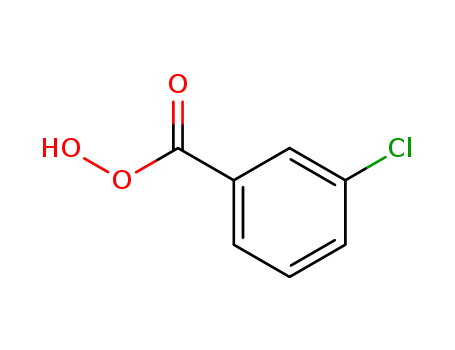
The research aimed to develop a one-pot method for converting α-aminoesters to α-ketoesters, which are valuable intermediates for enzyme inhibitor design studies. The process involved the oxidation of diazoesters using peracid, specifically m-chloroperbenzoic acid (MCPBA). The study built upon previous work by Curci and co-workers on the conversion of α-diazoketones to α-diketones and Takamura's method for converting α-aminoesters to α-diazoesters using isoamylnitrite in the presence of acetic acid. The researchers found that by replacing isoamyl nitrite with t-butyl nitrite, they could achieve a cleaner α-ketoester due to the easier removal of t-butanol. The one-pot procedure involved treating the diazotization mixture with MCPBA to directly afford the α-ketoester, avoiding the need to isolate the intermediate α-diazoesters. The study concluded that while the reaction had certain limitations, it provided a facile route for converting α-aminoesters to α-ketoesters in applicable cases. Chemicals used in the process included α-aminoesters, isoamylnitrite, t-butyl nitrite, acetic acid, and m-chloroperbenzoic acid (MCPBA).
10.1016/S0040-4039(00)96594-8
The research focuses on the development of two novel synthetic methods for the preparation of heterocyclic quinones, specifically benzofuranquinones and benzopyranquinone. The purpose of this study was to address the scarcity of methods for accessing benzoheterocyclique compounds, which are less common compared to naphtoquinones due to their stability. The researchers utilized an orthoquinonic synthon as a starting point and employed reactions such as nucleophilic substitution, sigmatropic rearrangements, and intramolecular cyclization to synthesize the target compounds. Key chemicals used in the process include octen-1-ol-3, diaza-1,8-bicycle 5,4,0 undecene-7 (DBU), meta-chloroperbenzoic acid (AMCPB), and chloro-1 nonen-1,E of-3 (N). The conclusions drawn from the study highlight the effectiveness of the synthetic strategies, which involve intramolecular reactions, in obtaining heterocyclic compounds that are difficult or impossible to synthesize using classical methods. These new methods are expected to facilitate the total syntheses of numerous natural heterocyclic compounds with quinonoid structures.
10.1021/jo501985u
The research focuses on the development of a direct, metal-free α-hydroxylation method for α-unsubstituted β-oxoesters and β-oxoamides, utilizing m-chloroperbenzoic acid (mCPBA) as the oxidant. This method provides a straightforward and mild reaction condition approach to synthesize important α-hydroxy-β-dicarbonyl compounds, which are prevalent in antibiotics and serve as key intermediates in the synthesis of various pharmaceuticals. The study also explores the conversion of these hydroxylated products into vicinal tricarbonyl compounds (VTCs), valuable synthetic precursors for numerous biological targets. The researchers concluded that the direct metal-free α-oxidation of α-unsubstituted β-dicarbonyl compounds was successfully achieved, offering a new and efficient route to α-hydroxylated β-oxoesters and β-oxoamides. The method's advantages include the ready availability of substrates, high atom economy, and the efficient conversion of α-hydroxy-β-dicarbonyl products into VTCs using Cu(OAc)2 under mild conditions, making it a useful tool for synthesizing polyfunctionalized compounds in organic and medicinal chemistry.
10.1021/jo9012783
The research presents a study on the ammonium-directed oxidation of cyclic allylic and homoallylic amines, with the aim of investigating the functionalization of a range of allylic 3-(N,N-dibenzylamino)cycloalk-1-enes using m-CPBA in the presence of Cl3CCO2H. The purpose of this study was to explore substrate-directed transformations, specifically the olefinic oxidation of allylic amines, which are valuable in synthetic processes. The researchers concluded that this oxidation methodology is general for a range of cyclic (5-, 7-, and 8-membered ring) allylic amines, yielding exclusively the corresponding syn-epoxide for the 5-membered ring, the anti-epoxide for the 8-membered ring, and predominantly the anti-epoxide for the 7-membered ring with high levels of diastereoselectivity. The oxidation products, which are versatile synthetic intermediates, can be readily transformed into a range of amino diols. Key chemicals used in the process include m-CPBA (meta-chloroperoxybenzoic acid), Cl3CCO2H (trichloroacetic acid), and a variety of cyclic amines and homoallylic amines.
10.1002/1615-4169(200108)343:6/7<618::AID-ADSC618>3.0.CO;2-E
The research focuses on the synthesis of both enantiomers of levoglucosenone from acrolein dimer using lipase-mediated kinetic hydrolysis. The purpose of this study was to develop an efficient method for the synthesis of levoglucosenone, a chiral building block with high chemical potential, which is utilized in the construction of various optically active compounds. The researchers concluded that they had successfully developed a new route to racemic levoglucosenone and its resolution into both enantiomers of enantiopure levoglucosenone. Key chemicals used in the process included acrolein dimer, sodium borohydride, vinyl acetate, p-toluenesulfonic acid, m-chloroperbenzoic acid, o-iodoxybenzoic acid, and various lipases for the enzymatic resolution steps. The synthesis involved several steps, including reduction, oxidative acetalization, Swern oxidation, and dehydrogenation, ultimately leading to the desired enantiomers of levoglucosenone.
10.1080/14786419.2015.1075525
The research focuses on the utilization of hydrotalcite catalysis for the synthesis of novel chiral building blocks, specifically lactones 7 and 8, derived from carvone. The methodology involves a regioselective Baeyer–Villiger reaction using hydrogen peroxide as the oxidant and hydrotalcites as catalysts, which is considered green due to the lack of by-products other than water. The study compares different reaction conditions, including the use of AlCl3 and meta-chloroperbenzoic acid (m-CPBA) as oxidants, and evaluates the efficiency of the catalysts in terms of yield and selectivity. Reactants such as carvone, benzonitrile, and various catalysts were used, and the progress of reactions was monitored by thin-layer chromatography (TLC). Analyses of the synthesized compounds were conducted using techniques like infrared spectroscopy (IR), nuclear magnetic resonance (NMR), and high-resolution mass spectrometry (HRMS) to determine their structures and confirm their formation.
10.1002/rcm.8757
The study focused on the bioinspired oxidation of the flavonoids orientin and isoorientin, which are C-glycosidic flavonoids found in certain plant species, including Passiflora edulis var. flavicarpa. The aim was to evaluate and characterize the in vitro metabolism of these flavonoids by simulating phase I biotransformation reactions using Salen complexes as catalysts. The chemicals used in the study included m-chloroperbenzoic acid (m-CPBA) and iodozylbenzene (PhIO) as oxidants, and the Jacobsen catalyst or [Mn(3-MeOSalen)Cl] as catalysts. The [Mn(3-MeOSalen)Cl] catalyst was synthesized and characterized by spectrometric techniques. The study utilized UPLC-DAD and HPLC/MS/MS to monitor and analyze the oxidation reactions and products, which are crucial for understanding the potential pharmacological and toxicological properties of these compounds, thus aiding in the safe use of plant products containing orientin as a chemical marker.
10.1246/cl.1987.875
The research focuses on the synthesis of optically active Litsenolide C, a natural product with significant bioactivity, derived from the Lauraceae family. The purpose of the study was to develop a new synthetic strategy that would establish the required absolute configuration at C(3) and C(4) of 3-hydroxy-4-valerolactone through diastereoface differentiation reaction of acrylate α-anion equivalent with (R)-(+)-2-tert-butyldimethylsilyloxypropanal (1), and to form the C(2)-C(3) bond by erythro selective reaction of the aldehyde with lithium enolate derived from 2-(phenylthio)ester. The key chemicals used in the process included methyl 2-(phenylthio)hexadecanoate, (R)-(+)-2-tert-butyldimethylsilyloxypropanal, lithium diisopropylamide (LDA), diethylaluminum chloride, and m-chloroperbenzoic acid. The conclusions of the research were that the synthesis of Litsenolide C was successfully achieved with a yield of approximately 40% based on the aldehyde 1, and the method demonstrated high chemical yield, a specific erythro/threo ratio for the formed C-C bond, and non-chelation-controlled stereoselectivity in the diastereoface differentiation reaction.
10.1246/cl.1994.1491
The study investigates the formation and characterization of high valent iron porphyrin species derived from iron(III) meso-tetra-(pentafluorophenyl)porphyrin (TPFP). The researchers used m-chloroperoxybenzoic acid (mCPBA) to oxidize the perchlorate iron(III) complex of TPFP, resulting in the formation of an oxo iron(IV) porphyrin -cation radical. This species was characterized by low-temperature UV-vis absorption spectra, proton NMR, and ESR, revealing its unique spectroscopic properties compared to other known iron porphyrin species. The study also explored the potential formation of iron(V) porphyrin from the oxo iron(IV) porphyrin -cation radical of TPFP but found that the addition of methanol led to a reduction back to the iron(III) porphyrin complex. The findings suggest that the strong electron-withdrawing power of the pentafluorophenyl group in TPFP influences the stability and reactivity of the high valent iron porphyrin species.


 O,
O, Xi,
Xi, C
C


