Welcome to LookChem.com Sign In|Join Free
  • or

Encyclopedia

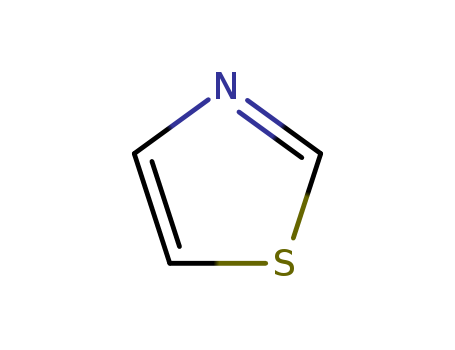
Thiazole

Base Information
  • Chemical Name:Thiazole
  • CAS No.:288-47-1
  • Deprecated CAS:857224-45-4
  • Molecular Formula:C3H3NS
  • Molecular Weight:85.1295
  • Hs Code.:29341000
  • European Community (EC) Number:206-021-3
  • UN Number:1993
  • UNII:320RCW8PEF
  • DSSTox Substance ID:DTXSID2059776
  • Nikkaji Number:J26D
  • Wikipedia:Thiazole
  • Wikidata:Q413426
  • Metabolomics Workbench ID:44003
  • ChEMBL ID:CHEMBL15605
  • Mol file:288-47-1.mol
Thiazole

Synonyms:Thiazole;Thiazoles

Suppliers and Price of Thiazole
Supply Marketing:
Business phase:
The product has achieved commercial mass production*data from LookChem market partment
Manufacturers and distributors:
  • Manufacture/Brand
  • Chemicals and raw materials
  • Packaging
  • price
  • TRC
  • Thiazole
  • 100mg
  • $ 60.00
  • TRC
  • Thiazole
  • 50mg
  • $ 45.00
  • TCI Chemical
  • Thiazole >98.0%(GC)
  • 5g
  • $ 24.00
  • TCI Chemical
  • Thiazole >98.0%(GC)
  • 25g
  • $ 70.00
  • SynQuest Laboratories
  • Thiazole
  • 5 g
  • $ 76.00
  • SynQuest Laboratories
  • Thiazole
  • 25 g
  • $ 125.00
  • Sigma-Aldrich
  • Thiazole 99%
  • 1g
  • $ 37.90
  • Sigma-Aldrich
  • Thiazole ≥99%
  • 1 SAMPLE-K
  • $ 50.00
  • Sigma-Aldrich
  • Thiazole ≥99%
  • sample-k
  • $ 50.00
  • Sigma-Aldrich
  • Thiazole 99%
  • 5g
  • $ 119.00
Total 113 raw suppliers
Chemical Property of Thiazole
Chemical Property:
  • Appearance/Colour:colourless or pale yellow liquid 
  • Vapor Pressure:21.6mmHg at 25°C 
  • Melting Point:-33 °C 
  • Refractive Index:n20/D 1.538(lit.)  
  • Boiling Point:116.5 °C at 760 mmHg 
  • PKA:2.44(at 20℃) 
  • Flash Point:26 ºC 
  • PSA:41.13000 
  • Density:1.18 g/cm3 
  • LogP:1.14310 
  • Storage Temp.:Flammables area 
  • Sensitive.:Air & Light Sensitive 
  • Water Solubility.:slightly soluble 
  • XLogP3:0.4
  • Hydrogen Bond Donor Count:0
  • Hydrogen Bond Acceptor Count:2
  • Rotatable Bond Count:0
  • Exact Mass:84.99862027
  • Heavy Atom Count:5
  • Complexity:30.1
  • Transport DOT Label:Combustible Liquid
Purity/Quality:

99% *data from raw suppliers

Thiazole *data from reagent suppliers

Safty Information:
  • Pictogram(s): HarmfulXn, Flammable
  • Hazard Codes:Xn,F 
  • Statements: 10-22-37/38-41 
  • Safety Statements: 16-26-39 
MSDS Files:

SDS file from LookChem

Total 1 MSDS from other Authors

Useful:
  • Chemical Classes:Nitrogen Compounds -> Thiazoles
  • Canonical SMILES:C1=CSC=N1
  • General Description Thiazole, also known as 3-Azathiophene, is a heterocyclic compound featuring a five-membered ring containing both sulfur and nitrogen atoms. It serves as a key structural motif in various pharmacologically active compounds and coordination complexes, demonstrating versatile reactivity in synthetic chemistry, such as participating in metal-assisted condensation reactions and forming derivatives with potential anti-inflammatory and analgesic properties.
Technology Process of Thiazole

There total 66 articles about Thiazole which guide to synthetic route it. The literature collected by LookChem mainly comes from the sharing of users and the free literature resources found by Internet computing technology. We keep the original model of the professional version of literature to make it easier and faster for users to retrieve and use. At the same time, we analyze and calculate the most feasible synthesis route with the highest yield for your reference as below:

synthetic route:
Guidance literature:
With 4 A molecular sieve; In toluene; at 130 ℃; for 14h; Product distribution; Mechanism; elimination of thiazole from thiazolylketofuranoses and -ketopyranoses; no reaction with 1-O-acetyl and 1-O-trimethylsilyl derivatives, thiazolyl alcohols; no elimination of furyl- and thienyl-group;
DOI:10.3987/COM-98-8154
Guidance literature:
With hydrogen; sodium acetate; palladium on activated charcoal; In methanol; at 23 ℃; for 12h;
DOI:10.1080/00397919508011485
Guidance literature:
With hydrogen; sodium acetate; palladium on activated charcoal; In methanol; at 23 ℃; for 12h;
DOI:10.1080/00397919508011485
Refernces

New platinum(II) and palladium(II) quinoline-imine-pyridine, quinoline-imine-thiazole and quinoline-imine-imidazole complexes by metal-assisted condensation reactions

10.1016/j.jorganchem.2011.03.046

The research focuses on the synthesis and reactivity of platinum(II) and palladium(II) complexes with tridentate N-donor ligands containing different heterocycles, such as pyridine, thiazole, and imidazole. The metal-assisted condensation reactions between 8-aminoquinoline and various aldehydes or ketones were utilized to prepare these complexes, which were then subjected to preliminary reactivity studies involving the coordinated tridentate N-donors, the chloro-ligand, and the M-CH3 bond. Reactants included 8-aminoquinoline, ortho-substituted aldehydo- or keto- N-heterocycles, and metal precursors like PtClMe(COD) and PdClMe(COD). The analyses used to characterize the complexes were elemental analysis, conductivity measurements, infrared (IR) spectroscopy, nuclear magnetic resonance (NMR) spectroscopy, and theoretical calculations using density functional theory (DFT). These techniques provided comprehensive insights into the structure, electronic properties, and reactivity of the synthesized complexes.

Reactions with 4-(cyanoacetyl)phenazone: Synthesis of novel thiazole, hydrazinopyrazole and pyrazolo[5.1-c][1.2.4]triazine derivatives

10.1002/ardp.19873200311

The research focuses on the synthesis of novel thiazole, hydrazinopyrazole, and pyrazolo[5.1-c][1.2.4]triazine derivatives through the reaction of mercaptoacetic acid with 4-(cyanoacetyl)phenazone. The study investigates the behavior of the synthesized thiazolol towards diazonium salts, aldehydes, and hydrazines, and reports on the preparation of a pyrazolo[5.1-c][1.2.4]triazine derivative of phenazone by coupling diazotized 5-amino-3-phenazonylpyrazole with 2-phenacylthiazol-4-ol. The purpose of this research is to explore the chemical properties and potential pharmacological applications of phenazone derivatives, which are known for their anti-inflammatory, analgesic, sedative, and antipyretic properties. The chemicals used in the process include 4-(cyanoacetyl)phenazone, mercaptoacetic acid, diazonium salts, aldehydes, hydrazines, and various other reagents for the synthesis and characterization of the new compounds. The conclusions drawn from the research include the successful synthesis of several stable 2-thiazolin-4-ones and the establishment of their structures through spectroscopic data, as well as the observation of specific reactivity patterns towards different reagents.


Post a RFQ

Enter 15 to 2000 letters.Word count: 0 letters

Attach files(File Format: Jpeg, Jpg, Gif, Png, PDF, PPT, Zip, Rar,Word or Excel Maximum File Size: 3MB)

1 Customer Service

What can I do for you?
Get Best Price

Get Best Price for 288-47-1