10.1016/j.tetasy.2008.09.028
The research aims to achieve a comprehensive understanding of the olfactory properties of the various isomers of Iralia?, an artificial violet odorant. The study focuses on the regioselective synthesis of methyl-ionone isomers (β- and γ-Iralia? isomers) and the preparation of their enantiomers using enzyme-mediated resolution. Key chemicals used in the research include citral, sulfuric acid, lithium aluminum hydride, manganese dioxide, and various reagents for specific reactions such as Horner–Emmons reaction and epoxidation. The researchers also used lipase PS for the resolution of racemic alcohols to obtain enantiomerically enriched forms. The absolute configuration of the enantiomers was determined by chemical correlation with known α-isomers. The synthesized isomers were evaluated by professional perfumers to describe their distinct olfactory profiles. The conclusions highlight that all isomeric forms exhibit unique olfactory characteristics, and structural modifications within the ionone framework significantly impact the odor, emphasizing the importance of precise chemical structure in fragrance design.
10.1006/jcat.1999.2803
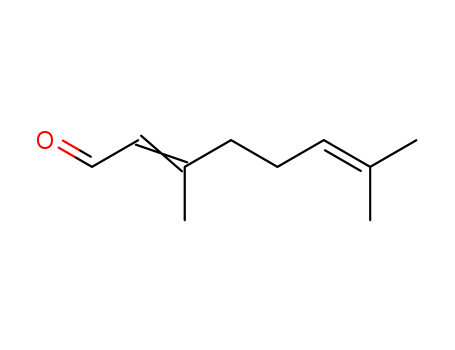
The research investigates the liquid-phase hydrogenation of citral over Pt/SiO2 catalysts, aiming to understand the effects of temperature on the reaction's activity and selectivity. Citral, an a,?-unsaturated aldehyde with a conjugated C==C-C==O bond system and an isolated C==C bond, is hydrogenated to produce various products like unsaturated alcohols (UALC), partially saturated aldehydes (PSALD), and completely saturated alcohols (SAT). The study finds that the reaction rate exhibits an unusual activity minimum at 373 K, attributed to the interplay between the decomposition of unsaturated alcohols (geraniol and nerol) and the desorption of CO. At lower temperatures (298 K), the reaction rate decreases significantly due to CO accumulation blocking active sites, while at higher temperatures (373 K and above), the enhanced CO desorption rate allows for stable activity and conventional Arrhenius behavior. The researchers propose a kinetic model based on Langmuir–Hinshelwood kinetics, incorporating dissociative adsorption of hydrogen, competitive adsorption between hydrogen and organic compounds, and the addition of a second hydrogen atom as the rate-determining step. The model successfully describes the observed product distributions and the unusual temperature dependence of the reaction rate.


 Xi
Xi


