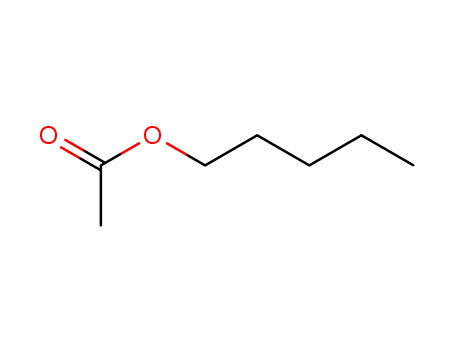
Chemical Property of Pentyl acetate
Chemical Property:
- Appearance/Colour:Clear colorless liquid
- Vapor Pressure:4 mm Hg ( 20 °C)
- Melting Point:-100 °C(lit.)
- Refractive Index:n20/D 1.402(lit.)
- Boiling Point:149.9 °C at 760 mmHg
- Flash Point:23.9 °C
- PSA:26.30000
- Density:0.876 g/cm3
- LogP:1.73970
- Storage Temp.:Flammables area
- Solubility.:10g/l
- Water Solubility.:10 g/L (20 ºC)
- XLogP3:1.9
- Hydrogen Bond Donor Count:0
- Hydrogen Bond Acceptor Count:2
- Rotatable Bond Count:5
- Exact Mass:130.099379685
- Heavy Atom Count:9
- Complexity:79
- Transport DOT Label:Flammable Liquid
- Purity/Quality:
-
99% *data from raw suppliers
Amyl Acetate >99.0%(GC) *data from reagent suppliers
Safty Information:
- Pictogram(s):
 Xi
Xi
- Hazard Codes:Xi
- Statements:
10-66
- Safety Statements:
23-25-24/25
- MSDS Files:
-
SDS file from LookChem
Total 1 MSDS from other Authors
Useful:
- Chemical Classes:Solvents -> Esters (
- Canonical SMILES:CCCCCOC(=O)C
- Inhalation Risk:A harmful contamination of the air will be reached rather slowly on evaporation of this substance at 20 °C.
- Effects of Short Term Exposure:The substance is irritating to the eyes, skin and respiratory tract. Exposure at high levels could cause lowering of consciousness.
- Effects of Long Term Exposure:The substance defats the skin, which may cause dryness or cracking.
-
Physical properties
Colorless liquid with a sweet, banana-like odor. A detection odor threshold concentration of 275
μg/m3 (52 ppbv) was reported by Punter (1983). Cometto-Mu?iz and Cain (1991) reported an
average nasal pungency threshold concentration of 1,650 ppmv.
-
Uses
Banana essence. Used as test odorant in studies of olfactory function and in studies of the psychosocial effects of odor. A colorless liquid made by adding sulfuric acid to a mixture
of amyl alcohol and acetic acid with subsequent recovery
by distillation. It is slightly soluble in water but insoluble
in alcohol. Amyl acetate was used as one of the solvents
in making celluloid film and as fuel for the Alteneck lamp,
adopted as the standard light in sensitometry by the International
Congress of Photography in 1889. n-Amyl acetate is used as a solvent forlacquers and paints; in fabrics’ printing; innail polish; and as a flavoring agent.