Refernces
10.1248/cpb.29.3158
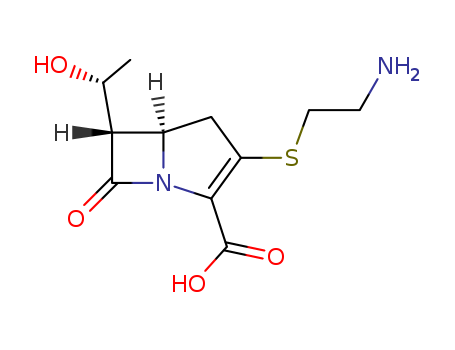
The research focuses on the synthesis and antibacterial activities of "1-thiathienamycin" and related compounds, which are part of the 2-(alkylthio)penem-3-carboxylic acid family. The purpose of this study was to determine if the hydroxyethyl group at the C-6 position, the natural side chain of thienamycin, would enhance the antibacterial potency of the parent penems. The researchers synthesized optically active "1-thiathienamycin" and other (hydroxyethyl)penemcarboxylic acids from 8R and 8S azetidinones via an intramolecular Wittig reaction of the trithiocarbonatephosphoranes. The study concluded that the introduction of the C-6 hydroxyethyl group generally increased activity against β-lactamase-producing strains, and the 8R trans diastereomers showed far more potent activity than the corresponding 8S trans diastereomers. Notably, the 8R penems with the amino function in the side chain exhibited outstanding anti-Pseudomonas activity. Chemicals used in the process included 2-(alkylthio)penem-3-carboxylic acids, azetidinones, trithiocarbonates, phosphoranes, and various reagents for the intramolecular Wittig reaction and subsequent transformations.
10.1248/cpb.34.1434
The research focuses on the formal total synthesis of thienamycin, a carbapenem antibiotic, from 4-propargyl-2-azetidinone. The purpose of the study was to develop a mild and efficient method for converting propiolic esters to β-keto esters, which are key intermediates in the synthesis of carbapenem β-lactams. The researchers successfully accomplished this by initially converting propiolic esters to β-phenylthio-α,β-unsaturated esters, treating them with N-bromoacetamide (NBA) in an aqueous solvent, and then reductively debromination with an aqueous solution of sodium sulfite, yielding β-ketoesters in good yields. This new method was applied to several substrates containing acid- or base-sensitive functionalities, demonstrating its effectiveness compared to existing methods.
10.1016/S0040-4039(01)81957-2
The study presents a novel, high-yield synthesis of the 1-carbapenam ring system, a precursor to thienamycin and clavulanic acid analogs. The entire carbon framework is introduced in a single step from simple precursors. Benzyl sorbate is isomerized to 3,5-hexadienoate, which reacts with chlorosulfonyl isocyanate to form B-lactam. This compound is then converted to an iodo-hydrin, reduced to an alcohol, and oxidized to a ketoester. The ketoester undergoes diazo group transfer and rhodium-catalyzed ring closure to form the final product. The study also explores the synthesis of o-nitrobenzyl ester derivatives and attempts to convert these compounds to the corresponding acids, though these attempts were unsuccessful due to decomposition. The synthesized compounds are analyzed using various techniques, including IR, NMR, and mass spectrometry.