Welcome to LookChem.com Sign In|Join Free
  • or

Encyclopedia

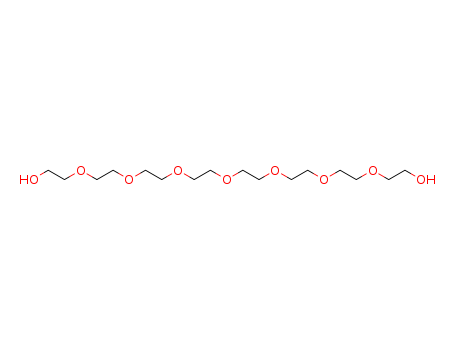
Octaethylene glycol

Base Information
  • Chemical Name:Octaethylene glycol
  • CAS No.:5117-19-1
  • Molecular Formula:C16H34O9
  • Molecular Weight:370.441
  • Hs Code.:2909499000
  • European Community (EC) Number:225-856-4
  • DSSTox Substance ID:DTXSID3058618
  • Nikkaji Number:J97.000J
  • Wikidata:Q27120582
  • Metabolomics Workbench ID:56585
  • Mol file:5117-19-1.mol
Octaethylene glycol

Synonyms:Octaethylene glycol;5117-19-1;3,6,9,12,15,18,21-Heptaoxatricosane-1,23-diol;Octanethyl glycol;HO-PEG8-OH;2-[2-[2-[2-[2-[2-[2-(2-hydroxyethoxy)ethoxy]ethoxy]ethoxy]ethoxy]ethoxy]ethoxy]ethanol;C16H34O9;EINECS 225-856-4;MFCD00698694;12034-81-0;PE8;PED-diol (n=8);Octa-ethylene glycol;4gs9;PEG8;PEG-8;SCHEMBL45160;DTXSID3058618;CHEBI:44794;AMY19030;BCP33115;AKOS015839805;C16-H34-O9;HY-W050087;SB67136;s10681;AS-19695;BP-21369;SY024582;LS-191709;CS-0031650;FT-0635546;O0295;EN300-1590283;A829142;A871353;J-511381;Q27120582;3,6,9,12,15,18,21-Heptaoxatricosane-21,23-diol;2-[2-[2-[2-[2-[2-[2-(2-hydroxyethyloxy)ethoxy]ethoxy]ethoxy]ethoxy]ethoxy]ethoxy]ethanol

Suppliers and Price of Octaethylene glycol
Supply Marketing:
Business phase:
The product has achieved commercial mass production*data from LookChem market partment
Manufacturers and distributors:
  • Manufacture/Brand
  • Chemicals and raw materials
  • Packaging
  • price
  • TRC
  • Octaethylene glycol
  • 1g
  • $ 120.00
  • TCI Chemical
  • Octaethylene Glycol >96.0%(GC)
  • 5g
  • $ 438.00
  • TCI Chemical
  • Octaethylene Glycol >96.0%(GC)
  • 1g
  • $ 136.00
  • SynQuest Laboratories
  • Octanethyl glycol
  • 1 g
  • $ 220.00
  • Sigma-Aldrich
  • Octaethylene glycol ≥95% (oligomer purity)
  • 5g-f
  • $ 442.00
  • Sigma-Aldrich
  • Octaethylene glycol ≥95% (oligomer purity)
  • 1g-f
  • $ 127.00
  • purepeg
  • Octaethylene glycol min.97%
  • 5 g
  • $ 310.00
  • Medical Isotopes, Inc.
  • Octaethylene glycol
  • 10 g
  • $ 1380.00
  • Medical Isotopes, Inc.
  • Octaethylene glycol
  • 1 g
  • $ 610.00
  • Matrix Scientific
  • 3,6,9,12,15,18,21-Heptaoxatricosane-1,23-diol 95+%
  • 500mg
  • $ 103.00
Total 83 raw suppliers
Chemical Property of Octaethylene glycol
Chemical Property:
  • Vapor Pressure:7.16E-11mmHg at 25°C 
  • Melting Point:22 °C 
  • Refractive Index:1.462 
  • Boiling Point:471.5 °C at 760 mmHg 
  • PKA:14.06±0.10(Predicted) 
  • Flash Point:239 °C 
  • PSA:105.07000 
  • Density:1.115 g/cm3 
  • LogP:-0.91280 
  • Storage Temp.:-20°C 
  • XLogP3:-2.2
  • Hydrogen Bond Donor Count:2
  • Hydrogen Bond Acceptor Count:9
  • Rotatable Bond Count:22
  • Exact Mass:370.22028266
  • Heavy Atom Count:25
  • Complexity:210
Purity/Quality:

97% *data from raw suppliers

Octaethylene glycol *data from reagent suppliers

Safty Information:
  • Pictogram(s):  
  • Hazard Codes: 
MSDS Files:

SDS file from LookChem

Total 1 MSDS from other Authors

Useful:
  • Canonical SMILES:C(COCCOCCOCCOCCOCCOCCOCCO)O
  • Description Octanethylene glycol is a polymer consisting of ethylene glycol monomers and two terminal hydroxyl groups. The PEG chain increases the water solubility of a compound in aqueous media. Increasing the number of ethylene glycol units within the entire chain improves the solubility properties of the PEG linker.
  • Uses Octaethylene Glycol is part of a leaf extract (Murdannia Bracteata) which was shown to exhibit antioxidant, antimicrobial and anti-cancer properties.Octaethylene Glycol also shows potential application as functional hydraulic fluids. Applications may include: bioconjugation, drug delivery, PEG hydrogel, crosslinker, and surface functionalization
Technology Process of Octaethylene glycol

There total 24 articles about Octaethylene glycol which guide to synthetic route it. The literature collected by LookChem mainly comes from the sharing of users and the free literature resources found by Internet computing technology. We keep the original model of the professional version of literature to make it easier and faster for users to retrieve and use. At the same time, we analyze and calculate the most feasible synthesis route with the highest yield for your reference as below:

synthetic route:
Guidance literature:
With hydrogen; palladium on activated charcoal; In methanol; at 60 ℃; for 1.5h; under 75006 Torr;
Guidance literature:
With hydrogen; palladium on activated charcoal; In dichloromethane; at 25 ℃; for 96h; under 3040 Torr;
DOI:10.1021/jo00050a065
Guidance literature:
With water; hydrogenchloride; In 1,4-dioxane; Rate constant; Equilibrium constant; Ambient temperature; effect of alkali-metal chlorides;
DOI:10.1039/P29830001121
Refernces

Synthesis of Enaminone-Pd(II) Complexes and Their Application in Catalysing Aqueous Suzuki-Miyaura Cross Coupling Reaction

10.1002/cjoc.201900417

The research focuses on the synthesis and characterization of a series of Pd(II)-enaminone complexes, termed Pd(eao)2, and their application as catalysts in the aqueous Suzuki-Miyaura cross-coupling reaction. The purpose of this study was to develop an effective catalytic method that enables the coupling of less reactive aryl bromides and chlorides with aryl/vinyl boronic acids in an environmentally benign aqueous medium, specifically using polyethylene glycol (PEG) 400. The conclusions drawn from the research indicate that these newly synthesized Pd(eao)2 complexes, particularly Pd(eao)2-1, exhibit excellent catalytic activity with broad substrate tolerance and high product yields at remarkably low catalyst loadings (as low as 0.5 mol%).

Ring-Substituted y1,2-Bis(4-hydroxyphenyl)ethylenediamine>dichloroplatinum(II) Complexes: Compounds with a Selective Effect on the Hormone-Dependent Mammary Carcinoma

10.1021/jm00396a012

This research aimed to develop platinum complexes with selective effects on hormone-dependent mammary carcinoma by synthesizing and testing [1,2-bis(4-hydroxyphenyl)ethylenediamine]dichloroplatinum(II) complexes with various substituents. The purpose was to create compounds that could target hormone-dependent breast cancer cells, potentially through the estrogen receptor system. The most promising compounds, meso-6-PtCl2 and its water-soluble (sulfato)platinum(II) derivative meso-6-PtS04, showed significant activity on the DMBA-induced, hormone-dependent mammary carcinoma in rats, being more effective than cisplatin and the related ligand meso-6. The research concluded that these platinum complexes have potential as therapeutic agents for hormone-dependent breast cancer, possibly due to a combination of cytotoxic and estrogenic properties. The chemicals used in the process included various substituted 1,2-bis(4-hydroxyphenyl)ethylenediamines, platinum salts, and solvents like t-BuOH, H2O, DMF, and polyethylene glycol 400, as well as reagents for the synthesis and testing of the complexes.

Behaviour of the gem-cyano-ethoxycarbonyl cyclohexane, thiopyran and pyran derivatives with sodium borohydride and lithium aluminium hydride

10.1016/S0040-4020(01)87766-8

The research investigates the behavior of gem-cyano-ethoxycarbonyl compounds (la-c and 7) when treated with sodium borohydride (NaBH4) and lithium aluminium hydride (LiAlH4). The purpose is to explore the reduction reactions of these compounds and understand the resulting products and their conformations. The study found that treating la-c with NaBH4 in solvents like 2-propanol or PEG-400 led to the reduction of the ethoxycarbonyl group and reductive deacetylation, yielding compounds 2a-c and 3a-b. When la-c and 7 were treated with NaBH4-CoCl2, selective reduction of the cyano group to an aminomethyl group occurred, with an acetyl group migrating to the aminomethyl group. Reduction with LiAlH4 followed by acetylation produced gem-aminomethyl-hydroxymethyl compounds 6a-c and 11. The study concluded that the preferred conformations of the resulting compounds depend on the spatial arrangement of the acetoxy groups, with compounds like 4a-b, 5a-b, and 6a-b showing equatorial disposition, while others like 4c, 5c, and 6c preferred axial disposition. The findings provide insights into the reactivity and structural preferences of these compounds under different reducing conditions.

Cu-catalyzed coupling-cyclization in PEG 400 under ultrasound: A highly selective and greener approach towards isocoumarins

10.1039/c3ra40969d

The study explores a CuI–K2CO3-PEG 400 catalytic system for the ultrasound-mediated coupling-cyclization of o-iodobenzoic acid with terminal alkynes to synthesize 3-substituted isocoumarins. This method is highlighted as a greener and more selective alternative to traditional approaches. The CuI acts as the catalyst, K2CO3 serves as the base, and PEG 400 functions both as a solvent and a ligand, facilitating the formation of isocoumarins with high regioselectivity. The process avoids the use of expensive or toxic palladium catalysts and harmful organic solvents, making it a more sustainable and practical option for producing isocoumarins, which have significant pharmacological interest.


Post a RFQ

Enter 15 to 2000 letters.Word count: 0 letters

Attach files(File Format: Jpeg, Jpg, Gif, Png, PDF, PPT, Zip, Rar,Word or Excel Maximum File Size: 3MB)

1 Customer Service

What can I do for you?
Get Best Price

Get Best Price for 5117-19-1