Welcome to LookChem.com Sign In|Join Free
  • or

Encyclopedia

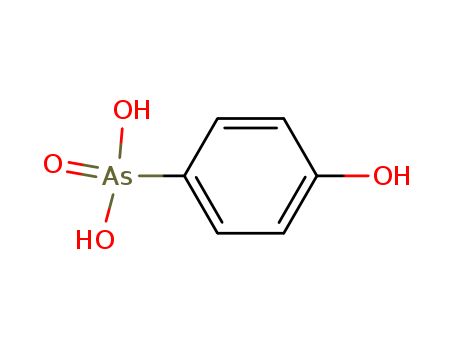
Oxarsanilic acid

Base Information
  • Chemical Name:Oxarsanilic acid
  • CAS No.:98-14-6
  • Molecular Formula:C6H7 As O4
  • Molecular Weight:218.041
  • Hs Code.:2836400000
  • European Community (EC) Number:202-641-3
  • NSC Number:1943
  • UNII:L49V552V77
  • DSSTox Substance ID:DTXSID00243359
  • Nikkaji Number:J54.495G
  • Wikidata:Q27282689
  • Mol file:98-14-6.mol
Oxarsanilic acid

Synonyms:4-Hydroxyphenylarsonic acid;98-14-6;Oxarsanilic acid;(4-Hydroxyphenyl)arsonic acid;4-Hydroxybenzenearsonic acid;Arsonic acid, (4-hydroxyphenyl)-;p-Hydroxybenzenearsonic acid;Phenol-p-arsonic acid;(p-Hydroxyphenyl)arsonic acid;Phenol-para-arsonic acid;Benzenearsonic acid, p-hydroxy-;para-Hydroxyphenylarsonic acid;p-Hydroxyphenylarsonic acid;NSC 1943;EINECS 202-641-3;BRN 2936785;UNII-L49V552V77;AI3-14867;NSC-1943;L49V552V77;DTXSID00243359;4-16-00-01187 (Beilstein Handbook Reference);C6H7AsO4;C6-H7-As-O4;SCHEMBL3056859;WLN: Q-AS-QO & R DQ;DTXCID50165850;NSC1943;1-decyl-1-oxido-piperidin-1-ium;MFCD00045707;AKOS015856390;LS-29094;H0201;D90814;A845819;Q27282689

Suppliers and Price of Oxarsanilic acid
Supply Marketing:
Business phase:
The product has achieved commercial mass production*data from LookChem market partment
Manufacturers and distributors:
  • Manufacture/Brand
  • Chemicals and raw materials
  • Packaging
  • price
  • TRC
  • 4-Hydroxyphenylarsonic Acid
  • 250mg
  • $ 45.00
  • TCI Chemical
  • 4-Hydroxyphenylarsonic Acid >98.0%(T)
  • 25g
  • $ 214.00
  • Chem-Impex
  • 4-Hydroxyphenylarsonicacid,≥98%(Assaybytitration) ≥98%(Assaybytitration)
  • 25G
  • $ 257.42
  • American Custom Chemicals Corporation
  • 4-HYDROXYPHENYLARSONIC ACID 95.00%
  • 25G
  • $ 1187.16
  • AK Scientific
  • 4-Hydroxyphenylarsonic Acid
  • 25g
  • $ 371.00
Total 27 raw suppliers
Chemical Property of Oxarsanilic acid
Chemical Property:
  • Vapor Pressure:4.68E-12mmHg at 25°C 
  • Melting Point:177.5°C (rough estimate) 
  • Boiling Point:529.9 °C at 760 mmHg 
  • PKA:pK1:3.89;pK2:8.37(phenol);pK3:10.05 (25°C) 
  • Flash Point:288.3 °C 
  • PSA:77.76000 
  • Density:g/cm3 
  • LogP:-1.04680 
  • Storage Temp.:Refrigerator 
  • Solubility.:Water (Slightly) 
  • Water Solubility.:almost transparency 
  • Hydrogen Bond Donor Count:3
  • Hydrogen Bond Acceptor Count:4
  • Rotatable Bond Count:1
  • Exact Mass:217.956028
  • Heavy Atom Count:11
  • Complexity:167
Purity/Quality:

97% *data from raw suppliers

4-Hydroxyphenylarsonic Acid *data from reagent suppliers

Safty Information:
  • Pictogram(s):  
  • Hazard Codes: 
  • Statements: 22-50/53 
  • Safety Statements: 22-36/37/39 
MSDS Files:

SDS file from LookChem

Useful:
  • Chemical Classes:Metals -> Arsenic Compounds, Organic
  • Canonical SMILES:C1=CC(=CC=C1O)[As](=O)(O)O
  • Uses 4-Hydroxyphenylarsonic Acid could be useful for synthesizing flower-?like CoFe2O4 particles that are an attractive sorbent for removing aromatic organoarsenicals from wastewater.
Technology Process of Oxarsanilic acid

There total 8 articles about Oxarsanilic acid which guide to synthetic route it. The literature collected by LookChem mainly comes from the sharing of users and the free literature resources found by Internet computing technology. We keep the original model of the professional version of literature to make it easier and faster for users to retrieve and use. At the same time, we analyze and calculate the most feasible synthesis route with the highest yield for your reference as below:

synthetic route:
Guidance literature:
With sulfuric acid; Diazotization.Verkochen der entstandenen Diazoloesung bei ca.70grad;
Refernces

Reactivity studies of rhodium(III) porphyrins with methanol in alkaline media

10.1021/om801029k

The research investigates the reaction of Rhodium(III) porphyrins (specifically Rh(ttp)Cl) with methanol in the presence of inorganic bases at high temperatures (150 °C) to produce rhodium porphyrin methyls (Rh(ttp)CH3) with high yields (up to 87%). The study aims to understand the carbon-hydrogen bond activation chemistry of rhodium porphyrins and to explore the conditions under which methanol can react with these complexes to aid in the design of catalysts for catalytic methane oxidation. The key findings suggest that Rh(ttp)H is the key intermediate for carbon-oxygen bond cleavage, and the role of bases is to facilitate the formation of reactive intermediates and enhance reaction rates. The research concludes that to achieve efficient rhodium porphyrin-based methane oxidation, it would be necessary to either continuously remove methanol or carry out the reaction at lower conversions. The key chemicals used in the research include Rh(ttp)Cl (rhodium(III) tetrakistolylporphyrinato chloride), methanol, various inorganic bases (such as KOH, NaOH, K2CO3, Na2CO3, Potassium bicarbonate (KHCO3), K3PO4, Potassium acetate (KOAc), and Sodium acetate (NaOAc)), and other rhodium porphyrin complexes like Rh(tpp)Cl, Rh(tmp)Cl, and Rh2(ttp)2.

Post a RFQ

Enter 15 to 2000 letters.Word count: 0 letters

Attach files(File Format: Jpeg, Jpg, Gif, Png, PDF, PPT, Zip, Rar,Word or Excel Maximum File Size: 3MB)

1 Customer Service

What can I do for you?
Get Best Price

Get Best Price for 98-14-6