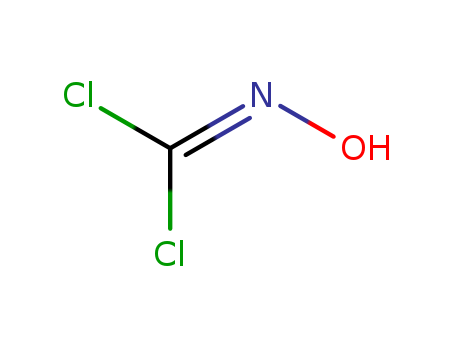
Chemical Property of Phosgene oxime
Chemical Property:
- Vapor Pressure:0.201mmHg at 25°C
- Melting Point:39-40 °C
- Boiling Point:185.1°C at 760 mmHg
- PKA:7.70±0.11(Predicted)
- Flash Point:65.7°C
- PSA:32.59000
- Density:1.66g/cm3
- LogP:1.20920
- XLogP3:2.1
- Hydrogen Bond Donor Count:1
- Hydrogen Bond Acceptor Count:2
- Rotatable Bond Count:0
- Exact Mass:112.9435190
- Heavy Atom Count:5
- Complexity:47.6
- Purity/Quality:
-
Safty Information:
- Pictogram(s):
- Hazard Codes:
- MSDS Files:
-
SDS file from LookChem
Useful:
- Chemical Classes:Toxic Gases & Vapors -> Chemical Weapons
- Canonical SMILES:C(=NO)(Cl)Cl
-
Description
Phosgene oxime is a colourless solid or yellowish-brown liquid with a disagreeable penetrating
odour. Pure phosgene oxime is a colourless, crystalline solid; the munitions grade
compound is a yellowish-brown liquid. Phosgene oxime is soluble in water and organic solvents, but hydrolyses rapidly, and especially in the presence of alkali. Chemically similar
to but more reactive than an amide. Incompatible with strong acids and bases, and
especially incompatible with strong reducing agents such as hydrides. It is also incompatible
with strongly oxidising acids, peroxides, and hydroperoxides. Phosgene oxime
is a very severe blistering agent. Both the liquid and the solid can give off vapours at
ambient temperatures. Phosgene oxime was developed as a potential chemical warfare
agent but has never been known to be used on the battlefield. Phosgene oxime (CX) is an
urticant or nettle agent causing instant intolerable pain, erythema, wheals, and urticaria.
It is very corrosive, capable of causing extensive tissue damage. Phosgene oxime was first
produced by the Germans in 1929 as a possible warfare agent. The mechanism of action
is not fully understood but the lesions produced in the skin are similar to those caused
by a strong acid. Phosgene oxime will penetrate ordinary clothing and surgical gear.
-
Uses
There are no commercial or beneficial uses of phosgene oxime.
It was developed and produced solely as a chemical warfare
agent, but has never been used on the battlefield.