Welcome to LookChem.com Sign In|Join Free
  • or

Encyclopedia

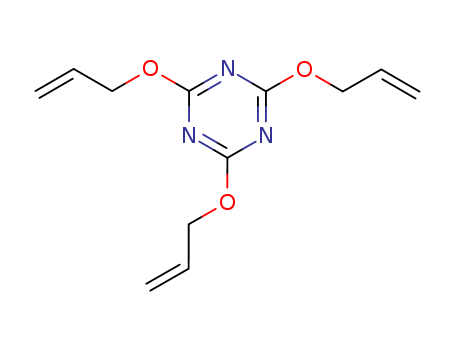
Triallyl cyanurate

Base Information
  • Chemical Name:Triallyl cyanurate
  • CAS No.:101-37-1
  • Deprecated CAS:2368803-30-7
  • Molecular Formula:C12H15N3O3
  • Molecular Weight:249.269
  • Hs Code.:2933 69 80
  • European Community (EC) Number:202-936-7
  • NSC Number:49121,4804
  • UNII:CDD3388O1D
  • DSSTox Substance ID:DTXSID8037754
  • Nikkaji Number:J39.663J
  • Wikidata:Q1894083
  • ChEMBL ID:CHEMBL2145133
  • Mol file:101-37-1.mol
Triallyl cyanurate

Synonyms:2,4,6-tris(allyloxy)-1,3,5-triazine

Suppliers and Price of Triallyl cyanurate
Supply Marketing:
Business phase:
The product has achieved commercial mass production*data from LookChem market partment
Manufacturers and distributors:
  • Manufacture/Brand
  • Chemicals and raw materials
  • Packaging
  • price
  • TRC
  • 2,4,6-Triallyloxy-1,3,5-triazine
  • 250mg
  • $ 45.00
  • TRC
  • 2,4,6-Triallyloxy-1,3,5-triazine
  • 2.5g
  • $ 70.00
  • TRC
  • 2,4,6-Triallyloxy-1,3,5-triazine
  • 500mg
  • $ 55.00
  • TCI Chemical
  • Triallyl Cyanurate >98.0%(GC)
  • 25g
  • $ 24.00
  • TCI Chemical
  • Triallyl Cyanurate >98.0%(GC)
  • 500g
  • $ 119.00
  • Sigma-Aldrich
  • 2,4,6-Tris(allyloxy)-1,3,5-triazine (stabilised) for synthesis
  • 30 kg
  • $ 2100.00
  • Sigma-Aldrich
  • 2,4,6-Tris(allyloxy)-1,3,5-triazine (stabilised) for synthesis. CAS 101-37-1, molar mass 249.27 g/mol., (stabilised) for synthesis
  • 8203599030
  • $ 2030.00
  • Sigma-Aldrich
  • 2,4,6-Triallyloxy-1,3,5-triazine 97%
  • 500g
  • $ 144.00
  • Sigma-Aldrich
  • 2,4,6-Tris(allyloxy)-1,3,5-triazine (stabilised) for synthesis
  • 250 g
  • $ 52.35
  • Sigma-Aldrich
  • 2,4,6-Tris(allyloxy)-1,3,5-triazine (stabilised) for synthesis. CAS 101-37-1, molar mass 249.27 g/mol., (stabilised) for synthesis
  • 8203590006
  • $ 30.00
Total 22 raw suppliers
Chemical Property of Triallyl cyanurate
Chemical Property:
  • Appearance/Colour:colourless solid 
  • Vapor Pressure:4.63E-05mmHg at 25°C 
  • Melting Point:26-28 °C 
  • Refractive Index:1.511 
  • Boiling Point:360.4 °C at 760 mmHg 
  • PKA:2.04±0.10(Predicted) 
  • Flash Point:131.5 °C 
  • PSA:66.36000 
  • Density:1.105 g/cm3 
  • LogP:1.56600 
  • Storage Temp.:Store at 
  • Solubility.:0.3g/l 
  • Water Solubility.:6g/L(20 oC) 
  • XLogP3:2.8
  • Hydrogen Bond Donor Count:0
  • Hydrogen Bond Acceptor Count:6
  • Rotatable Bond Count:9
  • Exact Mass:249.11134135
  • Heavy Atom Count:18
  • Complexity:219
Purity/Quality:

98% *data from raw suppliers

2,4,6-Triallyloxy-1,3,5-triazine *data from reagent suppliers

Safty Information:
  • Pictogram(s): HarmfulXn, Dangerous
  • Hazard Codes:Xn,N 
  • Statements: 22-51/53 
  • Safety Statements: 36-61 
MSDS Files:

SDS file from LookChem

Total 1 MSDS from other Authors

Useful:
  • Chemical Classes:Nitrogen Compounds -> Other Nitrogen Compounds
  • Canonical SMILES:C=CCOC1=NC(=NC(=N1)OCC=C)OCC=C
  • Uses Polymers as monomer and modifier, organic intermediate.
Technology Process of Triallyl cyanurate

There total 6 articles about Triallyl cyanurate which guide to synthetic route it. The literature collected by LookChem mainly comes from the sharing of users and the free literature resources found by Internet computing technology. We keep the original model of the professional version of literature to make it easier and faster for users to retrieve and use. At the same time, we analyze and calculate the most feasible synthesis route with the highest yield for your reference as below:

synthetic route:
Guidance literature:
1,3,5-trichloro-2,4,6-triazine; allyl alcohol; With sodium hydroxide; In water; at -5 - 40 ℃; for 1.25 - 1.5h;
With 4-methoxy-phenol; Product distribution / selectivity;
Refernces

Study of O-allylation using triazine-based reagents

10.1248/cpb.c16-00744

The study focuses on the development and application of acid-catalyzed allylating reagents based on triazine chemistry, specifically 2,4,6-tris(allyloxy)-1,3,5-triazine (TriAT-allyl) and its substituted derivatives. These reagents were used to synthesize allyl ethers and esters from various alcohols and carboxylic acids in the presence of a catalytic amount of trifluoromethanesulfonic acid (TfOH). The purpose of these chemicals is to provide a practical, high-yielding procedure for allylation, which is a method of introducing allyl groups into organic compounds. The allyl group is significant for protecting hydroxy and carboxy groups and can be used as monomer units in macromolecules. The study also explores the reaction mechanisms and the selectivity of the reactions, providing insights into the intermediates involved in the allylation process. The new reagents demonstrated remarkable reactivity, stability, and atom economy, addressing some of the drawbacks of conventional allylation methods such as poor stability, toxicity, and high cost.


Post a RFQ

Enter 15 to 2000 letters.Word count: 0 letters

Attach files(File Format: Jpeg, Jpg, Gif, Png, PDF, PPT, Zip, Rar,Word or Excel Maximum File Size: 3MB)

1 Customer Service

What can I do for you?
Get Best Price

Get Best Price for 101-37-1