Welcome to LookChem.com Sign In|Join Free
  • or

Encyclopedia

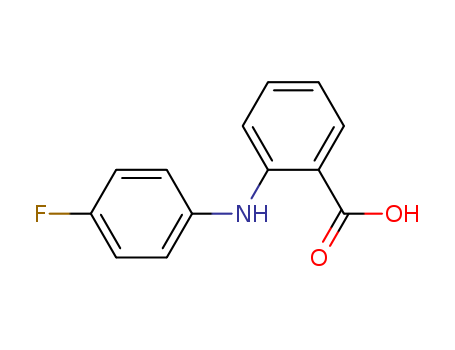
N-(4-Fluorophenyl)anthranilic acid

Base Information
  • Chemical Name:N-(4-Fluorophenyl)anthranilic acid
  • CAS No.:54-60-4
  • Molecular Formula:C13H10FNO2
  • Molecular Weight:231.226
  • Hs Code.:2922499990
  • European Community (EC) Number:688-429-5
  • DSSTox Substance ID:DTXSID20202307
  • Nikkaji Number:J2.726.206F
  • Wikidata:Q83075576
  • Mol file:54-60-4.mol
N-(4-Fluorophenyl)anthranilic acid

Synonyms:N-(4-Fluorophenyl)anthranilic acid;54-60-4;2-(4-Fluoroanilino)benzoic acid;2-[(4-fluorophenyl)amino]benzoic acid;2-((4-Fluorophenyl)amino)benzoic acid;Anthranilic acid, N-(p-fluorophenyl)-;N-(p-Fluorophenyl)anthranilic acid;N-(4-Fluorophenyl)anthranilsaeure [German];Acide N-(4-fluorophenyl)anthranilique [French];N-(4-Fluorophenyl)anthranilsaeure;2-(4-fluorophenylamino)benzoic acid;Acide N-(4-fluorophenyl)anthranilique;Benzoic acid, 2-((4-fluorophenyl)amino);4'-Fluorodiphenylamine-2-carboxylic acid;Oprea1_690090;AJ-333/13050067;SCHEMBL354430;DTXSID20202307;2-(4-Fluoroanilino)benzoic acid #;MFCD01675229;N-(4-fluorophenyl)-anthranilic acid;AKOS001312604;LS-05255;LS-20527;CS-0204504;FT-0676821;EN300-20867;E83289;A830261;Z104484144

Suppliers and Price of N-(4-Fluorophenyl)anthranilic acid
Supply Marketing:
Business phase:
The product has achieved commercial mass production*data from LookChem market partment
Manufacturers and distributors:
  • Manufacture/Brand
  • Chemicals and raw materials
  • Packaging
  • price
  • TRC
  • N-(4-Fluorophenyl)anthranilicAcid
  • 100mg
  • $ 75.00
  • SynQuest Laboratories
  • N-(4-Fluorophenyl)anthranilic acid 97%
  • 25 g
  • $ 750.00
  • SynQuest Laboratories
  • N-(4-Fluorophenyl)anthranilic acid 97%
  • 5 g
  • $ 395.00
  • Matrix Scientific
  • N-(4-Fluorophenyl)anthranilic acid 97%
  • 1g
  • $ 40.00
  • Matrix Scientific
  • N-(4-Fluorophenyl)anthranilic acid 97%
  • 5g
  • $ 134.00
  • Crysdot
  • 2-((4-Fluorophenyl)amino)benzoicacid 95+%
  • 25g
  • $ 377.00
  • Apolloscientific
  • 2-[(4-Fluorophenyl)amino]benzoicacid 98%
  • 1g
  • $ 171.00
  • Apolloscientific
  • 2-[(4-Fluorophenyl)amino]benzoicacid 98%
  • 500mg
  • $ 142.00
  • Apolloscientific
  • 2-[(4-Fluorophenyl)amino]benzoicacid 98%
  • 5g
  • $ 535.00
  • American Custom Chemicals Corporation
  • N-(4-FLUOROPHENYL)ANTHRANILIC ACID 95.00%
  • 100G
  • $ 2997.23
Total 16 raw suppliers
Chemical Property of N-(4-Fluorophenyl)anthranilic acid
Chemical Property:
  • Vapor Pressure:2.12E-06mmHg at 25°C 
  • Melting Point:199-203 °C(lit.) 
  • Refractive Index:1.646 
  • Boiling Point:378.4 °C at 760 mmHg 
  • PKA:3.68±0.36(Predicted) 
  • Flash Point:182.7 °C 
  • PSA:49.33000 
  • Density:1.342 g/cm3 
  • LogP:3.34050 
  • XLogP3:4.5
  • Hydrogen Bond Donor Count:2
  • Hydrogen Bond Acceptor Count:4
  • Rotatable Bond Count:3
  • Exact Mass:231.06955672
  • Heavy Atom Count:17
  • Complexity:264
Purity/Quality:

98%min *data from raw suppliers

N-(4-Fluorophenyl)anthranilicAcid *data from reagent suppliers

Safty Information:
  • Pictogram(s): IrritantXi,Corrosive
  • Hazard Codes:Xi,C 
  • Statements: 36/37/38 
  • Safety Statements: 26-36 
MSDS Files:

SDS file from LookChem

Useful:
  • Canonical SMILES:C1=CC=C(C(=C1)C(=O)O)NC2=CC=C(C=C2)F
Technology Process of N-(4-Fluorophenyl)anthranilic acid

There total 7 articles about N-(4-Fluorophenyl)anthranilic acid which guide to synthetic route it. The literature collected by LookChem mainly comes from the sharing of users and the free literature resources found by Internet computing technology. We keep the original model of the professional version of literature to make it easier and faster for users to retrieve and use. At the same time, we analyze and calculate the most feasible synthesis route with the highest yield for your reference as below:

synthetic route:
Guidance literature:
With copper(l) iodide; copper; potassium carbonate; In N,N-dimethyl-formamide; for 2h; Inert atmosphere;
DOI:10.1016/j.ejmech.2020.112193
Guidance literature:
With water; potassium hydroxide; In ethanol; at 70 ℃; Inert atmosphere;
DOI:10.1021/ol202318w
Guidance literature:
Refernces

Optimization of the heterocyclic core of the quinazolinone-derived CXCR3 antagonists

10.1016/j.bmcl.2007.11.060

The study focuses on the optimization of the heterocyclic core of quinazolinone-derived CXCR3 antagonists, which are compounds that block the CXCR3 receptor, a chemokine receptor involved in immune cell trafficking and implicated in various inflammatory and autoimmune diseases. The researchers synthesized a series of six-six and six-five fused heterocyclic CXCR3 antagonists and evaluated their activities in displacement assays and cell migration assays. They also studied the pharmacokinetic properties of several top-performing compounds. The aim was to discover compounds with increased potency and improved pharmacokinetic properties that could serve as tools to study the role of the CXCR3 receptor in vivo. The chemicals used in the study included various heterocyclic compounds such as quinoline, 1,8-naphthyridine, quinoxaline, benzoimidazole, imidazopyridine, imidazopyrimidine, and pyrozolopyridine derivatives. These chemicals were designed to replace the 8-aza-quinazolinone core of the existing CXCR3 antagonist AMG 487, with the goal of improving binding affinity to the CXCR3 receptor and potentially enhancing therapeutic efficacy in treating diseases like psoriasis, multiple sclerosis, inflammatory bowel disease, and rheumatoid arthritis.

A novel approach for the synthesis of lophocladines A, B and C1 analogues

10.1016/j.tetlet.2011.09.032

The research aims to develop an efficient synthetic route for lophocladines A and B, which are 2,7-naphthyridine derivatives with significant biological activities. These compounds have shown potential in various applications, including as NMDA receptor ligands and cytotoxic agents against cancer cells. The study employs nucleophilic substitution of 4-chloronicotinic acid with a carbanion generated from phenylacetonitrile as a key step, followed by reduction, lactamization, and oxidation to synthesize lophocladine A. Further amination leads to lophocladine B and its C1 analogues. 4-chloronicotinic acid (4) plays a crucial role as a starting material for the synthesis of lophocladines A and B. This compound is chosen due to its stability and ease of preparation, which makes it an ideal precursor for the nucleophilic substitution reaction that is central to the synthetic strategy. The synthesized compounds were evaluated for their cytotoxicity against leukemia cells, revealing that the naphthyridine C1 position significantly affects their potency. The study concludes that the developed synthetic method is efficient and can be applied to produce other C4 analogues, potentially expanding the scope of bioactive compounds for pharmaceutical applications.

2-Oxo-1,8-naphthyridine-3-carboxylic Acid Derivatives with Potent Gastric Antisecretory Properties

10.1021/jm00395a015

The research focuses on the synthesis and evaluation of 2-oxo-1,8-naphthyridine-3-carboxylic acid derivatives for their potent gastric antisecretory properties. The primary purpose of this study was to develop therapeutic agents for the treatment of peptic ulcer disease by optimizing the activity of these naphthyridine derivatives. The researchers synthesized various derivatives and evaluated their effects on gastric acid secretion using the pyloric-ligated rat model and the Pavlov-pouch dog model. Key compounds tested included 4-amino-1-ethyl-1,2-dihydro-2-oxo-1,8-naphthyridine-3-carboxylic acid ethyl ester (35) and 1-ethyl-1,2-dihydro-7-methyl-4-(4-methyl-1-piperazinyl)-2-oxo-1,8-naphthyridine-3-carboxylic acid ethyl ester (77). The study concluded that these compounds were more potent than cimetidine in reducing gastric acid output in rats and dogs.

10.1021/jo01353a009

The study explores the synthesis of various substituted naphthyridines and biphenyls through different chemical reactions. Key chemicals involved include N-(3-amino-4-picolylidene)-p-toluidine, which serves as a precursor for multiple reactions to produce compounds like 1,7-naphthyridine-2-aldoxime, 2,9-diaza-6,8-dihydro-7,7-dimethyl-5-oxoanthracene, and 7,9-diazabenz[f]indane. These compounds are formed by reacting the precursor with different reagents such as isonitrosoacetone, dimethyldihydroresorcinol, and cyclopentanone under specific conditions like heating and refluxing. The products are characterized by their melting points, yields, and elemental analysis. In another part of the study, the reaction of various p-aroylpropionic acids with benzoyl chloride is investigated, yielding substituted phthalides in the biphenyl series. The study also delves into the infrared and ultraviolet spectral analysis of these products to understand their structural properties.

Post a RFQ

Enter 15 to 2000 letters.Word count: 0 letters

Attach files(File Format: Jpeg, Jpg, Gif, Png, PDF, PPT, Zip, Rar,Word or Excel Maximum File Size: 3MB)

1 Customer Service

What can I do for you?
Get Best Price

Get Best Price for 54-60-4
