Welcome to LookChem.com Sign In|Join Free
  • or

Encyclopedia

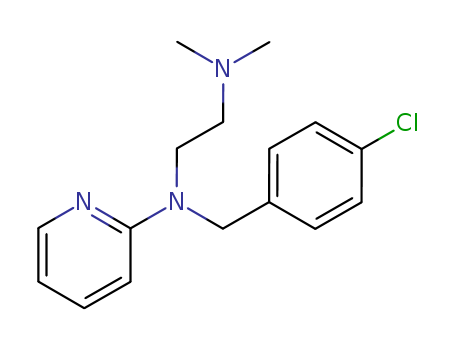
Chloropyramine

Base Information
  • Chemical Name:Chloropyramine
  • CAS No.:59-32-5
  • Molecular Formula:C16H20 Cl N3
  • Molecular Weight:289.808
  • Hs Code.:
  • European Community (EC) Number:200-421-1
  • NSC Number:241038
  • UNII:2K3L8O9SOV
  • DSSTox Substance ID:DTXSID50207729
  • Nikkaji Number:J4.599C
  • Wikipedia:Chloropyramine
  • Wikidata:Q729863
  • NCI Thesaurus Code:C81130
  • Pharos Ligand ID:TFS39MVZAX5G
  • Metabolomics Workbench ID:43717
  • ChEMBL ID:CHEMBL1194287
  • Mol file:59-32-5.mol
Chloropyramine

Synonyms:Avapena;chloropyramine;chloropyramine hydrochloride;chloropyramine monohydrochloride;chlorpyramine;halopyramine;N-(p-chlorobenzyl)-N-(2-pyridyl)-N',N''-dimethylethylenediamine;Suprastin

Suppliers and Price of Chloropyramine
Supply Marketing:
Business phase:
The product has achieved commercial mass production*data from LookChem market partment
Manufacturers and distributors:
  • Manufacture/Brand
  • Chemicals and raw materials
  • Packaging
  • price
  • Sigma-Aldrich
  • N-((4-CHLOROPHENYL)METHYL)-N',N'-DIMETHYL-N-2-PYRIDINYL-1,2-ETHANEDIAMINE Aldrich
  • 1g
  • $ 32.30
  • Biosynth Carbosynth
  • Chloropyramine
  • 5 g
  • $ 325.00
  • Biosynth Carbosynth
  • Chloropyramine
  • 2 g
  • $ 140.00
  • Biosynth Carbosynth
  • Chloropyramine
  • 1 g
  • $ 75.00
  • American Custom Chemicals Corporation
  • CHLOROPYRAMINE 95.00%
  • 5MG
  • $ 497.29
Total 40 raw suppliers
Chemical Property of Chloropyramine
Chemical Property:
  • Vapor Pressure:4.79E-07mmHg at 25°C 
  • Melting Point:25°C 
  • Refractive Index:1.6010 (estimate) 
  • Boiling Point:413.5°C at 760 mmHg 
  • PKA:9.00±0.28(Predicted) 
  • Flash Point:203.9°C 
  • PSA:19.37000 
  • Density:1.158g/cm3 
  • LogP:3.30320 
  • XLogP3:3.9
  • Hydrogen Bond Donor Count:0
  • Hydrogen Bond Acceptor Count:3
  • Rotatable Bond Count:6
  • Exact Mass:289.1345753
  • Heavy Atom Count:20
  • Complexity:264
Purity/Quality:

99.9% *data from raw suppliers

N-((4-CHLOROPHENYL)METHYL)-N',N'-DIMETHYL-N-2-PYRIDINYL-1,2-ETHANEDIAMINE Aldrich *data from reagent suppliers

Safty Information:
  • Pictogram(s):  
  • Hazard Codes: 
MSDS Files:

SDS file from LookChem

Useful:
  • Canonical SMILES:CN(C)CCN(CC1=CC=C(C=C1)Cl)C2=CC=CC=N2
  • Uses Chloropyramine is used for allergic dermatosis, allergic rhinitis and conjunctivitis, for drug-induced allergies, in the beginning stages of bronchial asthma, eczema, neurodermatitis, contact dermatitis, and toxicodermia. It also exhibits a sedative effect. Synonyms of this drug are suprastin, chlortripelenamine, and synopen.
Technology Process of Chloropyramine

There total 6 articles about Chloropyramine which guide to synthetic route it. The literature collected by LookChem mainly comes from the sharing of users and the free literature resources found by Internet computing technology. We keep the original model of the professional version of literature to make it easier and faster for users to retrieve and use. At the same time, we analyze and calculate the most feasible synthesis route with the highest yield for your reference as below:

synthetic route:
Guidance literature:
With sodium amide; toluene; anschliessend mit 4-Chlor-benzylchlorid;
Guidance literature:
With sodium hydride; toluene;
Refernces

Synthesis and in?vitro antitumour activity of crassalactone D, its stereoisomers and novel cinnamic ester derivatives

10.1016/j.ejmech.2017.03.088

The research presents a comprehensive study on the synthesis and in vitro antitumor activity of crassalactone D, its stereoisomers, and novel cinnamic ester derivatives. The purpose of the study was to develop a new one-pot synthesis method for these compounds starting from D-glucose and evaluate their cytotoxic effects against various human tumor cell lines. The conclusions drawn from the research indicate that many of the synthesized compounds exhibited potent cytotoxicities, with some showing higher potency than the commercial antitumor agent doxorubicin. The study also highlighted the importance of stereochemistry at the C-4 and C-7 positions, as well as the nature of the substituent at the C-4 position in the aromatic ring of the cinnamoate moiety, for biological activity. The chemicals used in the process included D-glucose, (methoxycarbonylmethylene)triphenylphosphorane (MCMP), (ethoxycarbonylmethylene)triphenylphosphorane (ECMP), cinnamoyl chloride, 4-nitrocinnamoyl chloride, 4-methoxycinnamic acid, and 4-fluorocinnamic acid, among others. The synthesized products were assessed for their in vitro antiproliferative activity, and the results were supported by flow cytometry and Western blot analysis, providing insights into the apoptotic mechanisms triggered by the compounds.

Post a RFQ

Enter 15 to 2000 letters.Word count: 0 letters

Attach files(File Format: Jpeg, Jpg, Gif, Png, PDF, PPT, Zip, Rar,Word or Excel Maximum File Size: 3MB)

1 Customer Service

What can I do for you?
Get Best Price

Get Best Price for 59-32-5