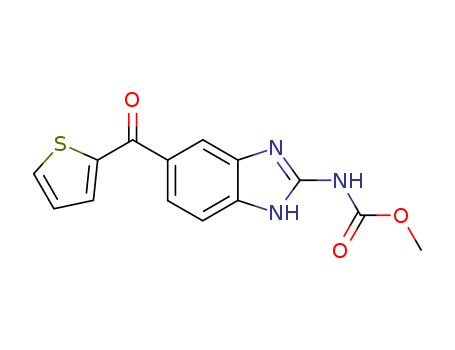
Chemical Property of Nocodazole
Chemical Property:
- Appearance/Colour:Amber powder
- Melting Point:300 °C (dec.)
- Refractive Index:1.731
- PKA:10.67±0.10(Predicted)
- PSA:112.32000
- Density:1.491 g/cm3
- LogP:3.10670
- Storage Temp.:2-8°C
- Solubility.:DMSO: 10 mg/mL, soluble
- XLogP3:2.8
- Hydrogen Bond Donor Count:2
- Hydrogen Bond Acceptor Count:5
- Rotatable Bond Count:4
- Exact Mass:301.05211239
- Heavy Atom Count:21
- Complexity:420
- Transport DOT Label:Poison
- Purity/Quality:
-
99%, *data from raw suppliers
Nocodazole *data from reagent suppliers
Safty Information:
- Pictogram(s):
 T,
T,  C,
C,  F
F
- Hazard Codes:T,C,F,Xn
- Statements:
61-40-36/37/38-34-11-68-63
- Safety Statements:
53-45-36/37/39-26-16-36/37
- MSDS Files:
-
SDS file from LookChem
Useful:
- Canonical SMILES:COC(=O)NC1=NC2=C(N1)C=C(C=C2)C(=O)C3=CC=CS3
-
Description
Nocodazole reversibly binds tubulin and alters tubulin-associated GTP hydrolysis as well as microtubule dynamics. While nocodazole is used to study many aspects on microtubule function, it is most commonly used to synchronize cell cycling in culture. Typically, nanomolar concentrations of nocodazole reduce both microtubule elongation and shortening velocities, resulting in arrest of cycling in a G2/M phase. Nocodazole is also used to induce the formation of Golgi ministacks in eukaryotic cells.
-
Uses
Antineoplastic;Microtubule poison A potent Tubulin production inhibitor and anti-neoplastic agent Nocodazole has been shown to enhance CRISPR genome editing efficiency. To see other small molecule CRISPR enhancers, visit sigma.com/CRISPR-enhancers. A synthetic chemotherapeutic agent with antineoplastic, antifungal and anthelmintic activities. Microtubule inhibitor; inhibits mitosis