Welcome to LookChem.com Sign In|Join Free
  • or

Encyclopedia

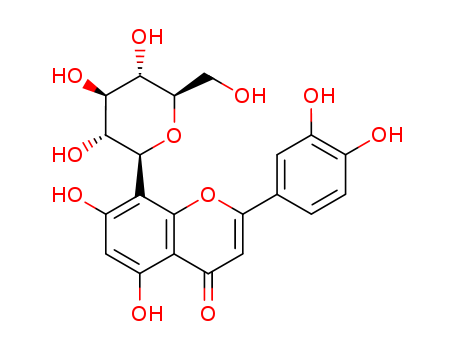
Homo-orientin

Base Information
  • Chemical Name:Homo-orientin
  • CAS No.:28608-75-5
  • Molecular Formula:C21H20O11
  • Molecular Weight:448.383
  • Hs Code.:29389090
  • NSC Number:133101
  • Wikidata:Q104194955
  • Mol file:28608-75-5.mol
Homo-orientin

Synonyms:8-C-beta-glucopyranosyl-3',4',5,7-tetrahydroxyflav-2-en-3-one;luteolin 8-C-beta-D-glucopyranoside;luteolin-8-c-glucoside;orientin;orientine

Suppliers and Price of Homo-orientin
Supply Marketing:
Business phase:
The product has achieved commercial mass production*data from LookChem market partment
Manufacturers and distributors:
  • Manufacture/Brand
  • Chemicals and raw materials
  • Packaging
  • price
  • Usbiological
  • Orientin
  • 2.5mg
  • $ 496.00
  • Usbiological
  • Orientin
  • 1mg
  • $ 355.00
  • Usbiological
  • Orientin
  • 20mg
  • $ 305.00
  • TRC
  • Orientin
  • 250mg
  • $ 290.00
  • TRC
  • Orientin
  • 100mg
  • $ 140.00
  • Sigma-Aldrich
  • Orientin ≥97% (HPLC)
  • 1mg
  • $ 108.00
  • Sigma-Aldrich
  • Orientin ≥97% (HPLC)
  • 5mg
  • $ 401.00
  • Sigma-Aldrich
  • Orientin primary pharmaceutical reference standard
  • 10mg
  • $ 524.00
  • Medical Isotopes, Inc.
  • Orientin
  • 10 mg
  • $ 1100.00
  • JR MediChem
  • Orientin?(NewProduct) 98%
  • 500mg
  • $ 518.00
Total 93 raw suppliers
Chemical Property of Homo-orientin
Chemical Property:
  • Appearance/Colour:yellow powder 
  • Vapor Pressure:3.63E-28mmHg at 25°C 
  • Melting Point:260-285 °C 
  • Refractive Index:1.767 
  • Boiling Point:816.1 °C at 760 mmHg 
  • PKA:6.24±0.40(Predicted) 
  • Flash Point:289.1 °C 
  • PSA:201.28000 
  • Density:1.759 g/cm3 
  • LogP:-0.20270 
  • Storage Temp.:2-8°C(protect from light) 
  • Solubility.:1 M NaOH: soluble1mg/mL, clear, yellow-orange 
  • XLogP3:-0.2
  • Hydrogen Bond Donor Count:8
  • Hydrogen Bond Acceptor Count:11
  • Rotatable Bond Count:3
  • Exact Mass:448.10056145
  • Heavy Atom Count:32
  • Complexity:729
Purity/Quality:

≥98% *data from raw suppliers

Orientin *data from reagent suppliers

Safty Information:
  • Pictogram(s):  
  • Hazard Codes: 
  • Safety Statements: 24/25 
MSDS Files:

SDS file from LookChem

Total 1 MSDS from other Authors

Useful:
  • Canonical SMILES:C1=CC(=C(C=C1C2=CC(=O)C3=C(O2)C(=C(C=C3O)O)C4C(C(C(C(O4)CO)O)O)O)O)O
  • General Description Orientin is a C-glycosidic flavonoid, specifically luteolin 8-C-glucoside, found in plants such as *Passiflora edulis var. flavicarpa*. It undergoes bioinspired oxidation via phase I biotransformation reactions catalyzed by Salen complexes, with oxidants like m-CPBA and PhIO, yielding metabolites that are analyzed using UPLC-DAD and HPLC/MS/MS. This process helps elucidate its pharmacological and toxicological properties, supporting its safe use as a chemical marker in plant-derived products.
Technology Process of Homo-orientin

There total 16 articles about Homo-orientin which guide to synthetic route it. The literature collected by LookChem mainly comes from the sharing of users and the free literature resources found by Internet computing technology. We keep the original model of the professional version of literature to make it easier and faster for users to retrieve and use. At the same time, we analyze and calculate the most feasible synthesis route with the highest yield for your reference as below:

synthetic route:
Guidance literature:
With hydrogen; palladium on activated charcoal; In ethanol; ethyl acetate; at 20 ℃;
DOI:10.1016/S0008-6215(01)00192-6
Guidance literature:
With recombinant Oryza sativa C-glycosyltransferase; In ethanol; at 30 ℃; pH=7.5; Enzymatic reaction;
DOI:10.1016/j.phytochem.2016.02.013
Guidance literature:
With hydrogenchloride; In methanol; for 1h; Heating;
DOI:10.1248/cpb.38.2277
Refernces

Bioinspired oxidation in cytochrome P450 of isomers orientin and isoorientin using Salen complexes

10.1002/rcm.8757

The study focused on the bioinspired oxidation of the flavonoids orientin and isoorientin, which are C-glycosidic flavonoids found in certain plant species, including Passiflora edulis var. flavicarpa. The aim was to evaluate and characterize the in vitro metabolism of these flavonoids by simulating phase I biotransformation reactions using Salen complexes as catalysts. The chemicals used in the study included m-chloroperbenzoic acid (m-CPBA) and iodozylbenzene (PhIO) as oxidants, and the Jacobsen catalyst or [Mn(3-MeOSalen)Cl] as catalysts. The [Mn(3-MeOSalen)Cl] catalyst was synthesized and characterized by spectrometric techniques. The study utilized UPLC-DAD and HPLC/MS/MS to monitor and analyze the oxidation reactions and products, which are crucial for understanding the potential pharmacological and toxicological properties of these compounds, thus aiding in the safe use of plant products containing orientin as a chemical marker.


Post a RFQ

Enter 15 to 2000 letters.Word count: 0 letters

Attach files(File Format: Jpeg, Jpg, Gif, Png, PDF, PPT, Zip, Rar,Word or Excel Maximum File Size: 3MB)

1 Customer Service

What can I do for you?
Get Best Price

Get Best Price for 28608-75-5