Welcome to LookChem.com Sign In|Join Free
  • or

Encyclopedia

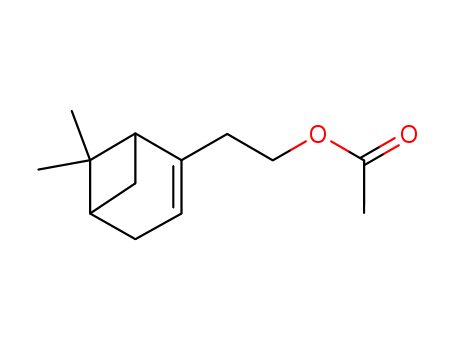
Nopyl acetate

Base Information
  • Chemical Name:Nopyl acetate
  • CAS No.:128-51-8
  • Molecular Formula:C13H20 O2
  • Molecular Weight:208.301
  • Hs Code.:2915390090
  • European Community (EC) Number:204-891-9
  • NSC Number:404963,1286
  • DSSTox Substance ID:DTXSID70977235
  • Nikkaji Number:J59.368K
  • Wikidata:Q82962339
  • ChEMBL ID:CHEMBL257347
  • Mol file:128-51-8.mol
Nopyl acetate

Synonyms:Nopyl acetate;128-51-8;Nopol acetate;Citroviol;Lignyl acetate;2-Pinene-10-methyl acetate;Bicyclo[3.1.1]hept-2-ene-2-ethanol, 6,6-dimethyl-, acetate;6,6-Dimethyl-2-norpinene-2-ethanol, acetate;6, acetate;NSC 1286;EINECS 204-891-9;6,6-Dimethylbicyclo(3.1.1)-2-heptene-2-ethyl acetate;2-(6,6-dimethyl-2-bicyclo[3.1.1]hept-2-enyl)ethyl acetate;2-(6,6-Dimethylbicyclo[3.1.1]hept-2-en-2-yl)ethyl acetate;AI3-14380;Bicyclo(3.1.1)hept-2-ene-2-ethanol, 6,6-dimethyl-, acetate;WLN: L46 EUTJ C1 C1 E2OV1;6165-23-7;Bicyclo[3.1.1]hept-2-ene-2-ethanol, 6,6-dimethyl-, 2-acetate;UNII-OTX3UCY28V;2-Norpinene-2-ethanol,6-dimethyl-, acetate;6,6-Dimethylbicyclo[3.1.1]-2-heptene-2-ethyl acetate;Bicyclo[3.1.1]hept-2-ene-2-ethanol,6-dimethyl-, acetate;Nopylacetate;2-{6,6-dimethylbicyclo[3.1.1]hept-2-en-2-yl}ethyl acetate;NSC-1286;2-(6,6-dimethyl-4-bicyclo[3.1.1]hept-3-enyl)ethyl acetate;NSC-404963;SCHEMBL132597;CHEMBL257347;DTXSID70977235;NSC1286;NSC404963;STL570065;AKOS030513519;LS-97333;6,6- Dimethylbicyclo-(3,1,1)- 2-heptene-2 ethylacetate;Biciclo[3.1.1]hept-2-eno-2-etanol, 6,6-dimetil-, 2-acetato;2-(6,6-Dimethylbicyclo[3.1.1]hept-2-en-2-yl)ethyl acetate #

Suppliers and Price of Nopyl acetate
Supply Marketing:
Business phase:
The product has achieved commercial mass production*data from LookChem market partment
Manufacturers and distributors:
  • Manufacture/Brand
  • Chemicals and raw materials
  • Packaging
  • price
Total 51 raw suppliers
Chemical Property of Nopyl acetate
Chemical Property:
  • Vapor Pressure:0.00751mmHg at 25°C 
  • Refractive Index:n20/D 1.472(lit.) 
  • Boiling Point:268.8°Cat760mmHg 
  • Flash Point:100.7°C 
  • PSA:26.30000 
  • Density:0.996g/cm3 
  • LogP:2.93200 
  • XLogP3:2.6
  • Hydrogen Bond Donor Count:0
  • Hydrogen Bond Acceptor Count:2
  • Rotatable Bond Count:4
  • Exact Mass:208.146329876
  • Heavy Atom Count:15
  • Complexity:302
Purity/Quality:

98% *data from raw suppliers

Safty Information:
  • Pictogram(s):  
  • Hazard Codes: 
MSDS Files:

SDS file from LookChem

Useful:
  • Canonical SMILES:CC(=O)OCCC1=CCC2CC1C2(C)C
Technology Process of Nopyl acetate

There total 2 articles about Nopyl acetate which guide to synthetic route it. The literature collected by LookChem mainly comes from the sharing of users and the free literature resources found by Internet computing technology. We keep the original model of the professional version of literature to make it easier and faster for users to retrieve and use. At the same time, we analyze and calculate the most feasible synthesis route with the highest yield for your reference as below:

synthetic route:

Reference yield:

Guidance literature:
Mutter-Substanz, Ac2O;

Reference yield: 86.0%

Guidance literature:
With lithium aluminium tetrahydride;
DOI:10.1016/0022-328X(85)87417-9
upstream raw materials:

formaldehyd

Beta-pinene

acetic anhydride

Downstream raw materials:

nopol

Refernces

3α-Acetoxy-6,6-dimethylbicyclo[3.1.1]heptane-2-spiro-1′- cyclopropane from nopylamine deamination

10.1039/a707911g

The study investigates the deamination of nopylamine hydrochloride using sodium nitrite in acetic acid, resulting in the formation of several products including nopyl chloride, nopyl acetate, 2-(1-acetoxyethyl)-6,6-dimethylbicyclo[3.1.1]hept-2-ene, and 3-acetoxy-6,6-dimethylbicyclo[3.1.1]heptane-2-spiro-1-cyclopropane. The researchers also compared this reaction with the acetolysis of nopyl toluene-p-sulfonate, which primarily yields 8,8-dimethyltricyclo[4.2.1.03,7]nonan-6-ol. The study explores the mechanisms behind these reactions, suggesting that the difference in products results from the transition state being reached early in deamination and late in toluene-p-sulfonate acetolysis. The researchers used various techniques such as GLC, NMR, and mass spectrometry to identify and characterize the products, providing insights into the reaction pathways and the influence of different leaving groups on the reaction outcomes.

Post a RFQ

Enter 15 to 2000 letters.Word count: 0 letters

Attach files(File Format: Jpeg, Jpg, Gif, Png, PDF, PPT, Zip, Rar,Word or Excel Maximum File Size: 3MB)

1 Customer Service

What can I do for you?
Get Best Price

Get Best Price for 128-51-8