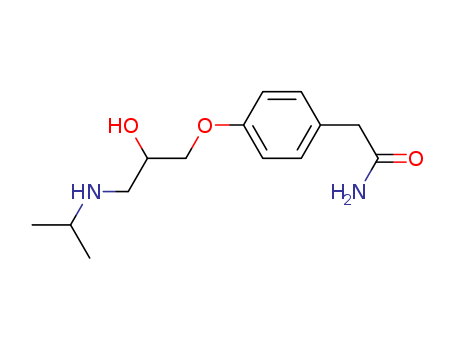
Chemical Property of Atenolol
Chemical Property:
- Appearance/Colour:white to off-white crystalline solid
- Vapor Pressure:3.82E-11mmHg at 25°C
- Melting Point:154 °C
- Refractive Index:1.5110 (estimate)
- Boiling Point:508.049 °C at 760 mmHg
- PKA:9.6(at 25℃)
- Flash Point:261.059 °C
- PSA:84.58000
- Density:1.125 g/cm3
- LogP:1.54330
- Storage Temp.:Store at RT
- Solubility.:H2O: 0.3 mg/mL
- Water Solubility.:13.5mg/L(25 oC)
- XLogP3:0.2
- Hydrogen Bond Donor Count:3
- Hydrogen Bond Acceptor Count:4
- Rotatable Bond Count:8
- Exact Mass:266.16304257
- Heavy Atom Count:19
- Complexity:263
- Purity/Quality:
-
99%, *data from raw suppliers
Atenolol *data from reagent suppliers
Safty Information:
- Pictogram(s):
 Xn
Xn
- Hazard Codes:Xn,F
- Statements:
22-36/37/38-20/21/22-36-11
- Safety Statements:
22-24/25-36-26-36/37-16
- MSDS Files:
-
SDS file from LookChem
Total 1 MSDS from other Authors
Useful:
- Drug Classes:Beta-Adrenergic Receptor Antagonists
- Canonical SMILES:CC(C)NCC(COC1=CC=C(C=C1)CC(=O)N)O
- Recent ClinicalTrials:The Effect of Nitrendipine/Atenolol Combination on Blood Pressure Variability.
- Recent EU Clinical Trials:The RIME-IVF study
- Recent NIPH Clinical Trials:Clinical Significance of Sphingosine-1-Phosphate in the Evaluation of Endothelial Function and Cardiovascular Risk in Hypertension
-
Uses
β-blockers. Clinical application in the treatment of hypertension, angina and arrhythmia. Selective b1 adrenergic receptor agonist, anti-hypertensive, anti-anginal, anti-arrhythmic Atenolol is 2-[4′[2-hydroxy-3-(iso-propylamino)propoxy]phenyl]acetamide
(12.1.7) [11–13].Atenolol is a selective β1-adrenoblocker, or in other words, a cardioblocker. Like acebutol,
atenolol possesses antianginal, antihypotensive, and antiarrhythmic action. It is used for arte�rial hypotension, preventing attacks of angina, sinus tachycardia, and preventing supraven�tricular tachyarrhythmia. It is used for preventing angina pectoris.
-
Therapeutic Function
Beta-adrenergic blocker
-
Clinical Use
Beta-adrenoceptor blocker:
Hypertension
Angina
Arrhythmias
-
Drug interactions
Potentially hazardous interactions with other drugs
Anaesthetics: enhanced hypotensive effect.
Analgesics: NSAIDs antagonise hypotensive effect.
Anti-arrhythmics: increased risk of myocardial
depression and bradycardia; increased risk of
bradycardia, myocardial depression and AV block
with amiodarone; increased risk of myocardial
depression and bradycardia with flecainide.
Antidepressants: enhanced hypotensive effect with
MAOIs.
Antihypertensives: enhanced hypotensive effect;
increased risk of withdrawal hypertension with
clonidine; increased risk of first dose hypotensive
effect with post-synaptic alpha-blockers such as
prazosin.
Antimalarials: increased risk of bradycardia with
mefloquine.
Antipsychotics enhanced hypotensive effect with
phenothiazines.
Calcium-channel blockers: increased risk of
bradycardia and AV block with diltiazem;
hypotension and heart failure possible with
nifedipine and nisoldipine; asystole, severe
hypotension and heart failure with verapamil.
Cytotoxics: possible increased risk of bradycardia
with crizotinib.
Diuretics: enhanced hypotensive effect.
Fingolimod: possibly increased risk of bradycardia.
Moxisylyte: possible severe postural hypotension.
Sympathomimetics: severe hypertension with
adrenaline and noradrenaline and possibly with
dobutamine.