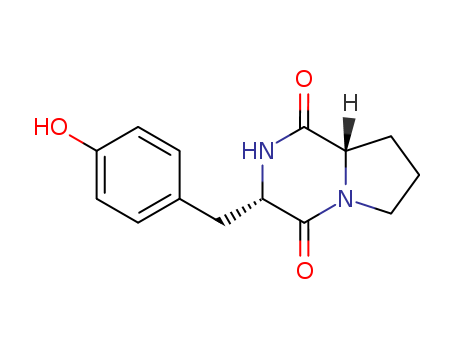
Chemical Property of Maculosin
Chemical Property:
- Vapor Pressure:4.07E-14mmHg at 25°C
- Melting Point:156-159 °C
- Boiling Point:581.4°Cat760mmHg
- PKA:9.92±0.15(Predicted)
- Flash Point:305.4°C
- PSA:69.64000
- Density:1.36g/cm3
- LogP:0.69080
- Storage Temp.:-15°C
- XLogP3:1
- Hydrogen Bond Donor Count:2
- Hydrogen Bond Acceptor Count:3
- Rotatable Bond Count:2
- Exact Mass:260.11609238
- Heavy Atom Count:19
- Complexity:377
- Purity/Quality:
-
97% *data from raw suppliers
Cyclo(L-prolinyl-L-tyrosine) *data from reagent suppliers
Safty Information:
- Pictogram(s):
- Hazard Codes:
- MSDS Files:
-
SDS file from LookChem
Useful:
- Canonical SMILES:C1CC2C(=O)NC(C(=O)N2C1)CC3=CC=C(C=C3)O
- Isomeric SMILES:C1C[C@H]2C(=O)N[C@H](C(=O)N2C1)CC3=CC=C(C=C3)O
-
Description
Maculosin is a diketopiperazine metabolite produced by A. alternata, L. capsici, Streptomyces, and the Gram-negative, nonobligate predator bacterial strain 679-2. It acts as a host-specific phytotoxin, inducing formation of weeping necrotic lesions in leaves of spotted knapweed (C. maculosa) when used at a concentration of 10 μM. Maculosin reduces the growth of the plant pathogenic bacteria X. axonopodis and R. solanacearum (MICs = 31.25 μg/ml) as well as the pathogenic oomycetes P. cactorum, P. capsici, P. cinnamomi, P. infestans, and P. ultimum when used at concentrations ranging from 10 to 100 mg/ml. Maculosin also inhibits the growth of M. luteus, M. smegmatis, S. cerevisiae, C. albicans, C. neoformans, and A. niger when used in combination with pyrrolnitrin or banegasin.
-
Uses
Cyclo(L-prolinyl-L-tyrosine) is a diketopiperazine derivative isolated from Bacillus thuringiensis and Bacillus endophyticus. Cyclo(L-Pro-L-Tyr) (maculosin) is a diketopiperazine formed by the fusion of tyrosine and proline, reported as a secondary metabolite of fungi and bacteria. In Pseudomonas aeruginosa, cyclo(L-Pro-L-Tyr) is capable of activating N-acylhomoserine lactones (AHLs). Cyclo(L-Pro-L-Tyr) is also capable of activating or antagonizing other LuxR-based quorum-sensing systems. While the mode of action of cyclo(L-Pro-L-Tyr) is not known, its activity suggests the existence of cross talk among bacterial signalling systems. Cyclo(L-Pro-L-Tyr) was identified as a host-specific toxin produced by Alternaria alternata on spotted knapweed.