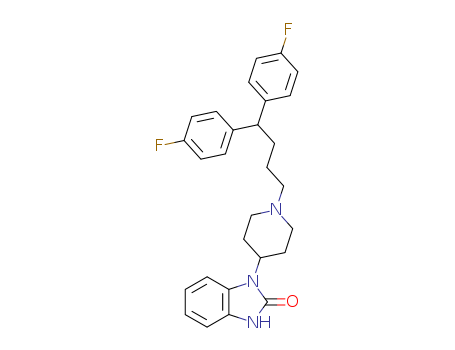
Chemical Property of Pimozide
Chemical Property:
- Melting Point:214-218°
- Boiling Point:°Cat760mmHg
- PKA:7.32(at 25℃)
- Flash Point:°C
- PSA:41.03000
- Density:1.224g/cm3
- LogP:5.79490
- Storage Temp.:2-8°C
- Solubility.:DMSO: 18 mg/mL
- Water Solubility.:2.9mg/L(30 oC)
- XLogP3:6.3
- Hydrogen Bond Donor Count:1
- Hydrogen Bond Acceptor Count:4
- Rotatable Bond Count:7
- Exact Mass:461.22786888
- Heavy Atom Count:34
- Complexity:632
- Purity/Quality:
-
99%, *data from raw suppliers
Pimozide
*data from reagent suppliers
Safty Information:
- Pictogram(s):

- Hazard Codes:Xn
- Statements:
22
- Safety Statements:
36
- MSDS Files:
-
SDS file from LookChem
Useful:
- Drug Classes:Antipsychotic Agents
- Canonical SMILES:C1CN(CCC1N2C3=CC=CC=C3NC2=O)CCCC(C4=CC=C(C=C4)F)C5=CC=C(C=C5)F
- Recent ClinicalTrials:Electrophysiological Effects of Potential QT Prolonging Drugs
- Recent EU Clinical Trials:Cognitive effects of adjuntive Vortioxetine in early Schizophrenia
-
Description
Pimozide is a dopamine receptor antagonist (Kis = 2.4, 0.3, and 1.8 nM for D2, D3, and D4 receptors, respectively). It also binds to eight additional receptors (Kds = 25-3,100 nM for the human receptors) and inhibits the voltage-gated sodium channel Nav1.2 and the voltage-gated potassium channel Kv11.1 (IC50s = 42 and 340 nM, respectively). Pimozide (0.5, 1, and 2 mg/kg) decreases the number of licks and reduces fluid intake of a sweetened solution in rats. It decreases the number of threats and attacks and increases immobility time in the neutral arena aggression test, indicating increased passiveness, in male mice when administered at a dose of 0.75 mg/kg for 10 days. Formulations containing pimozide have been used in the treatment of Tourette syndrome.
-
Uses
Pimozide is a D2 dopamine receptor antagonist that binds to the cloned 5-HT7 receptor with high affinity (1,2,3,4). Pimozide is also a Ca2+ channel antagonist. Pimozide is used as an antipsychotic. Used for the suppression of motor and phonic tics in patients with Tourette's Disorder who have failed to respond satisfactorily to standard treatment.
-
Drug interactions
Potentially hazardous interactions with other drugs
Anaesthetics: enhanced hypotensive effect.
Analgesics: increased risk of convulsions with
tramadol; enhanced hypotensive and sedative
effects with opioids; increased risk of ventricular
arrhythmias with methadone.
Anti-arrhythmics: increased risk of ventricular
arrhythmias with anti-arrhythmics that prolong
the QT interval - avoid with amiodarone and
disopyramide (risk of ventricular arrhythmias). Antibacterials: avoid with macrolides and moxifloxacin
(increased risk of ventricular arrhythmias).
Antidepressants: concentration increased by SSRIs
- avoid; increased risk of ventricular arrhythmias
with SSRIs and tricyclics - avoid; increased risk of
ventricular arrhythmias with delamanid.
Antiepileptics: antagonises anticonvulsant effect.
Antifungals: avoid with imidazoles and triazoles -
risk of ventricular arrhythmias.
Antimalarials: avoid with artemether/lumefantrine and
piperaquine with artenimol; increased risk of ventricular
arrhythmias with mefloquine and quinine - avoid.
Antipsychotics: increased risk of ventricular
arrhythmias with droperidol, phenothiazines,
risperidone or sulpiride - avoid; concentration
possibly increased by lurasidone.
Antivirals: concentration increased by atazanavir,
boceprevir, efavirenz, fosamprenavir, indinavir,
ritonavir, saquinavir and telaprevir, increased risk of
ventricular arrhythmias - avoid.
Anxiolytics and hypnotics: increased sedative effects.
Aprepitant: avoid concomitant use.
Atomoxetine: increased risk of ventricular arrhythmias.
Beta-blockers: increased risk of ventricular
arrhythmias with sotalol.
Cobicistat: concentration possibly increased by
cobicistat - avoid.
Cytotoxics: use crizotinib with caution; avoid with
lapatinib and idelalisib; increased risk of ventricular
arrhythmias with panobinostat and vandetanib -
avoid; increased risk of ventricular arrhythmias with
arsenic trioxide.
Diuretics: increased risk of ventricular arrhythmias
due to hypokalaemia.
Fosaprepitant: avoid concomitant use.
Grapefruit juice: avoid concomitant use.
Ivabradine: increased risk of ventricular arrhythmias.