Welcome to LookChem.com Sign In|Join Free
  • or

Encyclopedia

DICUMAROL

Base Information
  • Chemical Name:DICUMAROL
  • CAS No.:66-76-2
  • Molecular Formula:C19H12 O6
  • Molecular Weight:336.301
  • Hs Code.:29322985
  • Mol file:66-76-2.mol
DICUMAROL

Synonyms:Coumarin,3,3'-methylenebis[4-hydroxy- (8CI);3,3'-Methylenebis[4-hydroxy-1,2-benzopyrone]; 3,3'-Methylenebis[4-hydroxycoumarin];Acadyl; Acavyl; Antitrombosin; Baracoumin; Bis(4-hydroxycoumarin-3-yl)methane;Bis-3,3'-(4-hydroxycoumarinyl)methane; Bishydroxycoumarin; Cuma; Cumid;Di-4-hydroxy-3,3'-methylenedicoumarin; Dicoumal; Dicoumarin; Dicoumarol;Dicuman; Dicumarine; Dicumarol; Dicumol; Dufalone; Kumoran; Melitoxin; NC 034;NSC 17860; NSC 221570; NSC 41834; Temparin; Trombosan

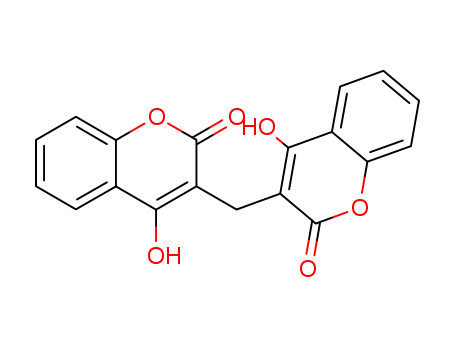
Suppliers and Price of DICUMAROL
Supply Marketing:
Business phase:
The product has achieved commercial mass production*data from LookChem market partment
Manufacturers and distributors:
  • Manufacture/Brand
  • Chemicals and raw materials
  • Packaging
  • price
  • TRC
  • Dicumarol
  • 25g
  • $ 525.00
  • TCI Chemical
  • Dicoumarol
  • 25G
  • $ 273.00
  • TCI Chemical
  • Dicoumarol
  • 1G
  • $ 29.00
  • Sigma-Aldrich
  • 3,3′-Methylene-bis(4-hydroxycoumarin)
  • 5g
  • $ 44.60
  • Sigma-Aldrich
  • Dicoumarol
  • 500mg
  • $ 64.19
  • Sigma-Aldrich
  • 3,3′-Methylene-bis(4-hydroxycoumarin)
  • 25g
  • $ 122.00
  • Crysdot
  • Dicoumarol 95+%
  • 100mg
  • $ 67.00
  • ChemScene
  • Dicoumarol 99.40%
  • 100mg
  • $ 60.00
  • Chem-Impex
  • 3,3-Methylene-bis(4-hydroxycoumarin)(synthetic),98%(HPLC) 98%(HPLC)
  • 25G
  • $ 123.20
  • Chem-Impex
  • 3,3-Methylene-bis(4-hydroxycoumarin)(synthetic),98%(HPLC) 98%(HPLC)
  • 5G
  • $ 39.20
Total 42 raw suppliers
Chemical Property of DICUMAROL
Chemical Property:
  • Appearance/Colour:white fine crystalline powder 
  • Vapor Pressure:0mmHg at 25°C 
  • Melting Point:290-292 °C(lit.)
     
  • Refractive Index:1.4450 (estimate) 
  • Boiling Point:620.702oC at 760 mmHg 
  • PKA:4.20±1.00(Predicted) 
  • Flash Point:231.949°C 
  • PSA:100.88000 
  • Density:1.573g/cm3 
  • LogP:2.90140 
  • Storage Temp.:+2C to +8C 
  • Water Solubility.:Soluble in aqueous alkaline solutions, organic bases, 0.1 N NaOH (15 mg/ml), Pyridine (50 mg/ml), chloroform (slightly soluble), 
Purity/Quality:

98% *data from raw suppliers

Dicumarol *data from reagent suppliers

Safty Information:
  • Pictogram(s): T
  • Hazard Codes:T,N 
  • Statements: 22-48/25-51/53 
  • Safety Statements: 37-45-61 
MSDS Files:

SDS file from LookChem

Useful:
  • Description The plants containing dicoumarol mainly include red carnation grass (Trifolium pratense L., hongchezhoucao), rotten alfalfa (Medicago sativa L., zimuxu), rotten white vanilla rhinoceros (Melilotus albus Desr., baixiangcaomuxi), and other plants in Leguminosae. Dicoumarol is a competitive inhibitor of NADH:quinone oxidoreductase (NQO1) with IC50 values of 2.6 and 404 nM in the absence and presence of 2 μM BSA, respectively. It has antiproliferative activity against MIA PaCa-2 pancreas and HCT116 colon carcinoma cells (IC50s = 52 and 19 μM, respectively, after a 96 hour incubation). Dicoumarol inhibits stress-activated protein kinase (SAPK) in HEK293 cells (IC50 = 19-33 μM) at a point upstream of MEKK1 and downstream of TNF receptor-associated factor 2 (TRAF2), and it inhibits TNF-α and LPS-induced NF-κB activation in HeLa cells. It also has antiproliferative activity against FL5.12 lymphocytic and MCF-7 breast carcinoma cells (100 μM) by suppressing JNK activation.
  • Physical properties Appearance: white or milky white crystalline powder, slightly fragran; Solubility: not dissolved in water, ethanol, and ether, slightly dissolved in chloroform, dissolved in alkali solution; Melting point: 287–293?°C.?It can be bluer or with purple fluorescence in the ultraviolet light.
  • Uses Dicumarol is a natural chemical used as an anticoagulant agents that functions as a vitamin K antagonist and is also a derivative of Coumarin. This drug is used for preventing and treating thrombosis, thrombophlebitis, thromboemolium, and for preventing thrombo-formation in post-operational periods.
  • Indications Intravascular thromboembolic diseases include postoperative or postoperative thrombotic phlebitis, pulmonary embolism, myocardial infarction, and atrial fibrillation caused by embolism.
  • Clinical Use Dicumarol is used alone or as an adjunct to heparin in theprophylaxis and treatment of intravascular clotting. It is usedin postoperative thrombophlebitis, pulmonary embolus, acuteembolic and thrombotic occlusion of peripheral arteries, andrecurrent idiopathic thrombophlebitis. It has no effect on analready-formed embolus but may prevent further intravascularclotting. Because the outcome of acute coronary thrombosisdepends largely on extension of the clot and formation ofmural thrombi in the heart chambers, with subsequent embolization,dicumarol has been used in this condition. It hasalso been administered to arrest impending gangrene afterfrostbite. The dose, after determination of the prothrombinclotting time, is 25 to 200 mg, depending on the size and thecondition of the patient. The drug is given orally in the formof capsules or tablets. On the second day and thereafter, itmay be given in amounts sufficient to maintain the prothrombinclotting time at about 30 seconds. If hemorrhages shouldoccur, a dosage of 50 to 100 mg of menadione sodium bisulfiteis injected, supplemented by a blood transfusion.
Technology Process of DICUMAROL

There total 26 articles about DICUMAROL which guide to synthetic route it. The literature collected by LookChem mainly comes from the sharing of users and the free literature resources found by Internet computing technology. We keep the original model of the professional version of literature to make it easier and faster for users to retrieve and use. At the same time, we analyze and calculate the most feasible synthesis route with the highest yield for your reference as below:

synthetic route:
Guidance literature:
With piperidine; In ethanol; at 20 ℃; for 4h;
DOI:10.1016/j.bmc.2004.01.010
Guidance literature:
In aq. phosphate buffer; ethanol; at 24.84 ℃; pH=3; Electrochemical reaction; Green chemistry;
DOI:10.1039/c4ra08181a
Guidance literature:
With hydrogenchloride; for 3h; Product distribution; Heating;
DOI:10.1007/BF00568940
Post a RFQ

Enter 15 to 2000 letters.Word count: 0 letters

Attach files(File Format: Jpeg, Jpg, Gif, Png, PDF, PPT, Zip, Rar,Word or Excel Maximum File Size: 3MB)

1 Customer Service

What can I do for you?
Get Best Price

Get Best Price for 66-76-2