Refernces
10.1021/ol9001575
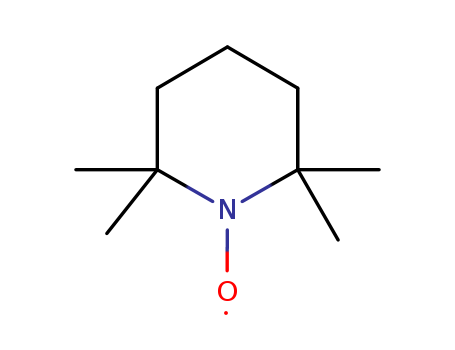
The research aims to develop a new biradical compound that can serve as an improved polarizing agent for dynamic nuclear polarization (DNP) in nuclear magnetic resonance (NMR) experiments. The authors synthesized a biradical containing a 1,3-bisdiphenylene-2-phenylallyl (BDPA) free radical covalently attached to a 2,2,6,6-tetramethylpiperidine-1-oxyl (TEMPO) free radical. The BDPA radical was chosen for its stability and narrow line width at high magnetic fields, while TEMPO provides a broad line with significant spectral density matching the nuclear Larmor frequency. The synthesis involved creating a functionalized BDPA precursor (7) through a series of reactions, including bromination, elimination, and conjugate addition, followed by coupling with TEMPO to form the biradical (9). The resulting biradical exhibited an electron paramagnetic resonance (EPR) spectrum with characteristics suitable for DNP, featuring two peaks separated by a value close to the 1H Larmor frequency. The study concluded that the synthesized BDPA-TEMPO biradical has the desired properties for enhancing DNP in NMR experiments, with future work focusing on making the biradical water-soluble for testing in aqueous solutions.
10.1021/ol801555f
The study presents a novel recovery strategy for the catalyst TEMPO (2,2,6,6-tetramethylpiperidine-1-oxyl) by combining perfluoroalkyl chains and triazole moieties. The researchers synthesized new TEMPO derivatives that are insoluble in organic or fluorinated solvents and water, yet they promote the oxidation of alcohols to aldehydes with high yields and selectivity in organic solvent/water mixtures. These TEMPO derivatives can be easily recovered by liquid/emulsion filtration, allowing for reuse without loss of activity. The chemicals used in the study include perfluoroalkyl chains, triazole moieties, TEMPO, benzyl azides, copper catalysts for the click chemistry reaction, and various alcohols as substrates for oxidation. The purpose of these chemicals was to create a catalyst that maintains the high activity of homogeneous TEMPO catalysts while being easily recoverable and recyclable, which is beneficial for sustainable and efficient catalytic processes.
10.1039/b713083j
The research focuses on the reversible switching of substrate activity in poly-N-isopropylacrylamide (PNIPAM) peptide conjugates, utilizing temperature as the trigger for enzymatic hydrolysis. The purpose of this study was to develop a method to control the activity of smart polymers, which respond to external stimuli such as temperature, pH, and light, by altering their morphology and hydrophilicity. The researchers synthesized PNIPAM peptide conjugates using controlled free-radical polymerization techniques like atom transfer radical polymerization (ATRP), RAFT, and nitroxide mediated free-radical polymerization (NMP). Key chemicals used in the process included N-isopropylacrylamide (NIPAM), alkoxyamines (such as TEMPO and sterically hindered nitroxide), and chymotrypsin for enzymatic studies. The conclusions drawn from the research were that the activity of PNIPAM peptide conjugates towards enzymatic hydrolysis could be controlled by temperature, with the system's activity being suppressed at higher temperatures and reactivated upon cooling, demonstrating the potential for temperature-induced switching of biological responses in these conjugates.


 C,
C, Xi
Xi


