Welcome to LookChem.com Sign In|Join Free
  • or

Encyclopedia

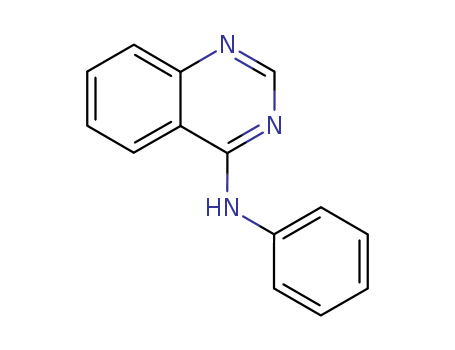
N-PHENYL-4-QUINAZOLINAMINE

Base Information
  • Chemical Name:N-PHENYL-4-QUINAZOLINAMINE
  • CAS No.:34923-95-0
  • Molecular Formula:C14H11 N3
  • Molecular Weight:221.261
  • Hs Code.:
  • Mol file:34923-95-0.mol
N-PHENYL-4-QUINAZOLINAMINE

Synonyms:Quinazoline,4-anilino- (6CI,7CI); 4-(N-Phenylamino)quinazoline; 4-Anilinoquinazoline; NSC288013; Phenyl(quinazolin-4-yl)amine

Suppliers and Price of N-PHENYL-4-QUINAZOLINAMINE
Supply Marketing:
Business phase:
The product has achieved commercial mass production*data from LookChem market partment
Manufacturers and distributors:
  • Manufacture/Brand
  • Chemicals and raw materials
  • Packaging
  • price
Total 9 raw suppliers
Chemical Property of N-PHENYL-4-QUINAZOLINAMINE
Chemical Property:
  • Vapor Pressure:3.64E-06mmHg at 25°C 
  • Boiling Point:386.1°Cat760mmHg 
  • Flash Point:187.3°C 
  • PSA:37.81000 
  • Density:1.256g/cm3 
  • LogP:3.44640 
Purity/Quality:

≥98% *data from raw suppliers

Safty Information:
  • Pictogram(s):  
  • Hazard Codes: 
MSDS Files:

SDS file from LookChem

Useful:
Technology Process of N-PHENYL-4-QUINAZOLINAMINE

There total 19 articles about N-PHENYL-4-QUINAZOLINAMINE which guide to synthetic route it. The literature collected by LookChem mainly comes from the sharing of users and the free literature resources found by Internet computing technology. We keep the original model of the professional version of literature to make it easier and faster for users to retrieve and use. At the same time, we analyze and calculate the most feasible synthesis route with the highest yield for your reference as below:

synthetic route:
Guidance literature:
With nickel; In methanol; for 6h; Heating;
DOI:10.1055/s-2004-815949
Refernces

Kinase scaffold repurposing for neglected disease drug discovery: Discovery of an efficacious, lapatanib-derived lead compound for trypanosomiasis

10.1021/jm400349k

This research presents the repurposing of kinase scaffolds for the discovery of new drugs to combat neglected tropical diseases, specifically focusing on human African trypanosomiasis (HAT), a disease caused by the protozoan parasite Trypanosoma brucei. The study aims to expedite drug discovery by utilizing chemical scaffolds from drugs approved for other indications, demonstrating the potential of lapatinib and canertinib, two 4-anilinoquinazolines with low micromolar EC50 values against T. brucei. The researchers synthesized and tested several potent 4-anilinoquinazolines, leading to the identification of NEU617 (23a), a highly potent and orally bioavailable inhibitor of trypanosome replication. The compound 23a was found to block kinetoplast duplication and arrest cytokinesis in trypanosomes, offering a new chemical tool for studying the regulation of the trypanosome cell cycle. The study concludes that compounds based on established human EGFR inhibitor chemotypes can be effective against HAT and that further optimization of these chemotypes is necessary to improve their pharmacokinetic properties and effectiveness in treating HAT. The chemicals used in the process include a series of 4-anilinoquinazoline derivatives, with lapatinib (GW572016, 1) and canertinib (CI-1033) as the starting points for optimization.


Post a RFQ

Enter 15 to 2000 letters.Word count: 0 letters

Attach files(File Format: Jpeg, Jpg, Gif, Png, PDF, PPT, Zip, Rar,Word or Excel Maximum File Size: 3MB)

1 Customer Service

What can I do for you?
Get Best Price

Get Best Price for 34923-95-0