Welcome to LookChem.com Sign In|Join Free
  • or

Encyclopedia

Formic Acid

Base Information
  • Chemical Name:Formic Acid
  • CAS No.:64-18-6
  • Deprecated CAS:8006-93-7,82069-14-5,1016316-60-1,67382-92-7,1016316-60-1,67382-92-7,82069-14-5
  • Molecular Formula:CH2O2
  • Molecular Weight:46.0257
  • Hs Code.:2915.11
  • European Community (EC) Number:200-579-1,213-599-0
  • ICSC Number:0485
  • UN Number:1779
  • UNII:0YIW783RG1
  • DSSTox Substance ID:DTXSID2024115
  • Nikkaji Number:J1.402H
  • Wikipedia:Formic acid
  • Wikidata:Q161233,Q27110013
  • NCI Thesaurus Code:C83719
  • RXCUI:4537
  • Metabolomics Workbench ID:37099
  • ChEMBL ID:CHEMBL116736
  • Mol file:64-18-6.mol
Formic Acid

Synonyms:aluminum formate;ammonium formate;ammonium tetraformate;calcium formate;chromic formate;cobalt(II) formate dihydrate;cobaltous formate;cupric formate;formate;formic acid;formic acid, 14C-labeled;formic acid, aluminum salt;formic acid, ammonium (2:1) salt;formic acid, ammonium (4:1) salt;formic acid, ammonium salt;formic acid, cadmium salt;formic acid, calcium salt;formic acid, cesium salt;formic acid, cobalt (+2) salt;formic acid, copper (+2) salt;formic acid, copper salt;formic acid, copper, ammonium salt;formic acid, copper, nickel salt;formic acid, cromium (+3) salt;formic acid, cromium (+3), sodium (4:1:1) salt;formic acid, lead (+2) salt;formic acid, lead salt;formic acid, lithium salt;formic acid, magnesium salt;formic acid, nickel (+2) salt;formic acid, nickel salt;formic acid, potassium salt;formic acid, rubidium salt;formic acid, sodium salt;formic acid, sodium salt, 13C-labeled;formic acid, sodium salt, 14C-labeled;formic acid, strontium salt;formic acid, thallium (+1) salt;formic acid, zinc salt;lead formate;lithium formate;magnesium formate;methanoic acid;nickel formate;nickel formate dihydrate;potassium formate;sodium formate;strontium formate;zinc formate

Suppliers and Price of Formic Acid
Supply Marketing:
Business phase:
The product has achieved commercial mass production*data from LookChem market partment
Manufacturers and distributors:
  • Manufacture/Brand
  • Chemicals and raw materials
  • Packaging
  • price
Total 44 raw suppliers
Chemical Property of Formic Acid
Chemical Property:
  • Appearance/Colour:colorless liquid with a pungent odor 
  • Melting Point:8 °C 
  • Refractive Index:n20/D 1.377  
  • Boiling Point:100.56 °C at 760 mmHg 
  • Flash Point:29.888 °C 
  • PSA:37.30000 
  • Density:1.155 g/cm3 
  • LogP:0.33670 
  • Water Solubility.:MISCIBLE 
  • XLogP3:-0.2
  • Hydrogen Bond Donor Count:1
  • Hydrogen Bond Acceptor Count:2
  • Rotatable Bond Count:0
  • Exact Mass:46.005479302
  • Heavy Atom Count:3
  • Complexity:10.3
  • Transport DOT Label:Corrosive Flammable Liquid
Purity/Quality:

99% *data from raw suppliers

Safty Information:
  • Pictogram(s): ToxicT, CorrosiveC, IrritantXi 
  • Hazard Codes: C:Corrosive;
     
  • Statements: R35:; 
  • Safety Statements: S23:; S26:; S45:; 
MSDS Files:

SDS file from LookChem

Useful:
  • Chemical Classes:Other Classes -> Organic Acids
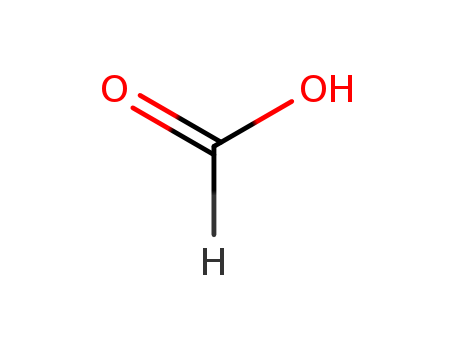
  • Canonical SMILES:C(=O)O
  • Inhalation Risk:A harmful contamination of the air can be reached rather quickly on evaporation of this substance at 20 °C.
  • Effects of Short Term Exposure:The substance is very corrosive to the eyes, skin and respiratory tract. Corrosive on ingestion. Inhalation of the vapour may cause lung oedema. The substance may cause effects on the energy metabolism. This may result in acidosis.
Technology Process of Formic Acid

There total 3339 articles about Formic Acid which guide to synthetic route it. The literature collected by LookChem mainly comes from the sharing of users and the free literature resources found by Internet computing technology. We keep the original model of the professional version of literature to make it easier and faster for users to retrieve and use. At the same time, we analyze and calculate the most feasible synthesis route with the highest yield for your reference as below:

synthetic route:
Guidance literature:
With acetate buffer; potassium chloride; water; at 25 ℃; Rate constant; var. anions as catalysts;
DOI:10.1021/ja00067a020
Guidance literature:
With hydrogenchloride; In ethanol; water; Heating; acid hydrolysis; other reagent: conc. H2SO4/glacial acetic acid, multistep reaction;
Guidance literature:
With hydrogenchloride; In ethanol; water; Heating; acid hydrolysis; other reagent: conc. H2SO4/glacial acetic acid, multistep reaction;
Refernces

New pyrazolopyrimidine derivatives as Leishmania amazonensis arginase inhibitors

10.1016/j.bmc.2019.05.026

The research focuses on the synthesis and evaluation of new pyrazolopyrimidine derivatives as potential inhibitors of Leishmania amazonensis arginase, an enzyme crucial for polyamine biosynthesis in the parasite. Six derivatives with varying substituents at the 4-position of the phenyl group were synthesized and tested for their inhibitory activity against recombinant L. amazonensis arginase (LaARG). The synthesis involved reactions of phenylhydrazine with malononitrile, formic acid, and phosphorous oxychloride to obtain the desired compounds, which were then confirmed through techniques like NMR, IR, EI-MS, and HRMS. The biological evaluation included determining the IC50 values, kinetic analysis of enzyme inhibition, and molecular docking studies to understand the interaction of these compounds with LaARG. Additionally, the compounds were assessed for their cytotoxicity on mammalian macrophages and their anti-leishmanicidal activity against L. amazonensis amastigotes. The study utilized various analytical methods such as high-performance liquid chromatography (HPLC) for purity assessment and molecular modeling for structural analysis of the enzyme-inhibitor complexes.

Rh-Catalyzed Synthesis of Coumarin Derivatives from Phenolic Acetates and Acrylates via C-H Bond Activation

10.1021/acs.joc.5b01713

The research focuses on the development of an efficient method for the synthesis of coumarin derivatives, which are valuable natural products with a range of biological and pharmacological activities. The study utilizes a rhodium (Rh)-catalyzed annulation strategy involving the reaction of phenolic acetates with acrylates, activated via C-H bond activation. The process employs [Rh2(OAc)4] as a catalyst, formic acid as a reducing agent, and NaOAc as a base to achieve high yields of coumarin derivatives with excellent regioselectivity. The researchers concluded that this method is particularly useful for electron-deficient phenolic substrates and offers a complementary approach to existing methods, which are generally applicable only to electron-rich substrates. The study demonstrates the diversity-oriented synthesis of bioactive coumarin derivatives in high yields and under mild conditions, with a wide range of substrate scope.

Palladium-Catalyzed Enantioselective Intramolecular Dearomative Heck Reaction

10.1021/jacs.8b09186

The study presents a protocol for synthesizing chiral spiroheterocyclic and benzofused heterocyclic compounds through a Pd-catalyzed enantioselective intramolecular dearomative Heck reaction. The reaction involves the cross-coupling of aryl halides or aryl triflates with the internal C=C bonds of indoles, benzofurans, pyrroles, and furans. The protocol utilizes various chiral phosphoramidite ligands, such as new BINOL- and H8-BINOL-based ligands, and (S)-SEGPHOS, which play crucial roles in achieving high enantioselectivities. The reactions are performed in the presence of palladium catalysts (Pd(OAc)? or Pd(dba)?) and bases like Cs?CO? or NEt?, with formic acid (HCO?H) often added to enhance enantioselectivity. The study demonstrates a broad substrate scope, yielding products with good to excellent yields and enantioselectivities. The synthesized compounds feature N/O-substituted quaternary carbon stereocenters and exocyclic olefin moieties, and further synthetic transformations of these products, such as hydrogenation, hydroboration, and ring-expanding rearrangements, are also explored without loss of enantiopurity.

Structural studies of some push-pull N-arylbenzazoles

10.1039/c0dt00029a

The research focuses on the structural studies of push-pull N-arylbenzazoles, which are a series of compounds with a benzazole core and an N-aryl group bearing a strong electron-withdrawing group in the 2-position of the N-aryl ring. The purpose of the study was to analyze the X-ray crystal structures and calculated structures of these compounds to understand how they cope with the competing influences of push-pull conjugation and steric hindrance. The chemicals used in the process included carbazoles, indoles, benzimidazoles, and indazoles, with electron-withdrawing groups such as carbomethoxy and nitro groups, and various solvents and reagents for synthesis and analysis, such as formic acid, anhydrous potassium carbonate, and DMF.

Post a RFQ

Enter 15 to 2000 letters.Word count: 0 letters

Attach files(File Format: Jpeg, Jpg, Gif, Png, PDF, PPT, Zip, Rar,Word or Excel Maximum File Size: 3MB)

1 Customer Service

What can I do for you?
Get Best Price

Get Best Price for 64-18-6