Welcome to LookChem.com Sign In|Join Free
  • or

Encyclopedia

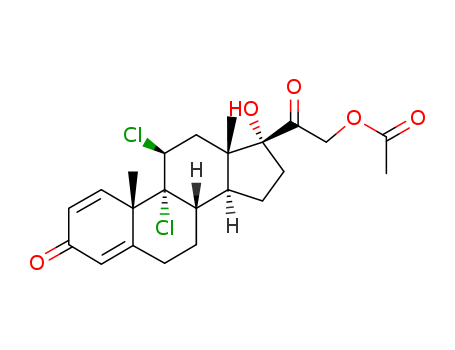
C23H28Cl2O5

Base Information
  • Chemical Name:C23H28Cl2O5
  • CAS No.:79-61-8
  • Molecular Formula:C23H28Cl2O5
  • Molecular Weight:455.378
  • Hs Code.:1302199099
  • DSSTox Substance ID:DTXSID401000180
  • Mol file:79-61-8.mol
C23H28Cl2O5

Synonyms:C23H28Cl2O5;C23-H28-Cl2-O5;SCHEMBL22527645;DTXSID401000180;AKOS026749851;BS-24317;9,11-Dichloro-17-hydroxy-3,20-dioxopregna-1,4-dien-21-yl acetate

Suppliers and Price of C23H28Cl2O5
Supply Marketing:
Business phase:
The product has achieved commercial mass production*data from LookChem market partment
Manufacturers and distributors:
  • Manufacture/Brand
  • Chemicals and raw materials
  • Packaging
  • price
  • Sigma-Aldrich
  • Dichlorisone acetate ≥97%
  • 500mg
  • $ 56.70
  • ChemScene
  • Dichlorisone acetate 99.77%
  • 50mg
  • $ 108.00
  • ChemScene
  • Dichlorisone acetate 99.77%
  • 10mg
  • $ 60.00
  • American Custom Chemicals Corporation
  • DICHLORISONE ACETATE 95.00%
  • 5G
  • $ 1050.24
  • American Custom Chemicals Corporation
  • DICHLORISONE ACETATE 95.00%
  • 1G
  • $ 695.39
  • American Custom Chemicals Corporation
  • DICHLORISONE ACETATE 95.00%
  • 500MG
  • $ 597.40
Total 16 raw suppliers
Chemical Property of C23H28Cl2O5
Chemical Property:
  • Vapor Pressure:1.06E-16mmHg at 25°C 
  • Refractive Index:1.585 
  • Boiling Point:596.2 °C at 760 mmHg 
  • Flash Point:314.4 °C 
  • PSA:80.67000 
  • Density:1.34 g/cm3 
  • LogP:3.73630 
  • XLogP3:3.1
  • Hydrogen Bond Donor Count:1
  • Hydrogen Bond Acceptor Count:5
  • Rotatable Bond Count:4
  • Exact Mass:454.1313794
  • Heavy Atom Count:30
  • Complexity:881
Purity/Quality:

99% *data from raw suppliers

Dichlorisone acetate ≥97% *data from reagent suppliers

Safty Information:
  • Pictogram(s):  
  • Hazard Codes: 
MSDS Files:

SDS file from LookChem

Useful:
  • Canonical SMILES:CC(=O)OCC(=O)C1(CCC2C1(CC(C3(C2CCC4=CC(=O)C=CC43C)Cl)Cl)C)O
  • Isomeric SMILES:CC(=O)OCC(=O)[C@]1(CCC2C1(CC([C@]3(C2CCC4=CC(=O)C=CC43C)Cl)Cl)C)O
  • Uses antipruretic
  • Therapeutic Function Antipruritic, Antihistaminic, Appetite stimulant
Technology Process of C23H28Cl2O5

There total 6 articles about C23H28Cl2O5 which guide to synthetic route it. The literature collected by LookChem mainly comes from the sharing of users and the free literature resources found by Internet computing technology. We keep the original model of the professional version of literature to make it easier and faster for users to retrieve and use. At the same time, we analyze and calculate the most feasible synthesis route with the highest yield for your reference as below:

synthetic route:
Guidance literature:
With p-toluenesulfonyl chloride; In pyridine; water; for 0.25h;
Guidance literature:
With di-(p-methoxyphenyl)tellurium oxide; In methanol; dichloromethane; for 21h;
Guidance literature:
With pyridine; selenium(IV) oxide; In tert-butyl alcohol;
DOI:10.1021/ja01500a051
Refernces

Synthesis, optical properties and protonation of chlorophyll derivatives appending a pyridyl group in the C3-substituent

10.1016/j.dyepig.2015.03.006

The research focuses on the synthesis, optical properties, and protonation of chlorophyll-a (Chl-a) derivatives that have a 2-(2/3/4-pyridyl)ethenyl group at the C3 position. The derivatives were synthesized using the Wittig reaction on methyl pyropheophorbide-d, which involved reactants such as 2/3/4-(chloromethyl)pyridine hydrochloride and triphenylphosphine. The resulting olefins were then subjected to catalytic hydrogenation using PtO2 in a mixed solvent of acetone and ethanol to yield the corresponding regioisomers. The optical properties of these derivatives were analyzed using visible absorption and fluorescence emission spectra, with the longest wavelength (Qy) maxima shifting bathochromically based on the linker between the chlorin and pyridyl moieties. Protonations were conducted by titrating the synthetic chlorophyll-pyridine conjugates with trifluoroacetic acid in chloroform, and the resulting visible spectral changes indicated the order of protonation. The analyses included the determination of association constants, high-resolution mass spectrometry (HRMS), and nuclear magnetic resonance (NMR) spectroscopy.


Post a RFQ

Enter 15 to 2000 letters.Word count: 0 letters

Attach files(File Format: Jpeg, Jpg, Gif, Png, PDF, PPT, Zip, Rar,Word or Excel Maximum File Size: 3MB)

1 Customer Service

What can I do for you?
Get Best Price

Get Best Price for 79-61-8