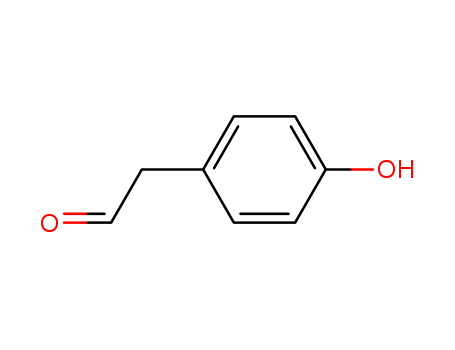
Chemical Property of 4-Hydroxyphenylacetaldehyde
Chemical Property:
- Vapor Pressure:0.00209mmHg at 25°C
- Melting Point:118℃
- Refractive Index:1.554
- Boiling Point:281.4 °C at 760 mmHg
- PKA:9.93±0.15(Predicted)
- Flash Point:117.9 °C
- PSA:37.30000
- Density:1.153 g/cm3
- LogP:1.13360
- Storage Temp.:-20?C Freezer
- XLogP3:0.5
- Hydrogen Bond Donor Count:1
- Hydrogen Bond Acceptor Count:2
- Rotatable Bond Count:2
- Exact Mass:136.052429494
- Heavy Atom Count:10
- Complexity:104
- Purity/Quality:
-
99%, *data from raw suppliers
4-Hydroxyphenylacetaldehyde,approximately~15%wt/volinEthylAcetate *data from reagent suppliers
Safty Information:
- Pictogram(s):
 Xi
Xi
- Hazard Codes:Xi
- MSDS Files:
-
SDS file from LookChem
Useful:
- Canonical SMILES:C1=CC(=CC=C1CC=O)O
-
General Description
2-(4-Hydroxyphenyl)acetaldehyde (also known as 4-hydroxyphenylacetaldehyde) is a key intermediate in the enzymatic synthesis of (S)-norcoclaurine, where it is generated via the oxidative decarboxylation of tyrosine using sodium hypochlorite. This aldehyde subsequently reacts with dopamine in a stereoselective Pictet-Spengler reaction catalyzed by (S)-norcoclaurine synthase (NCS) to form (S)-norcoclaurine, an important precursor in benzylisoquinoline alkaloid synthesis. The process highlights its role as a reactive electrophile in biocatalytic transformations.