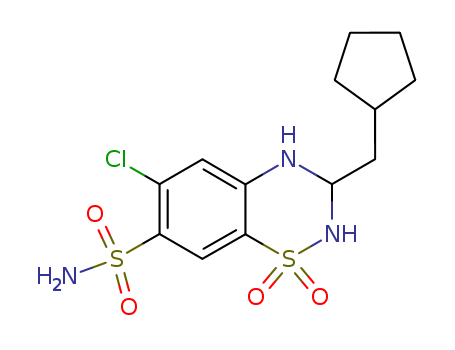
Chemical Property of Cyclopenthiazide
Chemical Property:
- Appearance/Colour:crystals
- Vapor Pressure:1.29E-14mmHg at 25°C
- Melting Point:238-242ºC
- Refractive Index:1.6
- Boiling Point:605.6 °C at 760 mmHg
- PKA:9.00±0.40(Predicted)
- Flash Point:320.1 °C
- PSA:135.12000
- Density:1.471 g/cm3
- LogP:4.92630
- Storage Temp.:Refrigerator
- Solubility.:Acetonitrile (Slightly), DMSO (Slightly), Methanol (Sparingly)
- Water Solubility.:50mg/L(room temperature)
- XLogP3:1.3
- Hydrogen Bond Donor Count:3
- Hydrogen Bond Acceptor Count:7
- Rotatable Bond Count:3
- Exact Mass:379.0427261
- Heavy Atom Count:23
- Complexity:637
- Purity/Quality:
-
99%, *data from raw suppliers
Cyclopenthiazide *data from reagent suppliers
Safty Information:
- Pictogram(s):
- Hazard Codes:
- MSDS Files:
-
SDS file from LookChem
Useful:
- Canonical SMILES:C1CCC(C1)CC2NC3=CC(=C(C=C3S(=O)(=O)N2)S(=O)(=O)N)Cl
-
Uses
Cyclopenthiazide is a thiazide diuretic. Cyclopenthiazide is used in the treatment of oedema caused by conditions such as kidney disease, liver cirrhosis and pre-menstrual syndrome as well as in the treatment of hypertension. Antihypertensive;Sodium Chloride Symporter Inhibitor
-
Clinical Use
Thiazide diuretic:
Hypertension
Heart failure
Oedema
-
Drug interactions
Potentially hazardous interactions with other drugs
Analgesics: increased risk of nephrotoxicity with
NSAIDs; antagonism of diuretic effect. Anti-arrhythmics: hypokalaemia leads to increased
cardiac toxicity; effects of lidocaine and mexiletine
antagonised.
Antibacterials: avoid administration with
lymecycline.
Antidepressants: increased risk of hypokalaemia
with reboxetine; enhanced hypotensive effect with
MAOIs; increased risk of postural hypotension with
tricyclics.
Antiepileptics: increased risk of hyponatraemia with
carbamazepine.
Antifungals: increased risk of hypokalaemia with
amphotericin.
Antihypertensives: enhanced hypotensive effect;
increased risk of first dose hypotension with post�synaptic alpha-blockers like prazosin; hypokalaemia
increases risk of ventricular arrhythmias with sotalol.
Antipsychotics: hypokalaemia increases risk
of ventricular arrhythmias with amisulpride;
enhanced hypotensive effect with phenothiazines;
hypokalaemia increases risk of ventricular
arrhythmias with pimozide - avoid.
Atomoxetine: hypokalaemia increases risk of
ventricular arrhythmias.
Cardiac glycosides: increased toxicity if hypokalaemia
occurs.
Ciclosporin: increased risk of nephrotoxicity and
possibly hypomagnesaemia.
Cytotoxics: increased risk of ventricular arrhythmias
due to hypokalaemia with arsenic trioxide; increased
risk of nephrotoxicity and ototoxicity with platinum
compounds.
Lithium: excretion reduced, increased toxicity