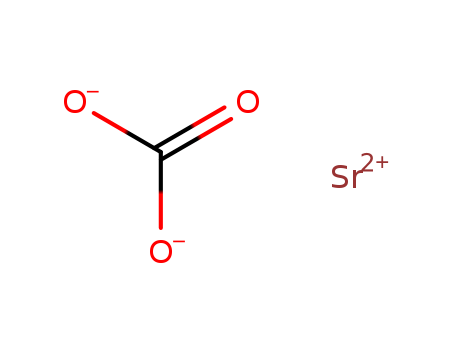
Chemical Property of Strontium carbonate
Chemical Property:
- Appearance/Colour:Milky white free flowing powder
- Vapor Pressure:2.58E-05mmHg at 25°C
- Melting Point:1497 °C
- Boiling Point:333.6 °C at 760 mmHg
- Flash Point:169.8 °C
- PSA:63.19000
- Density:3.7 g/mL at 25 °C(lit.)
- LogP:-2.44700
- Hydrogen Bond Donor Count:0
- Hydrogen Bond Acceptor Count:3
- Rotatable Bond Count:0
- Exact Mass:147.89035611
- Heavy Atom Count:5
- Complexity:18.8
- Purity/Quality:
-
97% *data from raw suppliers
Safty Information:
- Pictogram(s):
- Hazard Codes:
- MSDS Files:
-
SDS file from LookChem
Useful:
- Chemical Classes:Metals -> Metals, Inorganic Compounds
- Canonical SMILES:C(=O)([O-])[O-].[Sr+2]
- Inhalation Risk:A nuisance-causing concentration of airborne particles can be reached quickly.
- Effects of Short Term Exposure:May cause mechanical irritation to the eyes and respiratory tract.
-
Description
Strontium carbonate (SrCO3) is an inorganic compound composed of strontium, carbon, and oxygen. It typically exists as a white solid at room temperature. Strontium carbonate is categorized as an inorganic compound and specifically as a carbonate salt.
-
Uses
Industrial Applications:
Strontium Carbonate is used in the production of color television tubes, ceramic ferrite magnets, zinc, glass, pyrotechnics, paints, dryers, and strontium metal.
Biomaterials:
Incorporated into composite bioceramics for potential bone regenerative applications.
Flame Retardancy:
Strontium Carbonate is utilized as a synergistic agent in flame-retardant systems for polypropylene.
The consumption of strontium carbonate has increased significantly in various industrial applications, including the production of color television tubes, ceramic ferrite magnets, zinc, glass, pyrotechnics, paints, dryers, and strontium metal. The demand is expected to continue growing, especially due to the expansion of the electric vehicle market.
-
Medical Applications
Incorporated into composite bioceramics for bone regenerative applications, enhancing proliferation and osteogenesis-related gene expressions of bone mesenchymal stem cells.
-
Production Methods
Strontium carbonate is commercially produced from strontium sulfate contained in celestite ores. Commercial production methods include the "black ash" process, where celestite is reduced by carbon to yield strontium sulfide, which is then converted to strontium carbonate. Alternatively, strontium carbonate can be produced from celestite via the metathesis reaction with sodium bicarbonate.
-
References
[1] Preparation of strontium carbonate via celestite leaching in NaHCO3 using two interconnected reactors
DOI 10.1016/j.hydromet.2021.105729
[2] Strontium carbonate in glazes from the SiO2–Al2O3–CaO–MgO–Na2O–K2O system, sintering and surface properties
DOI 10.1016/j.oceram.2022.100233
[3] Synergistic effects of strontium carbonate on a novel intumescent flame-retardant polypropylene system
DOI 10.1002/pat.5314
[4] Fabrication of strontium carbonate-based composite bioceramics as potential bone regenerative biomaterials
DOI 10.1016/j.colsurfb.2022.112755