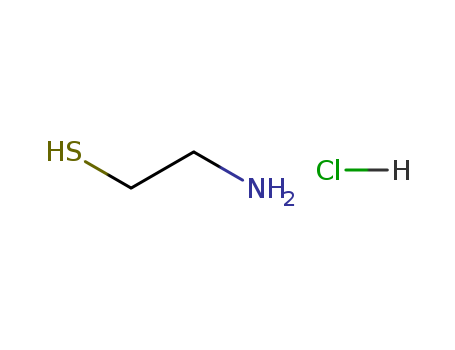
Chemical Property of 2-Sulfanylethylazanium;chloride
Chemical Property:
- Appearance/Colour:white crystalline powder with a strong and disagreeable smell
- Vapor Pressure:16.7mmHg at 25°C
- Melting Point:66-70 °C
- Refractive Index:1.6100 (estimate)
- Boiling Point:133.6 °C at 760 mmHg
- Flash Point:34.6 °C
- PSA:64.82000
- Density:0.75 g/cm3
- LogP:1.37720
- Storage Temp.:2-8°C
- Sensitive.:Hygroscopic
- Solubility.:H2O: 1 m at 20 °C, clear, colorless
- Water Solubility.:VERY SOLUBLE
- Hydrogen Bond Donor Count:2
- Hydrogen Bond Acceptor Count:2
- Rotatable Bond Count:1
- Exact Mass:113.0065981
- Heavy Atom Count:5
- Complexity:10
- Purity/Quality:
-
99% *data from raw suppliers
Cysteamine hydrochloride
*data from reagent suppliers
Safty Information:
- Pictogram(s):
 Xn
Xn
- Hazard Codes:Xn,Xi
- Statements:
22-36/37/38
- Safety Statements:
36/37/39-26-36
- MSDS Files:
-
SDS file from LookChem
Useful:
- Canonical SMILES:C(CS)[NH3+].[Cl-]
-
Description
Cysteamine is a stable aminothiol with radioprotective activities. It reduces ionizing radiation-induced death and chromosomal damage in mice in a dose-dependent manner. Cysteamine binds rapidly and temporarily to plasma proteins upon administration and this activity is directly correlated to its radioprotective effects. In vitro, 0.1 mM cysteamine depletes 90% of free cystine from cystinotic fibroblasts. Formulations containing cysteamine have been used to treat nephropathic cystinosis and reduce glomerular deterioration in humans.
-
Uses
Cysteamine hydrochloride is used as an antioxidant and in radiation therapy. Cysteamine hydrochloride has been used in the in-situ generation of chiral cysteamine-capped cadmium sulfide quantum dots (CA-CdS QDs) for the sensing of Cd2+ and S2-. An inhibitor of DMBA-induced mammary tumors2-Mercaptoethylamine hydrochloride acts as a precursor in taurine biosynthesis and component of coenzyme A. It is involved in the preparation of active pharmaceutical ingredients like ranitidine and nizatidine. It acts as an antidote for acetaminophen poisoning. Further, it is used in the oral treatment of nephropathic cystinosis, radiation sickness and disorders of cysteine excretion. In addition to this, it serves as an antioxidant and an inhibitor of 7,12-Dimethylbenz[a]anthracene (DMBA)-induced tumors.