Welcome to LookChem.com Sign In|Join Free
  • or

Encyclopedia

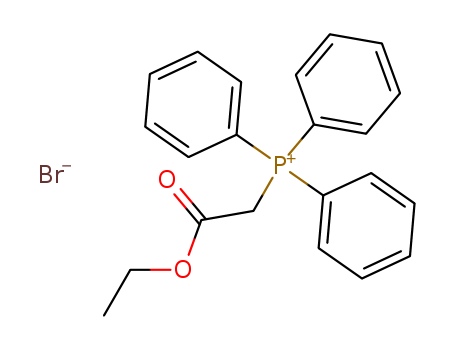
(Carbethoxymethyl)triphenylphosphonium bromide

Base Information
  • Chemical Name:(Carbethoxymethyl)triphenylphosphonium bromide
  • CAS No.:1530-45-6
  • Molecular Formula:C22H22BrO2P
  • Molecular Weight:429.293
  • Hs Code.:29310095
  • European Community (EC) Number:216-230-1,806-404-0
  • NSC Number:60450
  • DSSTox Substance ID:DTXSID40934653
  • Mol file:1530-45-6.mol
(Carbethoxymethyl)triphenylphosphonium bromide

Synonyms:(Carboxymethyl)triphenylphosphoniumbromide ethyl ester (6CI,7CI);(2-Ethoxy-2-oxoethyl)(triphenyl)phosphonium bromide;Carboethoxymethyltriphenylphosphonium bromide;Ethoxycarbonylmethyltriphenylphosphoniumbromide;NSC 60450;

Suppliers and Price of (Carbethoxymethyl)triphenylphosphonium bromide
Supply Marketing:
Business phase:
The product has achieved commercial mass production*data from LookChem market partment
Manufacturers and distributors:
  • Manufacture/Brand
  • Chemicals and raw materials
  • Packaging
  • price
  • Acrotein
  • (Carbethoxymethyl)triphenylphosphoniumbromide 97%
  • 500g
  • $ 165.00
  • AK Scientific
  • (Carbethoxymethyl)triphenylphosphoniumbromide
  • 500g
  • $ 200.00
  • AK Scientific
  • (Carbethoxymethyl)triphenylphosphoniumbromide
  • 100g
  • $ 49.00
  • AK Scientific
  • (Carbethoxymethyl)triphenylphosphoniumbromide
  • 100g
  • $ 67.00
  • AK Scientific
  • (Carbethoxymethyl)triphenylphosphoniumbromide
  • 1kg
  • $ 482.00
  • Alfa Aesar
  • (Ethoxycarbonylmethyl)triphenylphosphonium bromide, 98+%
  • 500g
  • $ 374.00
  • Alfa Aesar
  • (Ethoxycarbonylmethyl)triphenylphosphonium bromide, 98+%
  • 25g
  • $ 30.80
  • Alfa Aesar
  • (Ethoxycarbonylmethyl)triphenylphosphonium bromide, 98+%
  • 100g
  • $ 81.30
  • Alichem
  • (2-Ethoxy-2-oxoethyl)triphenylphosphoniumbromide
  • 1000g
  • $ 247.50
  • Ambeed
  • (2-Ethoxy-2-oxoethyl)triphenylphosphoniumbromide 98%
  • 1kg
  • $ 226.00
Total 110 raw suppliers
Chemical Property of (Carbethoxymethyl)triphenylphosphonium bromide
Chemical Property:
  • Appearance/Colour:white or pale yellow powder 
  • Melting Point:145-150 °C (dec.)(lit.) 
  • PSA:39.89000 
  • LogP:0.54760 
  • Storage Temp.:2-8°C 
  • Sensitive.:Hygroscopic 
  • Solubility.:Chloroform (Slightly), Methanol (Slightly) 
  • Water Solubility.:It is soluble in water. 
  • Hydrogen Bond Donor Count:0
  • Hydrogen Bond Acceptor Count:3
  • Rotatable Bond Count:7
  • Exact Mass:428.05408
  • Heavy Atom Count:26
  • Complexity:359
Purity/Quality:

99% *data from raw suppliers

(Carbethoxymethyl)triphenylphosphoniumbromide 97% *data from reagent suppliers

Safty Information:
  • Pictogram(s): IrritantXi 
  • Hazard Codes:Xi 
  • Statements: 36/37/38 
  • Safety Statements: 26-36-24/25 
MSDS Files:

SDS file from LookChem

Useful:
  • Canonical SMILES:CCOC(=O)C[P+](C1=CC=CC=C1)(C2=CC=CC=C2)C3=CC=CC=C3.[Br-]
  • Uses suzuki reaction (Ethoxycarbonylmethyl)triphenylphosphonium bromide, is used as a pharmaceutical intermediate.
Technology Process of (Carbethoxymethyl)triphenylphosphonium bromide

There total 23 articles about (Carbethoxymethyl)triphenylphosphonium bromide which guide to synthetic route it. The literature collected by LookChem mainly comes from the sharing of users and the free literature resources found by Internet computing technology. We keep the original model of the professional version of literature to make it easier and faster for users to retrieve and use. At the same time, we analyze and calculate the most feasible synthesis route with the highest yield for your reference as below:

synthetic route:
Guidance literature:
In xylene; for 0.00833333h; Heating; microwave irradiation;
DOI:10.1081/SCC-100106048
Guidance literature:
With triphenylphosphine; In benzene; at 20 ℃; Inert atmosphere;
DOI:10.1055/s-0030-1261188
Refernces

Photochemical Rearrangement of 2-Substituted 4-Alkylidene-2,3-epoxy-1-tetralone to 3-(2-oxoalkylidene)-1-indanone

10.1246/cl.1986.1849

The research investigates the photochemical rearrangement of 2-substituted 4-alkylidene-2,3-epoxy-1-tetralone to 3-(2-oxoalkylidene)-1-indanone. The purpose is to explore the photoreactions of α,β-epoxy ketones and understand the factors determining their reaction pathways. Key chemicals used include 2-substituted 4-methylidene-2,3-epoxy-1-tetralones (1a-e), benzene, and Wittig reagent. The study found that irradiation of these compounds in benzene solution under an argon atmosphere led to the formation of 3-alkylidene-1-indanones (2a-e) with yields ranging from 27% to 56%. The photoreactions are suggested to occur from the (π, π*) triplet excited state. The research concludes that the nature of the excited state and the localization of excitation energy in the starting molecules significantly influence the reaction outcomes.

Post a RFQ

Enter 15 to 2000 letters.Word count: 0 letters

Attach files(File Format: Jpeg, Jpg, Gif, Png, PDF, PPT, Zip, Rar,Word or Excel Maximum File Size: 3MB)

1 Customer Service

What can I do for you?
Get Best Price

Get Best Price for 1530-45-6