Welcome to LookChem.com Sign In|Join Free
  • or

Encyclopedia

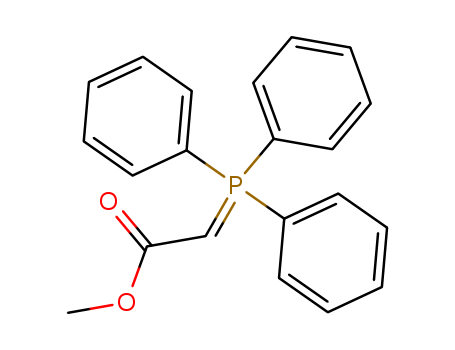
Methyl (triphenylphosphoranylidene)acetate

Base Information
  • Chemical Name:Methyl (triphenylphosphoranylidene)acetate
  • CAS No.:2605-67-6
  • Deprecated CAS:1057663-72-5
  • Molecular Formula:C21H19O2P
  • Molecular Weight:334.354
  • Hs Code.:29319090
  • European Community (EC) Number:220-018-4
  • NSC Number:407395,117573
  • UNII:D9MZ753Q8K
  • DSSTox Substance ID:DTXSID6062549
  • Nikkaji Number:J708.334C,J24.865G
  • Wikipedia:Carbomethoxymethylenetriphenylphosphorane
  • Wikidata:Q72492251
  • ChEMBL ID:CHEMBL1715161
  • Mol file:2605-67-6.mol
Methyl (triphenylphosphoranylidene)acetate

Synonyms:2605-67-6;Methyl (triphenylphosphoranylidene)acetate;Methyl 2-(triphenylphosphoranylidene)acetate;(Carbomethoxymethylene)triphenylphosphorane;CARBOMETHOXYMETHYLENE TRIPHENYLPHOSPHORANE;Acetic acid, (triphenylphosphoranylidene)-, methyl ester;Triphenyl(carbomethoxymethylene)phosphorane;(Triphenylphosphoranylidene)acetic acid methyl ester;MFCD00008455;Methyl triphenylphosphoranylideneacetate;(Methoxycarbonylmethylene)triphenylphosphorane;METHYL(TRIPHENYLPHOSPHORANYLIDENE)ACETATE;methyl 2-(triphenyl-lambda5-phosphanylidene)acetate;C21H19O2P;Acetic acid, 2-(triphenylphosphoranylidene)-, methyl ester;[(Methoxycarbonyl)methylene]triphenylphosphorane;D9MZ753Q8K;((Methoxycarbonyl)methylene)triphenylphosphorane;EINECS 220-018-4;NSC 117573;NSC 407395;NSC-117573;NSC-407395;Carbomethoxymethylenetriphenylphosphorane;2-(triphenylphosphoranylidene)acetic acid methyl ester;Methyl (triphenylphosphoranylidene) acetate;(Carbomethoxymethylene)triphenylphosphine;(Carbomethoxymethylidene)triphenylphosphorane;SCHEMBL9094;UNII-D9MZ753Q8K;METHOXYCARBONYLMETHYLENE-TRIPHENYLPHOSPHORANE;methyl triphenylphosphonoacetate;CHEMBL1715161;DTXSID6062549;AMY42253;BCP27417;methyl triphenylphosphanylideneacetate;methyl triphenylphosphorylideneacetate;NSC117573;NSC407395;Triphenylphosphinecarbomethoxymethylene;AKOS015836829;carbomethoxymethylene triphenylphosphine;CS-W008922;GS-3123;Methyl (triphenyphosphoranylidene)acetate;methyl triphenylphosphoranylidene-acetate;methyl(triphenylphosphoranylideneacetate);s12312;methyl (triphenyl phosphanylidene)acetate;methyl(triphenyl-phosphoranylidene)acetate;methyl(triphenylphos-phoranylidene)acetate;methyl(triphenylphosphoranylidene)-acetate;NCGC00161084-01;NCGC00161084-02;(carbmethoxymethylene)-triphenylphosphorane;carbomethoxy methylene triphenylphosphorane;methoxy-carbonylmethylenetriphenylphosphine;methoxycarbonylmethylen-triphenylphosphoran;methoxycarbonylmethylenetriphenylphosphorane;Methyl (triphenylphosphoranilidine)acetate;Methyl 2-triphenylphosphoranylideneacetate;SY013419;(carbomethoxymethylene) triphenylphosphorane;(carbomethoxymethylene)-triphenylphosphorane;(carbomethoxymethylene)triphenyl phosphorane;(methoxycarbonylmethylen)triphenylphosphoran;(triphenylphosphoranylidene) methyl acetate;methoxylcarbonylmethylenetriphenylphosphorane;methyl (triphenyl phosphoranylidene)acetate;methyl (triphenyl-phosphoranylidene)acetate;methyl (triphenylphos-phoranylidene)acetate;methyl (triphenylphosphoranylidene)-acetate;methyl-(triphenylphosphoranylidene)-acetate;Triphenylphosphoranylideneacetic acid methyl;methoxycarbonylmethylene triphenylphosphorane;methoxycarbonylmethylenetriphenyl phosphorane;methoxycarbonylmethylenetriphenylphosphor-ane;(carbomethoxymethylene) triphenyl phosphorane;FT-0623468;methoxycarbonyl-methylene-triphenylphosphorane;T1363;(methoxycarbonylmethylene) triphenylphosphorane;(methoxycarbonylmethylene)-triphenylphosphorane;EN300-82242;methyl 2-(triphenyl-5-phosphanylidene)acetate;(2-methoxy-2-oxoethylidene)triphenylphosphorane;Methyl (triphenylphosphoranylidene)acetate, 98%;(1-methoxycarbonylmethylidene)triphenylphosphoran;(methoxycarbonyl methylene) triphenyl phosphorane;[(methoxycarbonyl)methylene]-triphenylphosphorane;triphenyl phosphanyliden-acetic acid methyl ester;(triphenylphosphanylidene)-acetic acid methyl ester;(Triphenylphosphoranyliden)acetic acid methyl ester;METHYL (TRIPHENYLPHOSPHORANYLIDENE)ETHANOATE;(triphenyl-phosphanylidene)-acetic acid methyl ester;1-(Triphenylphosphonio)-2-oxo-2-methoxyethan-1-ide;triphenyl-phosphoranylidene acetic acid methyl ester;W-109807;METHYL 2-(TRIPHENYL-??-PHOSPHANYLIDENE)ACETATE;F0001-0864;(triphenyl-lambda5-phosphanylidene)-acetic acid methyl ester;(Triphenyl-lambda*5*-phosphanylidene)acetic acid methyl ester;Methyl (triphenylphosphoranylidene)acetate, purum, >=97.0% (CH)

Suppliers and Price of Methyl (triphenylphosphoranylidene)acetate
Supply Marketing:
Business phase:
The product has achieved commercial mass production*data from LookChem market partment
Manufacturers and distributors:
  • Manufacture/Brand
  • Chemicals and raw materials
  • Packaging
  • price
  • TRC
  • Methyl (triphenylphosphoranylidene)acetate
  • 250 g
  • $ 605.00
  • TCI Chemical
  • Methyl (Triphenylphosphoranylidene)acetate >98.0%(HPLC)(T)
  • 100g
  • $ 274.00
  • TCI Chemical
  • Methyl (Triphenylphosphoranylidene)acetate >98.0%(HPLC)(T)
  • 25g
  • $ 83.00
  • SynQuest Laboratories
  • Methyl (triphenylphosphoranylidene)acetate 98%
  • 25 g
  • $ 24.00
  • SynQuest Laboratories
  • Methyl (triphenylphosphoranylidene)acetate 98%
  • 100 g
  • $ 61.00
  • Sigma-Aldrich
  • Methyl (triphenylphosphoranylidene)acetate 98%
  • 100g
  • $ 243.00
  • Sigma-Aldrich
  • Methyl (triphenylphosphoranylidene)acetate 98%
  • 25g
  • $ 99.00
  • Sigma-Aldrich
  • Methyl (triphenylphosphoranylidene)acetate 98%
  • 5g
  • $ 38.20
  • Oakwood
  • (Carbomethoxymethylene)triphenylphosphorane 98%
  • 1g
  • $ 10.00
  • Oakwood
  • (Carbomethoxymethylene)triphenylphosphorane 98%
  • 25g
  • $ 25.00
Total 112 raw suppliers
Chemical Property of Methyl (triphenylphosphoranylidene)acetate
Chemical Property:
  • Appearance/Colour:white to off-white powder 
  • Vapor Pressure:0mmHg at 25°C 
  • Melting Point:168-172 °C(lit.) 
  • Refractive Index:1.608 
  • Boiling Point:479.138 °C at 760 mmHg 
  • Flash Point:256.768 °C 
  • PSA:36.11000 
  • Density:1.177 g/cm3 
  • LogP:2.95570 
  • Storage Temp.:Refrigerator (+4°C) 
  • Sensitive.:Air Sensitive 
  • Solubility.:Acetonitrile (Slightly), Chloroform (Slightly) 
  • Water Solubility.:insoluble 
  • XLogP3:4
  • Hydrogen Bond Donor Count:0
  • Hydrogen Bond Acceptor Count:2
  • Rotatable Bond Count:5
  • Exact Mass:334.11226684
  • Heavy Atom Count:24
  • Complexity:400
Purity/Quality:

99% *data from raw suppliers

Methyl (triphenylphosphoranylidene)acetate *data from reagent suppliers

Safty Information:
  • Pictogram(s): ToxicT, IrritantXi 
  • Hazard Codes:T,Xi 
  • Statements: 36/37/38-25 
  • Safety Statements: 22-24/25-36-26 
MSDS Files:

SDS file from LookChem

Useful:
  • Canonical SMILES:COC(=O)C=P(C1=CC=CC=C1)(C2=CC=CC=C2)C3=CC=CC=C3
  • Uses (Methoxycarbonylmethylene)triphenylphosphorane is used in olefination reactions. Wittig reagent for the two-carbon homologation of aldehydes to α,β-unsaturated esters. it undergoes the Wittig reaction with aldehydes to give substituted methyl acrylates. used in an efficient synthesis of pyrazoles via reaction with methyl diazoacetate in the presence of triethylamine. It is used in the preparation of (triphenylphosphoranylidene)-ketene. The Wittig reaction we performed in class involved the reaction of 2-nitrobenzaldehyde (1) with methyl (triphenylphosphoranylidene) acetate (2) to produce methyl (2E)-3-(2-nitrophenyl) acrylate (3) with a triphenylphosphine oxide (4) side product, and took place in a silica gel matrix to ensure even product dispersion for chromatography. (Methoxycarbonylmethylene)triphenylphosphorane is used in olefination reactions. Further, it undergoes the Wittig reaction with aldehydes to give substituted methyl acrylates. It is used in the preparation of (triphenylphosphoranylidene)-ketene. Wittig reagent for the two-carbon homologation of aldehydes to α,β-unsaturated esters. Also used in an efficient synthesis of pyrazoles via reaction with methyl diazoacetate in the presence of triethylamine.
Technology Process of Methyl (triphenylphosphoranylidene)acetate

There total 12 articles about Methyl (triphenylphosphoranylidene)acetate which guide to synthetic route it. The literature collected by LookChem mainly comes from the sharing of users and the free literature resources found by Internet computing technology. We keep the original model of the professional version of literature to make it easier and faster for users to retrieve and use. At the same time, we analyze and calculate the most feasible synthesis route with the highest yield for your reference as below:

synthetic route:
Guidance literature:
With sodium hydroxide; In dichloromethane; at 21 ℃; for 0.333333h;
DOI:10.1021/acs.orglett.7b00217
Guidance literature:
bromoacetic acid methyl ester; triphenylphosphine; In ethyl acetate;
With sodium hydroxide; In water; for 0.333333h;
DOI:10.1021/jo4023606
Refernces

Synthesis and in?vitro antitumour activity of crassalactone D, its stereoisomers and novel cinnamic ester derivatives

10.1016/j.ejmech.2017.03.088

The research presents a comprehensive study on the synthesis and in vitro antitumor activity of crassalactone D, its stereoisomers, and novel cinnamic ester derivatives. The purpose of the study was to develop a new one-pot synthesis method for these compounds starting from D-glucose and evaluate their cytotoxic effects against various human tumor cell lines. The conclusions drawn from the research indicate that many of the synthesized compounds exhibited potent cytotoxicities, with some showing higher potency than the commercial antitumor agent doxorubicin. The study also highlighted the importance of stereochemistry at the C-4 and C-7 positions, as well as the nature of the substituent at the C-4 position in the aromatic ring of the cinnamoate moiety, for biological activity. The chemicals used in the process included D-glucose, (methoxycarbonylmethylene)triphenylphosphorane (MCMP), (ethoxycarbonylmethylene)triphenylphosphorane (ECMP), cinnamoyl chloride, 4-nitrocinnamoyl chloride, 4-methoxycinnamic acid, and 4-fluorocinnamic acid, among others. The synthesized products were assessed for their in vitro antiproliferative activity, and the results were supported by flow cytometry and Western blot analysis, providing insights into the apoptotic mechanisms triggered by the compounds.

A SYNTHESIS OF L-lyxo-L-altro-NONITOL, A NEW NONITOL

10.1016/0008-6215(86)84007-1

The study focuses on the synthesis of L-lyxo-L-altro-nonitol, a new nonitol compound. The researchers used catalytic osmylation of (E)-6-O-benzyl-7,8-dideoxy-1,2:3,4-di-O-isopropylidene-α-D-glycero-D-galacto-non-7-enopyranose (1.5) to obtain a mixture of 6-O-benzyl-1,2:3,4-di-O-isopropylidene-α-L-lyxo-D-gulacto-nonopyranose (16) and the α-D-xylo-D-gulacto isomer 17. After debenzylation, crystalline 1,2:3,4-di-O-isopropylidene-α-L-lyxo-D-gulacto-nonopyranose (21) was isolated and converted into L-lyxo-L-altro-nonitol (L-lyxo-D-gulacto-nonitol) (23). The study also explored the preparation of the allylic alcohol 15 through Wittig olefination of 6-O-benzyl-1,2:3,4-di-O-isopropylidene-α-D-glycero-D-galacto-heptodiol-1,5-pyranose (13) with formylmethylenetriphenylphosphorane or (methoxycarbonylmethylene)triphenylphosphorane, followed by appropriate reduction of the enal 14 or conjugate ester 24. The study provides a new route to nonoses and nonitols, which have been traditionally challenging to synthesize.

The reactions of triphenylphosphine alkylenes with 3(2-thienyl)acrylonitriles

10.1080/10426500307778

The research investigates the reactions of triphenylphosphine alkylenes with 3(2-thienyl)acrylonitriles, aiming to explore the formation of various products under different reaction conditions and the influence of the substituents on the reaction outcomes. Key chemicals involved include ethyl 3-(2-thienyl)acrylocyanoacetate (1b), various ylides such as (methoxycarbonylmethylene)triphenylphosphorane (2a), (ethoxycarbonylmethylene)triphenylphosphorane (2b), (benzoylmethylene)triphenylphosphorane (2c), and (cyanomethylene)triphenylphosphorane (14). The study found that the initial Michael addition of ylides to the exocyclic methide carbon in 1b leads to diverse products depending on the nature of the ylide and reaction conditions. For instance, reactions with 2a and 2b in the presence of triethylamine yielded cyclopropane derivatives and new ylides, while the reaction with 2c in ethyl acetate containing benzoic acid produced a pyran derivative. The reaction of (cyanomethylene)triphenylphosphorane (14) with 1b resulted in a cyclopropane derivative, whereas with malonitrile 1a, it produced a ylide and a propene derivative. The research concludes that the substituents on the ylides and the reaction conditions significantly affect the reaction pathways and products, highlighting the versatility of these reactions in synthesizing complex organic compounds with potential biological activities.

Pyranonaphthoquinone Antibiotics. Part 1. Syntheses of 9-Demethoxyeleutherins and 9-Deoxynanaomycin A Methyl Ester.

10.1039/P19810001191

The research focuses on the synthesis of 9-demethoxyeleutherins and 9-deoxynanaomycin A methyl ester, which are pyranonaphthoquinone antibiotics known for their antimicrobial properties. The study aims to develop new synthetic routes to these complex molecules, potentially leading to the total synthesis of even more complex compounds like griseusin A and granaticin. The synthesis processes involve the use of indan-1-one derivatives as precursors, employing various chemical reactions such as Lemieux-Johnson oxidation, lithium aluminium hydride reduction, and Diels-Alder reactions. Key chemicals used in the process include indanone derivatives, methanol, acetonitrile, cerium(IV) ammonium nitrate, and methoxycarbonylmethylene-triphenylphosphorane.

Propenyl Carboxamide Derivatives as Antagonists of Platelet Activating Factor

10.1021/jm00172a029

This research aimed to develop a series of propenyl carboxamide derivatives as antagonists of Platelet Activating Factor (PAF), a phospholipid mediator involved in allergic and inflammatory diseases. The researchers synthesized and evaluated these compounds, which were conformationally constrained analogues of potent aryl-pentadienecarboxamides. The chemicals used in the synthesis included various aldehydes,(carbomethoxymethylene)triphenylphosphorane, sodium hydroxide, dicyclohexylcarbodiimide, 4-nitrophenol, and specific amines, among others. The research concluded that the position of methoxy groups and the nature of the linking unit "A" significantly influenced the oral bioavailability and activity of the compounds, providing valuable insights for the design of PAF antagonists.

Post a RFQ

Enter 15 to 2000 letters.Word count: 0 letters

Attach files(File Format: Jpeg, Jpg, Gif, Png, PDF, PPT, Zip, Rar,Word or Excel Maximum File Size: 3MB)

1 Customer Service

What can I do for you?
Get Best Price

Get Best Price for 2605-67-6