Welcome to LookChem.com Sign In|Join Free
  • or

Encyclopedia

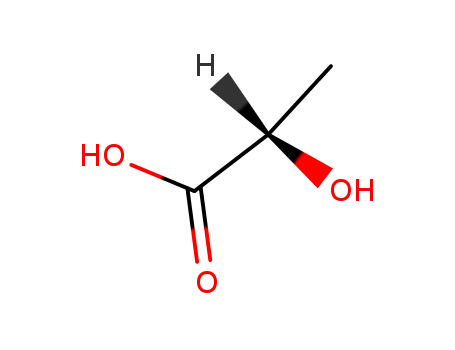
L-Lactic acid

Base Information
  • Chemical Name:L-Lactic acid
  • CAS No.:79-33-4
  • Deprecated CAS:1715-99-7
  • Molecular Formula:C3H6O3
  • Molecular Weight:90.0788
  • Hs Code.:29181100
  • European Community (EC) Number:201-196-2
  • UNII:F9S9FFU82N
  • DSSTox Substance ID:DTXSID6034689
  • Nikkaji Number:J9.134K
  • Wikidata:Q27080955
  • NCI Thesaurus Code:C61808
  • RXCUI:2462499
  • Metabolomics Workbench ID:37125
  • ChEMBL ID:CHEMBL330546
  • Mol file:79-33-4.mol
L-Lactic acid

Synonyms:2 Hydroxypropanoic Acid;2 Hydroxypropionic Acid;2-Hydroxypropanoic Acid;2-Hydroxypropionic Acid;Ammonium Lactate;D Lactic Acid;D-Lactic Acid;L Lactic Acid;L-Lactic Acid;Lactate;Lactate, Ammonium;Lactic Acid;Propanoic Acid, 2-Hydroxy-, (2R)-;Propanoic Acid, 2-Hydroxy-, (2S)-;Sarcolactic Acid

Suppliers and Price of L-Lactic acid
Supply Marketing:
Business phase:
The product has achieved commercial mass production*data from LookChem market partment
Manufacturers and distributors:
  • Manufacture/Brand
  • Chemicals and raw materials
  • Packaging
  • price
  • TRC
  • L-LacticAcid,90%
  • 10g
  • $ 105.00
  • TCI Chemical
  • L-Lactic Acid >85.0%(T)
  • 500g
  • $ 52.00
  • TCI Chemical
  • L-Lactic Acid >85.0%(T)
  • 25g
  • $ 27.00
  • SynQuest Laboratories
  • L-(+)-Lactic acid 98.0%
  • 50 g
  • $ 120.00
  • SynQuest Laboratories
  • L-(+)-Lactic acid 98.0%
  • 100 g
  • $ 200.00
  • SynQuest Laboratories
  • L-(+)-Lactic acid 98.0%
  • 250 g
  • $ 448.00
  • Sigma-Aldrich
  • L-(+)-Lactic acid ≥98%
  • 100g
  • $ 571.00
  • Sigma-Aldrich
  • L-(+)-Lactic acid solution ~40% in H2O
  • 1l
  • $ 539.00
  • Sigma-Aldrich
  • L-(+)-Lactic acid solution meets analytical specification of Ph. Eur., BP, 88-92% total acid basis
  • 6x1l
  • $ 507.00
  • Sigma-Aldrich
  • L-(+)-Lactic acid solution meets analytical specification of Ph. Eur., BP, 88-92% total acid basis
  • 4x2.5l
  • $ 623.00
Total 217 raw suppliers
Chemical Property of L-Lactic acid
Chemical Property:
  • Appearance/Colour:crystalline solid 
  • Vapor Pressure:0.038Pa at 25℃ 
  • Melting Point:52-54 °C 
  • Refractive Index:n20/D 1.427  
  • Boiling Point:227.6 °C at 760 mmHg 
  • PKA:pK at 25°, 3.79 
  • Flash Point:109.9 °C 
  • PSA:57.53000 
  • Density:1.276 g/cm3 
  • LogP:-0.54820 
  • Storage Temp.:2-8°C 
  • Sensitive.:Hygroscopic 
  • Solubility.:H2O: 10 mg/mL, clear, colorless 
  • Water Solubility.:SOLUBLE 
  • XLogP3:-0.7
  • Hydrogen Bond Donor Count:2
  • Hydrogen Bond Acceptor Count:3
  • Rotatable Bond Count:1
  • Exact Mass:90.031694049
  • Heavy Atom Count:6
  • Complexity:59.1
Purity/Quality:

≥99.2% *data from raw suppliers

L-LacticAcid,90% *data from reagent suppliers

Safty Information:
  • Pictogram(s): IrritantXi,Corrosive
  • Hazard Codes:Xi,C 
  • Statements: 38-41-34-36/37/38-36-35 
  • Safety Statements: 26-39-45-36/37/39-36 
MSDS Files:

SDS file from LookChem

Total 1 MSDS from other Authors

Useful:
  • Chemical Classes:Other Classes -> Organic Acids
  • Canonical SMILES:CC(C(=O)O)O
  • Isomeric SMILES:C[C@@H](C(=O)O)O
  • Recent EU Clinical Trials:A prospective, randomised, double-blinded, placebo-controlled study investigating the safety and tolerability of STA363 in patients with radiculopathy caused by lumbar disc herniation
  • Recent NIPH Clinical Trials:ADL quantification using ankle device and Barthel Index Score in elderly people.
  • General Description L(+)-Lactic acid is a naturally occurring chiral compound used as a starting material in the synthesis of enantiopure 2-(hydroxyalkyl)pyridine derivatives, which are important for asymmetric catalysis. Its (S)-configuration makes it a valuable precursor in chiral pool strategies for producing stereochemically defined intermediates. L(+)-Lactic acid's utility lies in its ability to contribute to the formation of complex chiral structures, such as hydroxyalkylpyridines and bipyridines, through reactions like lithiation, reduction, and coupling. Its role in these syntheses is confirmed by analytical techniques, including NMR spectroscopy and optical rotation measurements.
Technology Process of L-Lactic acid

There total 177 articles about L-Lactic acid which guide to synthetic route it. The literature collected by LookChem mainly comes from the sharing of users and the free literature resources found by Internet computing technology. We keep the original model of the professional version of literature to make it easier and faster for users to retrieve and use. At the same time, we analyze and calculate the most feasible synthesis route with the highest yield for your reference as below:

synthetic route:
Guidance literature:
With Leuconostoc mesenteroides; at 30 ℃; for 1h; potassium phosphate buffer, pH 5.0; other conditions also investigated; several substrates investigated;
Guidance literature:
With Leuconostoc mesenteroides; at 30 ℃; for 1h; potassium phosphate buffer, pH 5.0; other conditions also investigated; several substrates investigated;
Guidance literature:
With Pseudomonas putida HK-5 pyrroloquinoline quinone-dependent alcohol dehydrogenase; 4,4'-azobis(1-methylpyridinium) bis(methyl sulfate); NADH; In aq. buffer; for 2h; pH=7.1; enantioselective reaction; Catalytic behavior; Electrolysis; Enzymatic reaction;
DOI:10.1016/j.procbio.2017.01.006
Refernces

Scaffold-optimized dendrimers for the detection of the triacetone triperoxide explosive using quartz crystal microbalances

10.1002/cplu.201100080

The research focuses on the development of scaffold-optimized dendrimers for the detection of the explosive triacetone triperoxide (TATP) using quartz crystal microbalances (QCM). The purpose of this study is to enhance the sensitivity and selectivity of TATP detection, addressing the limitations of existing methods that rely on the analysis of H2O2 after hydrolysis or dissociation of TATP, which are time-consuming and not suitable for low-cost sensor technology. The researchers synthesized a series of polyphenylene dendrimers with various substituents at the internal branches, aiming to improve the affinity and selectivity for TATP. The chemicals used in the process include triacetone triperoxide (TATP) itself, polyphenylene dendrimers with different functional groups such as pyrenyl, pyridyl, nitro, cyano, and amide moieties, as well as tetraphenylcyclopentadienone and other reagents involved in the synthesis of the dendrimers. The conclusions drawn from the study indicate that the novel polyphenylene-type dendrimers, particularly those containing pyrenyl and cyanophenyl units, not only significantly enhanced the affinity to TATP but also improved selectivity over interfering compounds, allowing for exquisite discrimination of TATP. The study identified compound 5, a nonpolar and pyrenyl-containing dendrimer, as the most promising candidate for TATP sensor applications due to its superior overall characteristics in detection.

Enantioselective total synthesis of macrosphelides A and e

10.1016/j.tet.2011.04.099

The study describes a concise and efficient enantioselective synthesis of the 16-membered trilactone macrolides, macrosphelides A and E, from (S)-lactic acid. The synthesis features the use of a previously unexplored ?-ketophosphonate derived from lactic acid and the Yamaguchi lactonization method. The study begins with the addition of a lithium anion to ethyl (S)-trityloxy lactate to form the ?-ketophosphonate, which is then reacted with allylglyoxalate to produce a,?-unsaturated esters. Reduction of these esters yields diastereomeric alcohols, which are subsequently transformed into the required acid and alcohol fragments through protection, saponification, and coupling reactions. The final macro trilactone is obtained via esterification, deprotection, and lactonization steps, yielding macrosphelides A and E with high purity. The overall yield of the synthesis is approximately 19%, and the spectral data of the synthesized compounds match those of the natural products. The procedure is operationally simple and high-yielding, making it suitable for the synthesis of various analogues for potential anti-cancer drug development.

Preparation of chiral enantiopure 2-(hydroxyalkyl)pyridine derivatives. Use of the chiral pool

10.1039/b000269k

The research focuses on the preparation of chiral enantiopure 2-(hydroxyalkyl)pyridine derivatives, which are valuable in asymmetric catalysis. The experiments utilize naturally occurring chiral compounds such as D-mannitol, L-lactic acid, and L-mandelic acid as starting materials. Key reactants include 2-lithiopyridine, (R)-2,3-O-isopropylideneglyceraldehyde, and various esters derived from the aforementioned chiral compounds. The methodology involves the synthesis of 2-(1-hydroxyalkyl)pyridines and 6,6'-bis(1-hydroxyalkyl)-2,2'-bipyridines through a series of reactions, including lithiation, reduction with sodium borohydride, and nickel-catalyzed coupling. The analyses used to determine the success of the syntheses and the structures of the products encompass NMR spectroscopy (both 1H and 13C), optical rotation measurements, and in some cases, the preparation and analysis of Mosher's esters to determine the absolute configurations of the synthesized chiral alcohols.

Post a RFQ

Enter 15 to 2000 letters.Word count: 0 letters

Attach files(File Format: Jpeg, Jpg, Gif, Png, PDF, PPT, Zip, Rar,Word or Excel Maximum File Size: 3MB)

1 Customer Service

What can I do for you?
Get Best Price

Get Best Price for 79-33-4
