Welcome to LookChem.com Sign In|Join Free
  • or

Encyclopedia

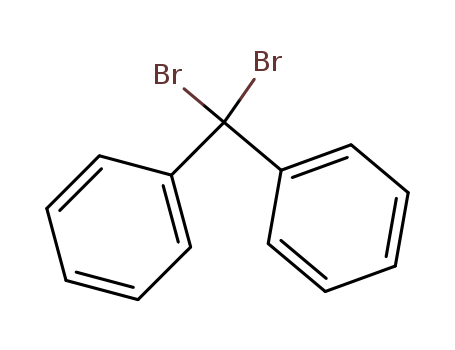
Dibromodiphenylmethane

Base Information
  • Chemical Name:Dibromodiphenylmethane
  • CAS No.:6425-27-0
  • Molecular Formula:C13H10Br2
  • Molecular Weight:326.03
  • Hs Code.:
  • DSSTox Substance ID:DTXSID50376404
  • Nikkaji Number:J488.631C
  • Wikidata:Q82165340
  • Mol file:6425-27-0.mol
Dibromodiphenylmethane

Synonyms:DIBROMODIPHENYLMETHANE;6425-27-0;[dibromo(phenyl)methyl]benzene;Diphenyldibrommethan;Diphenylmethylene bromide;SCHEMBL1538898;DTXSID50376404;HNBFCAMUUALGHT-UHFFFAOYSA-N;FT-0624669

Suppliers and Price of Dibromodiphenylmethane
Supply Marketing:
Business phase:
The product has achieved commercial mass production*data from LookChem market partment
Manufacturers and distributors:
  • Manufacture/Brand
  • Chemicals and raw materials
  • Packaging
  • price
  • American Custom Chemicals Corporation
  • DIBROMODIPHENYLMETHANE 98.00%
  • 5G
  • $ 1790.25
Total 15 raw suppliers
Chemical Property of Dibromodiphenylmethane
Chemical Property:
  • Boiling Point:335.5 °C at 760 mmHg 
  • Flash Point:182 °C 
  • PSA:0.00000 
  • Density:1.662 g/cm3 
  • LogP:4.67750 
  • XLogP3:4.9
  • Hydrogen Bond Donor Count:0
  • Hydrogen Bond Acceptor Count:0
  • Rotatable Bond Count:2
  • Exact Mass:325.91288
  • Heavy Atom Count:15
  • Complexity:169
Purity/Quality:

98%Min *data from raw suppliers

DIBROMODIPHENYLMETHANE 98.00% *data from reagent suppliers

Safty Information:
  • Pictogram(s):  
  • Hazard Codes: 
MSDS Files:

SDS file from LookChem

Useful:
  • Canonical SMILES:C1=CC=C(C=C1)C(C2=CC=CC=C2)(Br)Br
  • General Description BENZHYDRYLIDENE DIBROMIDE (Dibromodiphenylmethane) is a compound that participates in carbenoid reactions, such as its reaction with methyllithium and ethyl vinyl ether to form 1,1-diphenyl-2-ethoxycyclopropane and tetraphenylethylene. Its reactivity contrasts with structurally similar compounds like 9,9-dibromofluorene, which do not yield cyclopropane derivatives under analogous conditions. The study suggests that the formation of cyclopropane products depends on intermediate stability and steric factors, highlighting distinct mechanistic pathways for different substrates.
Technology Process of Dibromodiphenylmethane

There total 5 articles about Dibromodiphenylmethane which guide to synthetic route it. The literature collected by LookChem mainly comes from the sharing of users and the free literature resources found by Internet computing technology. We keep the original model of the professional version of literature to make it easier and faster for users to retrieve and use. At the same time, we analyze and calculate the most feasible synthesis route with the highest yield for your reference as below:

synthetic route:
Guidance literature:
With bromine; In diethyl ether; for 0.5h; Ambient temperature;
Guidance literature:
With bromine; In tetrachloromethane; Mechanism; Ambient temperature; Irradiation; object of study: the occurance of pentaphenylethyl radical in the reaction mixture (not occured);
DOI:10.1021/jo01290a033
Guidance literature:
With iron(III) chloride; lithium bromide; In chloroform-d1; at 20 ℃; for 2h; Sealed tube;
DOI:10.1021/acs.orglett.8b00831
Refernces

CARBENOID REACTION: THE REACTION OF DIBROMODIPHENYLMETHANE, 9,9-DIBROMOFLUORENE AND 9,9-DICHLORO-9H-TRIBENZO[a.c.e]CYCLOHEPTENE WITH ALKYLLITHIUM IN THE PRESENCE OF OLEFINS

10.1016/0040-4020(67)80009-7

The study investigates the carbenoid reaction of various compounds with alkyllithium in the presence of olefins. Dibromodiphenylmethane reacts with methyllithium in the presence of ethyl vinyl ether to produce 1,1-diphenyl-2-ethoxycyclopropane and tetraphenylethylene. However, 9,9-dibromofluorene and 9,9-dichloro-9H-tribenzo[a.c.e]cycloheptene do not yield cyclopropane derivatives under similar conditions but instead produce compounds like 9,9'-bifluorenylidene and 9-methylene-9H-tribenzo[a.c.e]cycloheptene. The study explores the mechanisms behind these reactions, suggesting that the formation of cyclopropane derivatives is influenced by the stability of intermediates and the steric hindrance around the reaction centers. The results indicate that the reactivity of these compounds with olefins cannot be fully explained by existing hypotheses and may involve different transition states and intermediates.

Post a RFQ

Enter 15 to 2000 letters.Word count: 0 letters

Attach files(File Format: Jpeg, Jpg, Gif, Png, PDF, PPT, Zip, Rar,Word or Excel Maximum File Size: 3MB)

1 Customer Service

What can I do for you?
Get Best Price

Get Best Price for 6425-27-0