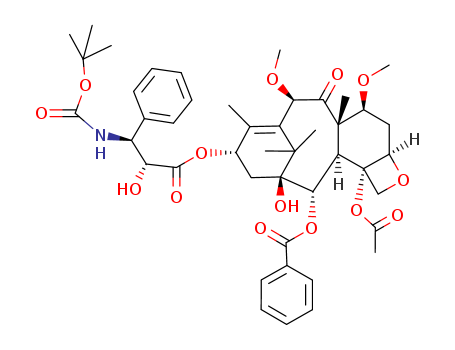
Chemical Property of Cabazitaxel
Chemical Property:
- Appearance/Colour:white powder
- Melting Point:180 °C
- Boiling Point:870.7±65.0 °C(Predicted)
- PKA:11.20±0.46(Predicted)
- PSA:202.45000
- Density:1.31
- LogP:4.95870
- Storage Temp.:Inert atmosphere,Store in freezer, under -20°C
- Solubility.:Chloroform (Slightly), DMSO (Slightly), Methanol (Slightly)
- XLogP3:2.7
- Hydrogen Bond Donor Count:3
- Hydrogen Bond Acceptor Count:14
- Rotatable Bond Count:15
- Exact Mass:835.37790549
- Heavy Atom Count:60
- Complexity:1690
- Purity/Quality:
-
99% *data from raw suppliers
Cabazitaxel *data from reagent suppliers
Safty Information:
- Pictogram(s):
- Hazard Codes:
- Safety Statements:
24/25
- MSDS Files:
-
SDS file from LookChem
Useful:
- Drug Classes:Antineoplastic Agents
- Canonical SMILES:CC1=C2C(C(=O)C3(C(CC4C(C3C(C(C2(C)C)(CC1OC(=O)C(C(C5=CC=CC=C5)NC(=O)OC(C)(C)C)O)O)OC(=O)C6=CC=CC=C6)(CO4)OC(=O)C)OC)C)OC
- Isomeric SMILES:CC1=C2[C@H](C(=O)[C@@]3([C@H](C[C@@H]4[C@]([C@H]3[C@@H]([C@@](C2(C)C)(C[C@@H]1OC(=O)[C@@H]([C@H](C5=CC=CC=C5)NC(=O)OC(C)(C)C)O)O)OC(=O)C6=CC=CC=C6)(CO4)OC(=O)C)OC)C)OC
- Recent ClinicalTrials:Enzalutamide and Cabazitaxel in Treating Patients With Metastatic, Castration-Resistant Prostate Cancer
- Recent EU Clinical Trials:A Phase II, Open-label Study to Assess the Efficacy, Safety, and Tolerability of AZD4635 in Combination with Durvalumab and in Combination with Cabazitaxel and Durvalumab in Patients Who Have Progressive Metastatic Castrate-Resistant Prostate Cancer (AARDVARC)
- Recent NIPH Clinical Trials:Early conversion to cabazitaxel for castration-resistant prostate cancer
-
Description
In June 2010, the U.S. FDA approved cabazitaxel (also referred to as
XRP6258 and RPR 116258A) in combination with the steroid prednisone
for the treatment of metastatic Castration-Resistant Prostate Cancer
(mCRPC) for patients who were previously treated with a docetaxelcontaining
regimen for late-stage disease.
Cabazitaxel is a semisynthetic analog of the
natural product taxol, which is isolated from the bark of the yew tree.
Cabazitaxel is a microtubule inhibitor that binds to the taxol-binding site of
tubulin. Similar to other tubulin inhibitors of the taxol class, cabazitaxel
inhibits microtubule disassembly resulting in mitotic blockade and cell
death. Docetaxel, also a semisynthetic taxol analog, was approved by the
FDA for the treatment of mCRPC in 2004. However, docetaxel is a substrate
for P-gp, which is thought to contribute to the constitutive and acquired
resistance of cancer cells to taxanes. Cabazitaxel has poor affinity for P-gp
and showed antitumor activity in preclinical in vitro studies and in vivo
tumor models that overexpress this protein. Cabazitaxel is synthesized on
a commercial scale from 10-deacetylbaccatin .
-
Uses
Cabazitaxel (Jevtana, XRP6258) is a semi-synthetic derivative of a natural taxoid. A novel semi-synthetic taxane with antitumor activity used for the treatment of castration-resistant prostate cancer. A microtubule inhibitor.
-
Clinical Use
Cabazitaxel was developed by Sanofi-Aventis as an intravenous injectable drug for the treatment of
hormone-refractory metastatic prostate cancer. As a microtubule inhibitor, cabazitaxel differs from docetaxel because it exhibits a much weaker affinity for P-glycoprotein (P-gp), an adenosine
triphosphate (ATP)-dependent drug efflux pump. Cancer cells that express P-gp become resistant
to taxanes, and the effectiveness of docetaxel can be limited by its high substrate affinity for P-gp.
Clinical studies confirmed that cabazitaxel retains activity in docetaxel-resistant tumors. Common
adverse events with cabazitaxel include diarrhea and neutropenia. Cabazitaxel in combination with
prednisone is an important new treatment option for men with docetaxel-refractory metastatic CRPC
(castration-resistant prostate cancer).
-
Drug interactions
Potentially hazardous interactions with other drugs
Antibacterials: Avoid with clarithromycin, rifabutin,
rifampicin and telithromycin.
Antidepressants: Avoid with St John's wort.
Antiepileptics: Avoid with carbamazepine,
fosphenytoin, phenobarbital, phenytoin and
primidone.
Antifungals: Avoid with itraconazole, ketoconazole
and voriconazole.
Antipsychotics: Avoid with clozapine (increased risk
of agranulocytosis).
Antivirals: Avoid with atazanavir, indinavir, ritonavir
and saquinavir.