- 70258-18-32-Chloro-5-chloromethylpyridine
- 70260-05-83-Thiophenemethanol,4-bromo-
- 70261-81-3Piperazine,1-methyl-4-[(4-nitrophenyl)methyl]-
- 70261-82-4Benzenamine,4-[(4-methyl-1-piperazinyl)methyl]-
- 702-62-51,3-Diazaspiro[4.5]decane-2,4-dione
- 702628-84-0Azetidine,3-(4-fluorophenoxy)-
- 702640-95-74,7-Dichloro-2-(trifluoromethyl)quinoline
- 702641-04-12-Iodo-5-(trifluoromethyl)benzoic acid
- 702641-06-32-Iodo-5-(trifluoromethyl)benzyl bromide
- 70264-94-73-Methoxy-4-bromomethylbenzoic acid methyl ester
Hot Products
- 124-73-21,2-Dibromotetrafluoroethane
- 100-41-4Ethylbenzene
- 22161-81-5Benzeneacetic acid,3-benzoyl-a-methyl-, (aS)-
- 147084-10-45H-Imidazo[2,1-b][3]benzazepine-3-carboxaldehyde,6,11-dihydro-11-(1-methyl-4-piperidinylidene)-
- 1313-27-5Molybdenum Trioxide
- 61337-67-5Mirtazapine
- 123-38-6Propionaldehyde
- 633-03-4Basic Green 1
- 104987-11-3Tacrolimus
- 141-53-7Sodium formate
- 8001-54-5Quaternary ammonium compounds, alkylbenzyldimethyl, chlorides
- 9003-39-8Povidone
- 10161-34-9Trenbolone acetate
- 402957-28-2Telaprevir
- 68-19-9Cyanocobalamin

|
Basic Information |

|
Post buying leads |
|
Suppliers |
|
Cas Database |

| Name |
1-Methyl-3-nitro-1-nitrosoguanidine |
EINECS | 200-730-1 |
| CAS No. | 70-25-7 | Density | 1.7979 (rough estimate) |
| PSA | 114.37000 | LogP | 0.32950 |
| Solubility | Reacts violently | Melting Point |
118 ºC (dec.) |
| Formula | C2H5 N5 O3 | Boiling Point | 267.16°C (rough estimate) |
| Molecular Weight | 147.093 | Flash Point | 120.541oC |
| Transport Information | UN 1325 | Appearance | yellow to pink crystals |
| Safety | Confirmed carcinogen with experimental carcinogenic, tumorigenic, and teratogenic data. Poison by ingestion, intraperitoneal, and intravenous routes. Moderately toxic by subcutaneous route. Experimental reproductive effects. Human mutation data reported. An explosive sensitive to heat or impact. Flammable when exposed to heat or flame; can react vigorously with oxidizing materials. When heated to decomposition it emits very toxic fumes of NOx. See also N-NITROSO COMPOUNDS. | Risk Codes | R45;R20;R36/38;R51/53 |
| Molecular Structure |
|
Hazard Symbols |
 
|
| Synonyms |
Guanidine,1-methyl-3-nitro-1-nitroso- (6CI,8CI); 1-Methyl-1-nitroso-2-nitroguanidine;1-Methyl-1-nitroso-3-nitroguanidine; 1-Methyl-3-nitro-1-nitrosoguanidine;1-Nitroso-3-nitro-1-methylguanidine; MNNG; Methylnitronitrosoguanidine;N-Methyl-N-nitroso-N'-nitroguanidine; N-Methyl-N1-nitro-N-nitrosoguanidine;N-Methyl-N'-nitro-N-nitrosoguanadine; N-Methyl-N'-nitro-N-nitrosoguanidine;N-Methyl-nitroso-N'-nitroguanidine; N-Nitroso-N-methyl-N'-nitroguanidine;N-Nitroso-N-methylnitroguanidine; N-Nitroso-N'-nitro-N-methylguanidine; NSC9369; NTG; Nitrosoguanidine |
Article Data | 4 |
1-Methyl-3-nitro-1-nitrosoguanidine Synthetic route

| Conditions | Yield |
|---|---|
| With nitric acid; sodium nitrite at 10℃; |
- 70-25-7
N-Methyl-N'-nitro-N-nitrosoguanidine

- 400736-91-6
(2E,4E)-5-Bromo-2,4-dimethyl-penta-2,4-dienoic acid

- 400736-94-9
(2E,4E)-5-bromo-2,4-dimethyl-penta-2,4-dienoic acid methyl ester
| Conditions | Yield |
|---|---|
| Stage #1: N-Methyl-N'-nitro-N-nitrosoguanidine With potassium hydroxide In diethyl ether at 0℃; for 0.25h; Stage #2: (2E,4E)-5-Bromo-2,4-dimethyl-penta-2,4-dienoic acid In diethyl ether | 99% |
- 70-25-7
N-Methyl-N'-nitro-N-nitrosoguanidine
- 1009365-40-5
C17H21FO3
- 1009367-58-1
methyl 2-(9-(4-fluorophenyl)-3-hydroxybicyclo[3.3.1]nonan-9-yl)acetate
| Conditions | Yield |
|---|---|
| Stage #1: N-Methyl-N'-nitro-N-nitrosoguanidine With potassium hydroxide In diethyl ether; water at 0℃; for 0.0833333h; Stage #2: C17H21FO3 In diethyl ether; dichloromethane at 0℃; for 0.166667h; | 99% |
- 70-25-7
N-Methyl-N'-nitro-N-nitrosoguanidine
- 15647-47-9
5-benzoylaminopentanoic acid
- 17079-25-3
methyl N-benzoyl-5-aminopentanoate
| Conditions | Yield |
|---|---|
| With sodium hydroxide In methanol; diethyl ether at 0℃; | 99% |
- 70-25-7
N-Methyl-N'-nitro-N-nitrosoguanidine
- 1310810-17-3
trans-methyl 4-(4-bromophenyl)but-2-enoate
| Conditions | Yield |
|---|---|
| Stage #1: N-Methyl-N'-nitro-N-nitrosoguanidine With potassium hydroxide In diethyl ether at 0℃; for 0.25h; Stage #2: trans-methyl 4-(4-bromophenyl)but-2-enoate With palladium diacetate In tetrahydrofuran; diethyl ether at 20℃; for 1h; | 98% |
- 70-25-7
N-Methyl-N'-nitro-N-nitrosoguanidine
| Conditions | Yield |
|---|---|
| With potassium hydroxide In diethyl ether; ethanol; water for 0.166667h; Inert atmosphere; | 98% |
- 70-25-7
N-Methyl-N'-nitro-N-nitrosoguanidine
- 110916-46-6
Mrz 2/138
| Conditions | Yield |
|---|---|
| In diethyl ether; water at 22℃; for 1.5h; | 96.5% |
| In diethyl ether; water at 20 - 22℃; for 0.5h; | 96.5% |
- 70-25-7
N-Methyl-N'-nitro-N-nitrosoguanidine
| Conditions | Yield |
|---|---|
| Stage #1: N-Methyl-N'-nitro-N-nitrosoguanidine With palladium diacetate; potassium hydroxide In diethyl ether; water at 0℃; for 0.333333h; Stage #2: (E)-methyl 4-(4-((3-phenoxybenzyl)oxy)bicyclo[2.2.1]heptan-1-yl)but-2-enoate With palladium diacetate In tetrahydrofuran at 0 - 20℃; for 1h; | 95% |
- 70-25-7
N-Methyl-N'-nitro-N-nitrosoguanidine
- 89232-30-4
(2E)-N-benzylbut-2-enamide
| Conditions | Yield |
|---|---|
| Stage #1: N-Methyl-N'-nitro-N-nitrosoguanidine With water; potassium hydroxide In diethyl ether at 0℃; for 0.25h; Stage #2: (2E)-N-benzylbut-2-enamide With palladium diacetate In tetrahydrofuran; diethyl ether at 20℃; for 1h; | 94% |
- 70-25-7
N-Methyl-N'-nitro-N-nitrosoguanidine
| Conditions | Yield |
|---|---|
| With sodium hydroxide In diethyl ether at 0℃; | 94% |
1-Methyl-3-nitro-1-nitrosoguanidine Chemical Properties
Molar mass: 147.09 g/mol
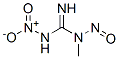
Structure of 1-Methyl-3-nitro-1-nitrosoguanidine(70-25-7):
Synonyms of 1-Methyl-3-nitro-1-nitrosoguanidine(70-25-7):1-METHYL-3-NITRO-1-NITROSOGUANIDINE;MNNG;N-METHYL-N'-NITRO-N-NITROSOGUANIDINE;N-METHYL-N-NITROSO-N'-NITROGUANIDINE;DIAZOMETHANE PRECURSOR;1-Methyl-1-Nitroso-3-nitroguanidine;1-methyl-3-nitro-1-nitroso-guanidin;1-nitroso-3-nitro-1-methylguanidine
Water solubility: Reacts violently
Melting point: 118°C (dec.)
storage temp:0-6°C
Stability of 1-Methyl-3-nitro-1-nitrosoguanidine(70-25-7): Unstable. Heat, light and moisture sensitive. May explode if stored in sealed ampules. Highly flammable. Incompatible with aqueous solutions, bases, acids, oxidizing agents, reducing agents. Alkaline hydrolysis releases toxic and explosive gases. Reacts violently with water. May detonate under impact.
Appearance: yellow to pink crystals
1-Methyl-3-nitro-1-nitrosoguanidine Toxicity Data With Reference
| 1. | dnd-hmn:fbr 20 µmol/L | ENMUDM Environmental Mutagenesis. 7 (1985),267. | ||
| 2. | sce-hmn:hla 300 nmol/L | CRNGDP Carcinogenesis. 5 (1984),593. | ||
| 3. | ivn-rat TDLo:25 mg/kg (15D preg):ETA,TER | KFIZAO Kyoto-furitsu Ika Daigaku Zasshi. Journal of the Kyoto Prefectural School of Medicine. 84 (1975),23. | ||
| 4. | orl-rat LD50:90 mg/kg | ZKKOBW Zeitschrift fuer Krebsforschung und Klinische Onkologie. 91 (1978),183. | ||
| 5. | scu-rat LD50:420 mg/kg | ZEKBAI Zeitschrift fuer Krebsforschung. 69 (1967),103. | ||
| 6. | ivn-rat LD50:80 mg/kg | EJCAAH European Journal of Cancer. 16 (1980),395. | ||
| 7. | ipr-mus LD50:66 mg/kg | JJIND8 JNCI, Journal of the National Cancer Institute. 62 (1979),911. | ||
| 8. | ivn-mus LD50:37,300 µg/kg | NCISP* National Cancer Institute Screening Program Data Summary, Developmental Therapeutics Program, Bethesda, MD 20205 JAN86 . | ||
| 9. | orl-ham LD50:1070 mg/kg | CALEDQ Cancer Letters (Shannon, Ireland). 4 (1978),241. |
1-Methyl-3-nitro-1-nitrosoguanidine Consensus Reports
1-Methyl-3-nitro-1-nitrosoguanidine Safety Profile
Confirmed carcinogen with experimental carcinogenic, tumorigenic, and teratogenic data. Poison by ingestion, intraperitoneal, and intravenous routes. Moderately toxic by subcutaneous route. Experimental reproductive effects. Human mutation data reported. An explosive sensitive to heat or impact. Flammable when exposed to heat or flame; can react vigorously with oxidizing materials. When heated to decomposition it emits very toxic fumes of NOx. See also N-NITROSO COMPOUNDS.
Hazard Codes:T ,N
,N ,N,T
,N,T
Risk Statements:
20: Harmful by inhalation
36: Irritating to the eyes
38: Irritating to the skin
45: May cause cancer
51: Toxic to aquatic organisms
53: May cause long-term adverse effects in the aquatic environment
Safety Statements:
45: In case of accident or if you feel unwell, seek medical advice immediately (show label where possible)
53: Avoid exposure - obtain special instruction before use
61: Avoid release to the environment. Refer to special instructions safety data sheet
1-Methyl-3-nitro-1-nitrosoguanidine Standards and Recommendations

What can I do for you?
Get Best Price

