M. Eisenacher et al. / Catalysis Communications 26 (2012) 214–217
215
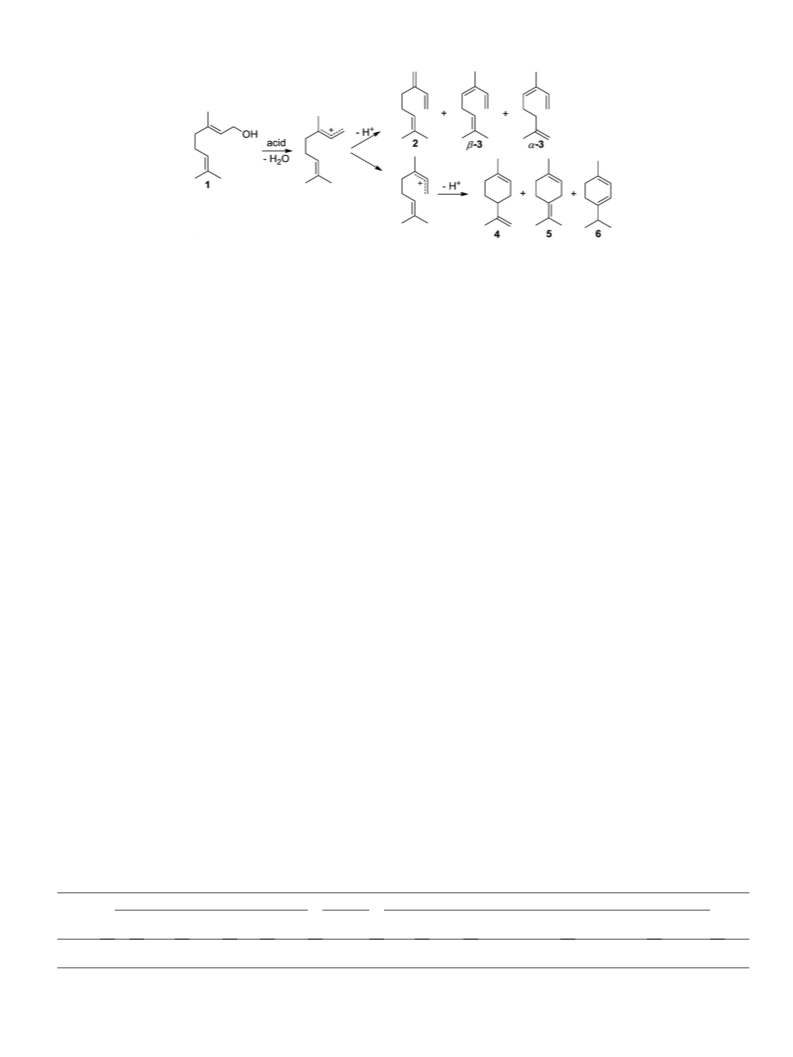
Scheme 1. Acidic treatment of geraniol (1) [15].
pentasil zeolite (SiO2/B2O3 ratio=33) were used in initial experiments
under the same reaction conditions (Table 1). The X-ray diffraction
analyses suggest that both catalysts consist of well-crystallized zeolites.
The BET surface area was 338.0 m2/g for the boron zeolite and
370.6 m2/g for H-ZSM5, the micropore surface was 247.3 m2/g for the
boron zeolite and 218.2 m2/g for H-ZSM5.
In contrast to previous protocols [13–15], limonene (4) terpinolene
(5) and terpinene (6) were not found in the reaction mixtures. Instead
of these compounds phellandrene (7) was surprisingly found as the
only monocyclic terpene.
The use of H-ZSM5 led to huge amounts of CO and CO2 which were
identified by gas chromatography. Linalool (8) was just found in
traces. In contrast in the presence of a boron pentasil zeolite a fruitful
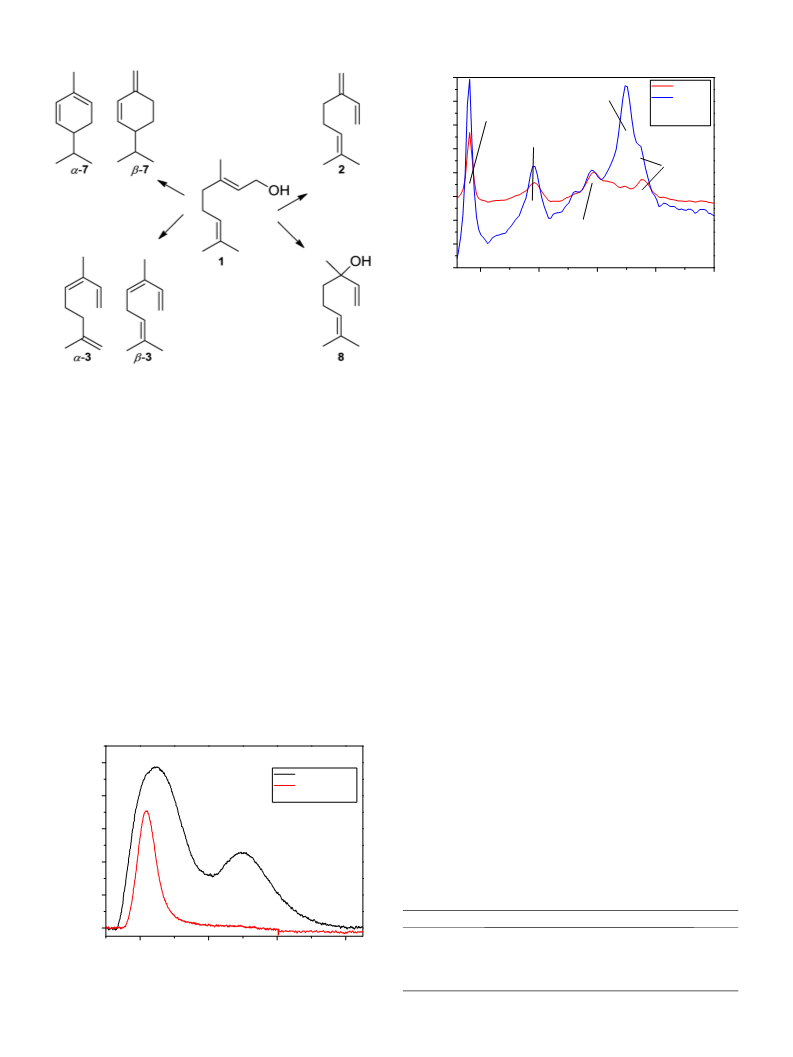
mixture of monoterpenes was found: phellandrene (7), myrcene (2),
ocimene (3) and linalool (8) were identified in the reaction mixture
(Scheme 2).
In order to understand the different product spectra obtained
from the weak acidic boron pentasil zeolite and the strong acid
H-ZSM5 catalyst, the differences between weak acidic boron pentasil
zeolite and strong acidic H-ZSM5 zeolite have been investigated by
ammonia-TPD and Fourier transformation infrared spectroscopy
(FT-IR). FT-IR measurements have been carried out by pyridine ad-
sorption experiments in order to study the surface acidity (Figs. 1
and 2) [16].
In order to optimize the selectivity for the formation of the different
monoterpenes 2, 3, 7, and 8 the influence of the reaction parameters
was investigated by means of a Design of Experiments. A response
surface design was chosen as suitable tool [17]. Reaction parameters
were varied in the ranges described in Table 2.
The results (Table 3) clearly illustrate that a total selectivity of up
to 99% to the four terpenes. The selectivity towards linalool (8) can be
increased to 25% if absolute pressure is diminished to 50 mbar.
To the best of our knowledge, formation of phellandrene (7) via
acidic treatment of geraniol (1) has not been previously reported. Selec-
tivity up to 27% towards phellandrene could be achieved.
The reaction mixture obtained in the present experiments usually
contained about 27% phellandrene (7) which results in a acyclic to
monocyclic ratio of 4:1. Previous work mentioned a 9:1 ratio for the
acidic gas phase treatment of geraniol [15].
The following general tendencies could be ascertained during our
experiments:
Increase of the temperature was reflected in the formation of de-
hydration products phellandrene (7), myrcene (2) and ocimene (3).
Low pressures enhanced the selectivity to the rearrangement product
linalool (8). Shorter residence times, due to increased N2-flow, lead to
higher selectivity regarding the dehydration products and linalool
(8). Longer retention time causes the formation of CO and CO2 in
higher quantities. Higher catalyst loadings lead to an increased for-
mation of myrcene (2). However, the other products were not formed
in higher amounts. These facts indicate that dehydration of geraniol
(1) to myrcene (2) might be kinetically controlled.
Ammonia-TPD showed that H-ZSM5 contains weak acidic sites
(desorption of NH3 at 230 °C) as well as strong acidic sites (desorption
of NH3 at about 500 °C) In contrast the boron pentasil zeolite has only
weak acidic sites (desorption of NH3 at about 210 °C). Therefore,
H-ZSM5 appears to be much more acidic than boron pentasil zeolite.
Pyridine adsorption IR measurements (Fig. 2) showed that boron
pentasil zeolite provides more Lewis acid sites than H-ZSM5 zeolite
(wave numbers 1485 cm−1 and 1628 cm−1). The amount of Broensted
acidic sites is comparable for both catalysts.
Raising the temperature up to 250 °C or higher results in more
than 50% conversion of geraniol (1). However thereby, the undesired
byproducts CO, CO2 and H2O were observed as the main products .
3. Mechanistic considerations
The weak acidic catalyst having a high amount of Lewis acidic sites
and low number of Broensted acid centers led to a more selective re-
action but a lower conversion was achieved. The strong acidic catalyst
H-ZSM5 behaved strictly opposite.
Therefore, subsequent optimization experiments have been carried
out using boron pentasil zeolite to achieve highest selectivity in forma-
tion of one of the monoterpenes 2, 3, 7, and 8.
A tentative mechanistic explanation towards formation of
phellandrenes from geraniol should involve acid-catalyzed cycliza-
tion of myrcene to form a-terpinyl carbocation which might under-
go a long range hydride shift from the allylic position of the
endocyclic double bond, followed by deprotonation. Such unusual
carbocation rearrangement could be imposed by the constrained
environment of the pentasil zeolite pores that marginally
Table 1
Initial experiments using boron pentasil zeolite and H-ZSM5 as catalyst.
Cat.
Reaction parameters
Conversiona
[%]
Selectivity [%]b
T
N2-flow
Geraniol
[g/h]
M Cat
[g]
Pressure
[mbar]
Linalool
Myrcene
Phellandrene
(mixture of α and β)
Ocimene (mixture
of cis and trans)
Unidentified
CO,
CO2
[°C]
[L/min]
B-Zeolite
H-ZSM5
220
220
10
10
30
30
3.00
3.00
80
80
22.4
74.2
15.2
0.3
36.7
27.7
22.8
1.6
11.4
0.9
1.4
11.3
12.5
58.2
a
Geraniol conversion (%)=(moles of reacted geraniol)/(moles of geraniol fed in).
Product selectivity (mol%)=(moles of carbon in a defined product)/(moles of carbon in reacted geraniol) the amount of dehydration water was neglected.
b

 Eisenacher, Matthias